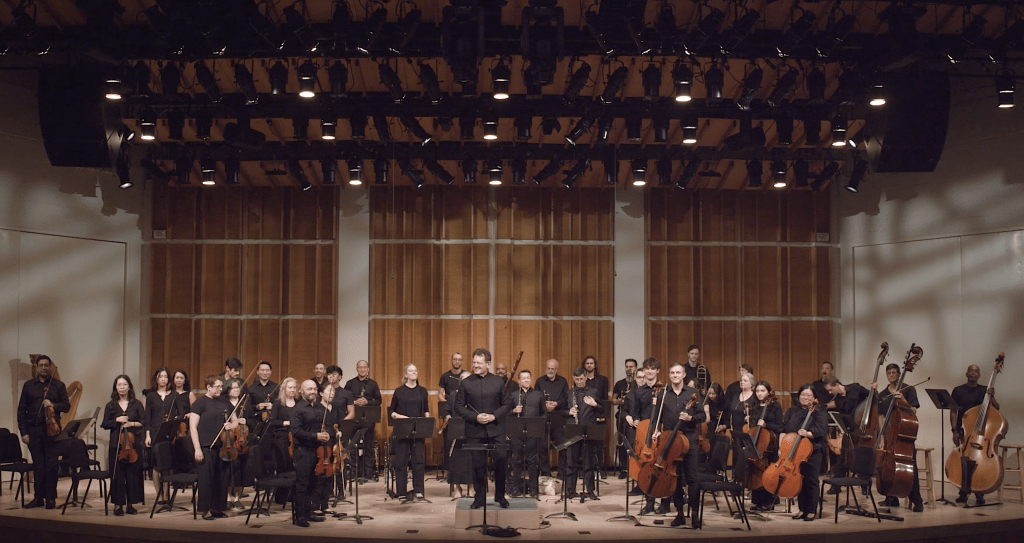
When the European Classical Music Awards announced that Maestro David Bernard had been named Conductor of the Year and Platinum Prize Winner at its Annual Grand Prix 2025, the news reverberated well beyond the Park Avenue Chamber Symphony at the DiMenna Center for Classical Music and the Massapequa Philharmonic at Tilles Center for the Performing Arts. It was, in the parlance of the concert world, a recognition long overdue — and for the musicians who have played under Bernard’s baton season after season, it was nothing short of a confirmation of what they have known for years. Bernard is not merely a conductor. He is a teacher, a collaborator, a keeper of the score’s innermost secrets, and — in the word one musician reaches for with unambiguous conviction — an artist of uncommon dedication.
This article draws on two sources of testimony: personal interviews with musicians of the Park Avenue Chamber Symphony and a series of questions posed directly to Bernard himself, whose answers illuminate the philosophy and craft that underlie every downbeat. Together, these voices compose a portrait as complete as any profile of a conductor can be — one shaped equally from the podium and from the chairs that face it.
Before the First Downbeat: The Annotated Score
The first thing to understand about David Bernard’s rehearsal process is that it does not begin at the first rehearsal. Weeks before the orchestra assembles, Bernard sends every musician a marked-up score — a detailed annotated blueprint of his interpretive intentions, complete with tempo indications, articulation adjustments, dynamic clarifications, and sometimes even changes to note values.
Asked what he communicates before raising the baton at that first rehearsal, Bernard explained:
“When I internalize works, I develop a clear view of how I’d like the work to ‘go’ — its nuances, phrasing, pacing, and rhetoric/syntax that is woven through its layers, much of which goes beyond what is actually written in the score. The very first part of the preparation occurs when I share this with the musicians through an annotated score, way before the first rehearsal. At the first rehearsal, we can begin with a common baseline beyond what it would be with “clean parts.”” — David Bernard

Asked specifically what goes into those markings, he elaborated with characteristic precision:
“Changes and clarifications to articulations, dynamics, note values, and sometimes even changes to notes. A phrase may need to end lifted, requiring a quarter note to be changed to an eighth with an eighth rest. Certain figures or lines may need to be played stronger or softer than marked to bring out a certain layering between the parts. Notating these decisions in ways that are clearest to the musicians helps achieve a specific way of playing a passage. It not only saves rehearsal time — it allows us to focus on deeper aspects of the music making.” — David Bernard
The musicians attest to how dramatically this shapes the rehearsal cycle from its opening moments. Lindsay Brillson, flute and piccolo with PACS since the 2023–2024 season, describes the downstream effect:
“This gives us the ability to get into the musical nuances of a piece much more quickly than we would otherwise, because we’re already in sync with what he wants. So the music begins to come together as something beyond the notes on the page from almost the first rehearsal.” — Lindsay Brillson, flute and piccolo
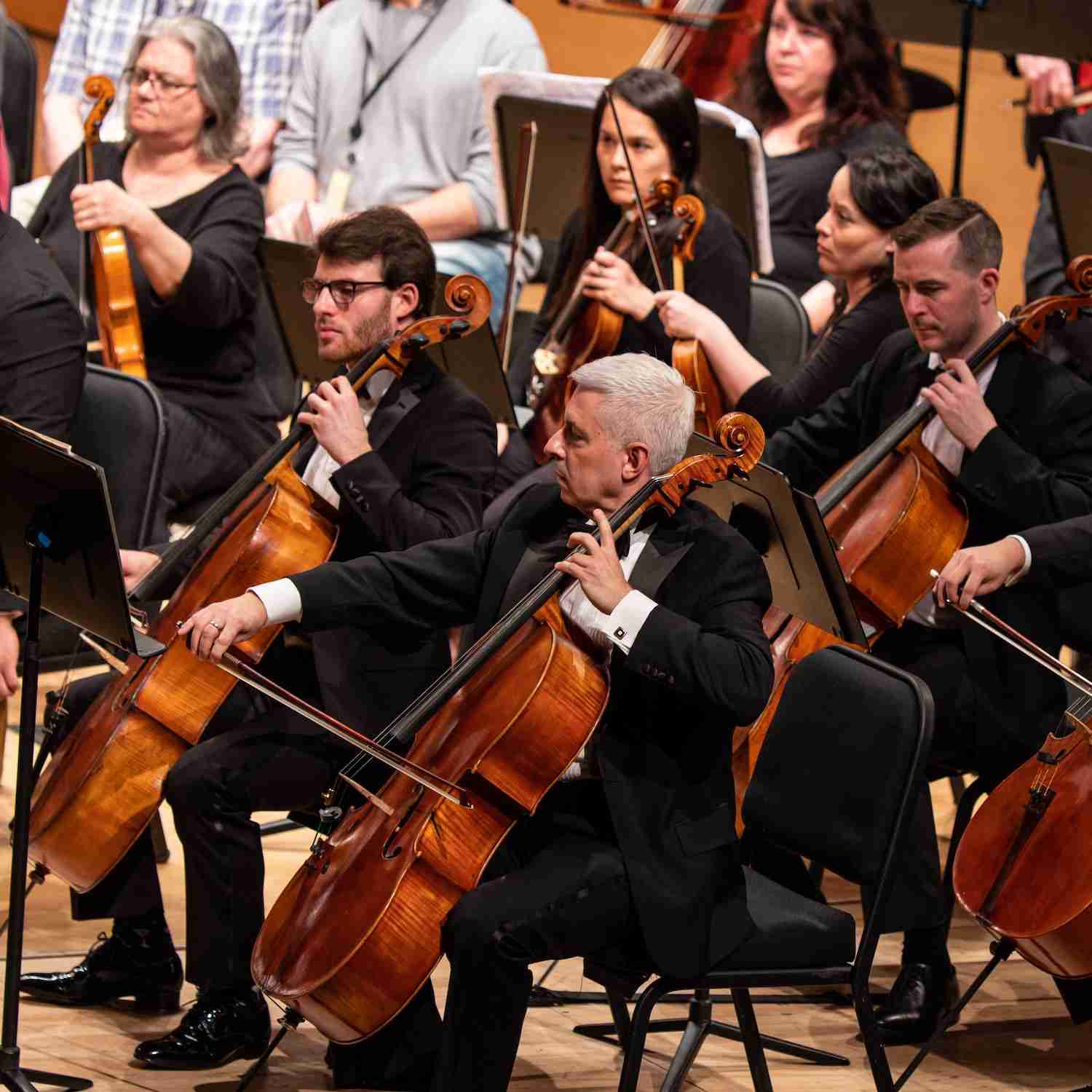
John Yakubik, the orchestra’s Principal Cellist for more than twenty years, confirms that this blueprint shapes the ensemble’s preparation from the first stand: “David circulates an annotated score prior to the start of a cycle. He has the principal strings mark up their parts accordingly, so everyone works from his blueprint.”
Davis Erin Anderson, French horn with PACS since spring 2023, underscores the practical consequence of this advance work:
“Before a cycle begins, the orchestra receives a marked score with indications for articulations, note length, directionality of a phrase. These things are added to each player’s part, hopefully in advance of the first rehearsal, so that we are not starting from fifty-plus different approaches.”
Gabrielle Miskovitz, a violinist and PACS member since 2005 who has served as both Concertmaster and Principal Second over the years, speaks to the deeper interpretive purpose this serves:
“David has a commitment to his interpretation and understanding of the music, which, without question, has allowed for the unique success of PACS over the decades. He is meticulously detailed with notations during score preparation, which allows us as musicians to understand his musical goals prior to the first rehearsal.” — Gabrielle Miskovitz, Violin

Going Deep: The Rehearsal Cycle
One of the first things a new member of the Park Avenue Chamber Symphony learns about David Bernard is that his strategy within each rehearsal— distinctive, deliberate, and by all accounts enormously effective — goes deep and often starts at the end of a movement and works backward through the score. Bernard frames the logic as a matter of depth over breadth:
“Given the choice between spending the whole rehearsal going deep on one movement of a symphony as opposed to covering all movements — especially during early rehearsals — I will always opt for going deep. When you go deep, the orchestra retains the experience in high resolution and brings it to the next rehearsal. Going deep involves addressing the music-making and execution with care, not in a taskmaster way, but in a “you can do this, no, that wasn’t quite it, let’s focus this way.” In this approach, achievement follows achievement, building commitment and enthusiasm in the orchestra.” — David Bernard
Patrick Sanguineti, in his second season as a PACS trumpeter, offers a vivid metaphor for what this achieves:
“David’s approach to a rehearsal cycle evokes learning to read a complex text in a non-native language. He targets fluency and pattern recognition. The process can frustrate at times, but the payoff is a delayed gratification: suddenly, as the cycle nears its end, the granular work David put into those passages reveals a wider grammar and vocabulary that the orchestra now has to put the whole work together — and in a way that feels natural and intuitive.” — Patrick Sanguineti, trumpet

Alexander Schulmeister, a violinist who has been with PACS almost since its founding — his first concert was the orchestra’s second, in early 2001 — identifies the cumulative architecture that Bernard builds:
“David drills into the music starting with the very first rehearsal, stressing ensemble, balance, articulation, and phrasing. David usually starts rehearsing at the end of a movement, working backwards to the beginning. Full movement run-throughs are done towards the end of the cycle; it is at that time that I feel the pieces coming together and becoming music rather than individual sections and passages.” — Alexander Schulmeister, violin
Madeleine Carroll, violist with the Park Avenue Chamber Symphony and Massapequa Philharmonic Orchestra, found the method transformative from her first encounter with it: “It is a brilliant approach that helps us as musicians better understand the inner workings of the movement and recognize key patterns. I can then apply what he has instructed us to do to the rest of the movement. I learn a lot faster this way.”

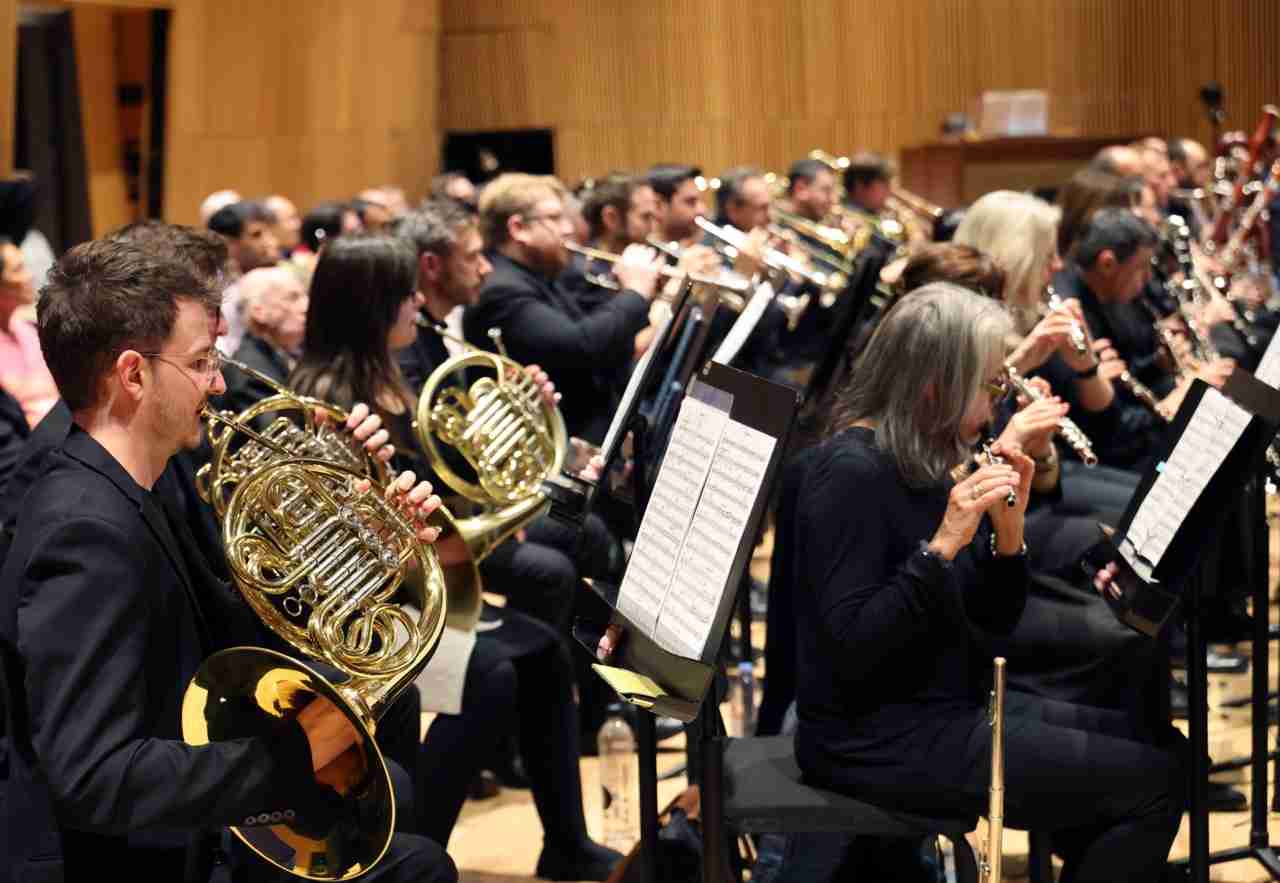
Davis Erin Anderson, French horn with PACS since spring 2023, offers a complementary image of the process: “A typical rehearsal under the baton of Maestro Bernard typically involves a deep dive into a certain section of music — a playthrough followed by hearing from individual sections or groups of sections. It’s sort of like taking a puzzle apart and putting it back together, with added clarity for just how things fit together.” The payoff, Anderson adds, is evident in the final product: “Maestro Bernard makes really good use of rehearsal time, so that when recording sessions or concerts come along, we’ve all had lots of repetition. Because of that, and because of independent practice and sometimes even sectionals that my fellow horn players and I will take upon ourselves, the final result is really clean.”
The Language of the Podium: Clarity as a Discipline
Every musician interviewed for this article used some variation of the word “clarity” to describe Bernard’s communication. But clarity, as Bernard practices it, is not merely a manner of speaking. It is a physical and philosophical commitment — an understanding that the conductor’s body and voice must become instruments of pure signal, stripped of noise.
On the subject of his famously understated physical presence on the podium — what I have described as “clear, expressive, compelling, and marvelously understated — no dramatic gesticulations or visual melodrama” — Bernard was direct:
“I am hyper-fixated on giving the musicians what they need to achieve, and in conducting, that requires clarity. It is absolutely a “less is more” kind of thing — to have clarity, you must eliminate “noise.” I am the “coach” — not a player, so my signals need to be unquestionably useful and usable for the musicians. To do this, you must quiet your body to the point where your motions become more meaningful and important to the players. When you lead this way, you are drawing the musicians to you — in essence drawing out the best performance in the most expressive and demonstrative way.” — David Bernard
The musicians recognize and respond to this economy with precision of their own. Brillson describes what it is like to be on the receiving end:
“Maestro Bernard is probably the clearest conductor I’ve ever worked with. He frequently uses a combination of precise musical description — for example, “the 16th following the dotted eighth needs just as much emphasis and volume as the eighth note” — as well as spoken rhythmic demonstration. He is incredibly efficient at communicating what he wants, and there is rarely any confusion as to what he’s aiming for. Additionally, if he feels you still haven’t understood his intention, he’ll speak with you during the break and ask if there’s anything he can do to help you achieve it.” — Lindsay Brillson, flute and piccolo
Tay Kwak, a violinist in his fourth season with the Massapequa Philharmonic, identifies something beyond the words themselves: “It is not what Maestro Bernard says. It is how he says it. His communication skills are specific, concise, and they are always reinforced with his conducting, markings on the parts, as well as rehearsal notes afterwards.”
William Nealon, the orchestra’s double bassist and a twenty-five-year PACS veteran, notes a particular and unusual technique: “He sings often, and he makes us sing our parts often. He does use a lot of metaphors — for example, he often says the beginning of a note should sound like a bell.” Schulmeister echoes this with something approaching wonder: “I have never played for a conductor who had the section sing their parts before.”
Anderson catalogues the sheer range of Bernard’s rehearsal techniques with an inventory that suggests a conductor of inexhaustible pedagogical resourcefulness: “Rehearsal techniques range from asking strings to play without their bows so as to dial in pitch and rhythm, singing individual lines so as to communicate rhythm or overall style, asking winds and brass to play a passage note by note so we can hear how our individual pitches fit into a chord, and lots of other ways that are so seamless I’m not even sure I can recall each one.”
John Yakubik, Principal Cellist, adds:
“He is a stickler for rhythm and articulation. He will have the orchestra say it a few times and then have us play it. There’s also a lot of singing to demonstrate the phrasing he would like.” What accompanies all of this is an atmosphere of consistent patience. Carroll captures it memorably: “He is a teacher, coach, collaborator, and friend. He approaches his instruction with kindness, encouragement, patience, humor, and a solid commitment to achieving his goals. He has a steady and positive temperament that allows me to make mistakes without being too hard on myself, so I can learn quickly from them and improve.”
Anderson reaches for a single word that encompasses it all: “I’d say Maestro Bernard is a coach more than anything else. My sense is that he fundamentally believes in the capabilities of each player, otherwise we wouldn’t be there. I think he sees his role as one in which he works with us to bring out the best in each of us.” The effect of that coaching, Anderson adds, is cumulative and deeply personal: “Being part of the PACS project has taught me a lot about developing a style to suit the group I’m playing with. The way in which I approach articulation or the length of notes is quite nuanced now, thanks to the way in which Maestro Bernard specifically approaches the pieces we play.” Miskovitz confirms that this communication extends well beyond the verbal, noting that over the course of rehearsals, Bernard “communicates these nuances through repetition of rehearsal as well as shaping gestures in the moment.”
Conducting from Memory: The Necessity of Eyes
Among the disciplines that distinguish Bernard’s work on the podium, none is more demanding — or more consequential in performance — than his practice of conducting the major repertoire entirely from memory. Mahler’s Ninth. Stravinsky’s Rite of Spring. Beethoven cycles. The score is never on the stand.
Asked what this discipline gives him in rehearsal and performance that a score on the stand could not provide, Bernard answered with characteristic economy:
“Yes — I conduct most concerts from memory. The most important benefit is that your body and eyes are free to fully engage with the musicians. When you look down at the score, you break that engagement, and the performance’s overall energy suffers. The connection between musicians and the conductor is made and maintained through the eyes. I believe it is a necessity. My goal in preparation is to internalize the score, which not only results in the high-resolution view discussed earlier, but also results in memorization.” — David Bernard
Kwak, reflecting on what this means from the musicians’ vantage point, speaks to the sheer depth of knowledge it implies: “Maestro Bernard’s understanding of each of the pieces is unparalleled, and his passion and work ethic are second to none. He conducts entirely from memory, and his knowledge of classical music is quite intimidating in the most admirable way. All of the training, knowledge, passion, and dedication just come out through his energy — and we just can’t help but be sucked into his vortex.”
Stripping Tradition: The Score on Its Own Terms
In a previous review of the PACS Mahler Ninth recording, I wrote that it achieves “that most elusive of musical goals: making a well-known work sound freshly minted, as if the ink on Mahler’s manuscript had barely dried.” That freshness does not arrive by accident. It is the result of a conductor who approaches a score by asking not what tradition demands, but what the music itself requires.
Asked directly how he strips away accumulated interpretive habit to help his musicians hear a familiar score with new ears, Bernard offered his fullest statement of artistic philosophy:
“When I approach a score, I tend to strive to highlight and release the natural flow and line inside the music — it is something of an obsession of mine. This can involve, to some degree, countering traditions of rubato to eliminate headwinds and obstacles to the flow and line that I see as embedded in the music. Mahler’s Ninth is a work that carries quite a bit of performance tradition, some of which I stripped away to achieve what I felt was driven by the music itself. The most drastic overall change in character is the opening of the First Movement, which is often played through the lens of tugging at heartstrings in anguish. To me, the music’s line demanded a youthful flow — looking back to Mahler’s childhood, strolling through the countryside. This fit the music like a glove — a unique and refreshing result.” — David Bernard
He went on to describe how the orchestra internalized that transformation in rehearsal:
“In rehearsal, the orchestra adapted beautifully — shifting from drawing espressivo from each note (a more vertical approach) to seeing the flow and line (a more horizontal approach). It is helpful to point out the contrapuntal dimension of this music — to listen to the outer voices and how they support each other. As we continued, the string players managed their sound and vibrato to support the line, and the new sound emerged. This particular transformation was memorable for me.” — David Bernard
Jenn Forese, a flutist with both PACS and the Massapequa Philharmonic who wrote her graduate thesis on Mahler, was uniquely positioned to recognize what Bernard was doing — and uniquely grateful for it:
“When we were working on Mahler 9, I really enjoyed the extra highlighting of particular phrases and moments that could have been overlooked. As someone who has studied Mahler intensely in graduate school and wrote my thesis focusing on Mahler, I truly appreciated the highlighting of moments that I already knew were often overlooked. It brought more justice to our performance of Mahler’s music.” — Jenn Forese, flute — PACS and MPO

Clarity and Abandon: Transparency Without Coldness
Critics everywhere have praised the textural transparency of the PACS recordings — every inner line audible, every contrapuntal strand traceable, yet nothing clinical, nothing merely correct. In my own reviews, I heard Bernard “conquering the symphony’s dramatic contrasts, soaring melodies, and virtuosic orchestration.” These qualities seem, on the surface, to be in tension: how do you rehearse clarity without draining a score of emotional abandon?
Bernard’s answer reveals a conductor who has thought deeply about layering as both a structural and expressive phenomenon:
“My favorite topic — clarifying and highlighting the layering that results in transparency and complexity all at once! When I look at a score, one of the most important tasks is identifying the layers that build the texture. From there, I decide how to highlight the line’s contours within each layer, so each layer has an audible identity of its own without overpowering the others. Exaggerating the contours allows each layer to convey its own energy and intensity.” — David Bernard
The musicians who play those inner voices experience this as one of the most rewarding dimensions of performing under Bernard. Emily Dana, a violist with both orchestras, describes it from within the inner voice itself:
“As a violist, I appreciate Bernard’s attention to detail in interpreting inner voices. Utilizing the inner voices within the score creates a feeling of playing chamber music within the larger symphony. For the listener, Bernard’s effort to bring out these inner lines, especially in his recordings, not only gives a unique listening experience and refreshing interpretation, but also special insight into the distinctive compositional expression of the composer.” — Emily Dana, viola
Madeline Carroll adds:
“His intricate knowledge of each score never fails to impress me. He is able to pinpoint internal lines and harmonies and bring them to the forefront. He turns these non-melodies into very special moments and makes the piece feel richer.” And Nealon, from the bass register, offers the most concise formulation of all: “As a double bassist, we often get ignored. Not with David. He listens to us.”

Anderson, who plays one of the orchestra’s quintessential inner voices, describes the experience of being brought into the foreground with a revealing analogy to her other musical life: “It’s a feeling of stepping forward. It’s a bit similar to playing my favorite role, which is second horn. In second chair, your role is mainly to support the principal horn player, which means keying into style and intonation. And every now and again, as in Mahler 9, there is a moment where the spotlight is on you, and it’s time to shine. Knowing where those moments come up and stepping forward when it is appropriate and stepping back when it’s time for someone else to have a moment is what it is all about.”
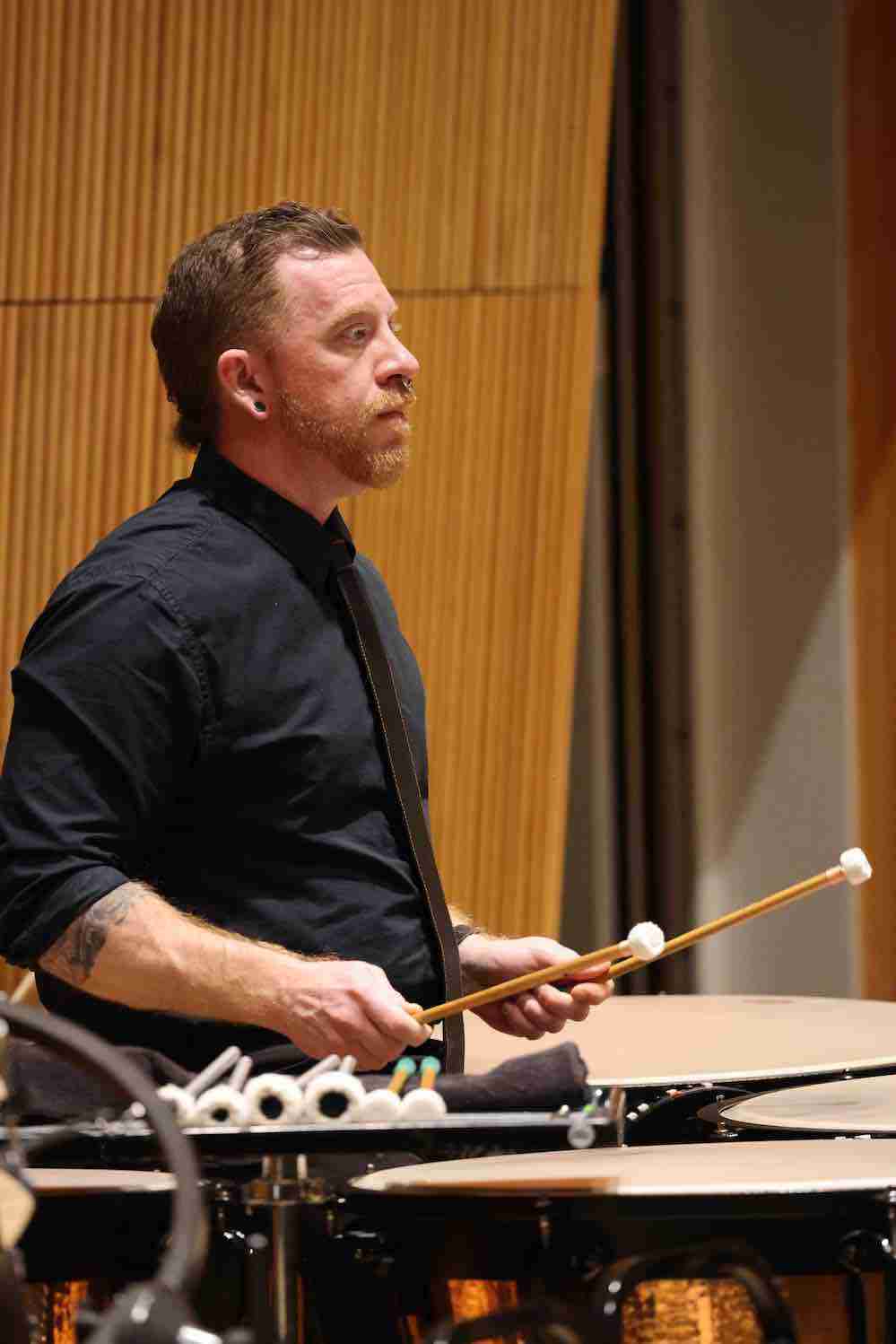
Paul Robertson, the orchestra’s Principal Timpanist since 2013, recalls a defining rehearsal moment in Bartók’s Concerto for Orchestra that crystallized this idea precisely:
“David explained that while a timpanist often provides rhythmic stability, we can also create melodic lines meant to “sing out.” He helped me explore the idea of being a melodic performer who blends into the ensemble rather than just a percussive one. Understanding that my instrument carries that kind of weight has fundamentally changed how I approach every new piece we perform.” — Paul Robertson, Principal Timpanist
Rubato: Guiding the Spontaneous
Reviewers have praised Bernard’s rubato as “instinctive and persuasive,” noting his feel for what one called the “echt Mahlerian style.” Rubato, by its nature, cannot be dictated from the podium; it must be breathed collectively, felt as a living negotiation between conductor and ensemble. Yet in a rehearsal context, it must also be built and established as something other than mere whim.
Bernard’s account of how he addresses this in rehearsal is one of the most revealing windows into his artistic thinking:
“While rubato can’t be dictated, it can, and must be, guided. Given my obsession with line and flow, for me, rubato must be consistent with the flow of the music and “make sense.” Guiding a natural rubato that fits with the inherent flow. Conducting rubato involves first choosing how it flows, and second, guiding it from “inside the line” collaboratively with the musicians. — David Bernard
This sense of guiding from within the music rather than imposing upon it is also what Bernard describes when he discusses the balance between rehearsal preparation and the spontaneity of live performance. Asked how much of the Rachmaninoff Second Symphony’s opening — which I described as arriving with “perfect security, authentic sweep, validity, and individuality” — is established in rehearsal versus emerging in the moment, he answered:
“The Introduction of Rachmaninoff Second is a fusion of everything we have been talking about, from arcs and the pacing of those arcs, to transparency through balancing and highlighting the contours of each layer, to building the stepwise builds — all of which are built in the rehearsal process. Yet in the moment of performance, I love to pace things a bit differently — stretching the pacing just a bit to add weight to an arrival, for example. Establishing and relentlessly maintaining the connection to the players through framing and eye contact enables this spontaneity and adds magic to the performance.” — David Bernard
Building an Ensemble, Building a Musician
There is a dimension to Bernard’s work that extends beyond any single rehearsal technique or interpretive philosophy. It is the conviction — articulated explicitly by Bernard himself and borne out by every musician who spoke for this article — that the goal of a rehearsal is not merely a fine performance. It is the empowerment and growth of each musician in the room.
Bernard invokes Leonard Bernstein to frame his philosophy:
“There is a wonderful quote by Leonard Bernstein: “A conductor must do more than just make an orchestra play; they must make them want to play.” My number one goal is for each musician to leave each rehearsal saying, “That was worth it — I accomplished something important.” So it isn’t just about making a great performance and building the orchestra; it is about building and empowering each musician. This is what makes musicians want to play and want to be in that room. And if you do that, you also build the best possible performance. As a result, it is a shared experience.” — David Bernard

The musicians speak about this transformation with striking consistency. Omar Arnouk, Principal Trumpet since 2020, makes the connection between Bernard’s ambition and their own with precision:
“I have been playing pieces that I never thought I would have the opportunity to play. The more challenging the repertoire that PACS tackles, the more confident I become as a player. David is ambitious, and his ambition causes the musicians to be ambitious as well.” — Omar Arnouk, Principal Trumpet
Dana traces a specific shift in her own preparation practice: “His ambition and dedication to the music is contagious: it leads to my desire to add score-study to my rehearsal preparation and give every performance my all.” Schulmeister, with more than thirty years in orchestras behind him, states his verdict without qualification: “Working with David is the most gratifying musical experience of my career.” And Kwak reaches for a film line he cannot improve upon: “He makes me want to be a better musician.”
Anderson echoes the sentiment with a horn player’s particular gratitude: “I never thought I’d have the privilege of playing some of the rep that comes up in PACS. A great example of this was our Mahler 9 cycle. And, as a horn player, having the chance to play Strauss’s music is a dream come true.”
Carroll, who has played in Bernard’s orchestras for more than a decade, speaks to the environment he creates and why she keeps returning to it:
“Most importantly, he exudes pure joy when conducting each and every piece. I feel the priority is always to enjoy the incredible music in front of us and to try our best. This environment Maestro Bernard has created is why I have played with his orchestras for over a decade.” — Madeleine Carroll, viola
The Mahler Ninth: Mystical Transcendence from the Inside
Any discussion of the Park Avenue Chamber Symphony under David Bernard must eventually arrive at Mahler’s Ninth Symphony — the recording that has drawn the widest critical attention and the work in which Bernard’s interpretive philosophy is perhaps most fully realized. In my review I wrote that the orchestra “responds with playing of remarkable sensitivity and precision, eliciting unprecedented lucidity from Mahler’s dense orchestration,” and that the final Adagio achieves “a rare mystical transcendence,” with string textures that produce “heart-stopping beauty, from whispered pianissimos that seem to emerge from silence to rich, full-bodied fortissimos of prodigious emotional authority.”
From within the orchestra, the sources of that achievement are clearly understood. Schulmeister speaks of preparation so thorough that the concert becomes almost inevitable: “It’s the constant attention to balance, articulation, and phrasing in rehearsals. What happens during the concert is the result — we are prepared so well that little needs to be added then.” Arnouk frames it as a matter of standards that admit no compromise: “David does not let the orchestra play in an insensitive or imprecise manner during rehearsals, and this transitions to the concerts and recordings. How you practice is typically how you end up playing when it matters.”
For the string players, the final Adagio presented challenges both technical and metaphysical. Dana describes the movement with the particular gravity it deserves:
“The experience in the final Adagio of Mahler’s Ninth is special because the paradigm of time is dramatically transfigured. Bernard is adept at communicating the expansiveness of time in the movement through both clarity and sensitivity in his conducting. At the symphony’s close, time, phrasing, and dynamics intertwine into an inevitable silence that requires extensive unity in the orchestra and subsequent trust in the conductor.” — Emily Dana, viola
Gabrielle Misjovitz, a violinist who has been a member of PACS since 2005 and has served as both Concertmaster and Principal Second over the years, offers a vivid physical image of what Bernard’s demands feel like under the bow:
“As a string player, particularly in the quietest and most sensitive passages, I feel like sometimes we’re practically playing on one individual bow hair in order to play softly enough! However, this delicacy allows David to provide overall shape to such special moments.” — Gabrielle Misjovitz, Violin
Davis Erin Anderson, French horn, speaks to the collective force of the experience with an eloquence that goes beyond analytical observation: “It really is a privilege to play Mahler 9, and based on our first run-throughs, I could tell that each and every one of us had already put a lot of practice time into it. For Maestro Bernard’s part, the level of preparation was really, really high. I don’t think I saw him look at the score once when he was conducting; he knew it so well. And as a result of that, his attention to what was happening within the orchestra was quite keen. Mahler 9 was one of those transcendent experiences you rarely get in life because we all came together to elevate ourselves and, by extension, one another, Maestro Bernard included.”
Nealon, speaking of the bass line in the final movement, abandons analytical distance entirely: “The basses have a fantastic part in the last movement of Mahler 9. It is overwhelmingly gorgeous. I started to cry at one point.”
Bernard himself, when asked how he builds a passage from a single solo voice into the full ensemble — as in the opening of the Mahler Fifth — described the fundamental craft of arc-building that underlies everything the string players feel in the Ninth:
“That particular passage is achieved by clearly conveying the stepwise build across the orchestra. Context is everything, and each musician needs to see where they fit in the overall arc. Each plateau builds on the previous plateau, and musicians can hear this. The most important part is to clearly convey how that arc is built.” — David Bernard
A Voice From the Soloist’s Perspective: Zlatomir Fung
The esteem in which David Bernard is held extends beyond the ranks of his own orchestras. When cellist Zlatomir Fung — Gold Medal winner at the XVI International Tchaikovsky Competition and one of the most celebrated young soloists in the world — performed the Dvořák Cello Concerto with the Massapequa Philharmonic Orchestra in April 2022, he emerged from the experience with a singular assessment that speaks to qualities his fellow musicians and Bernard’s own words have consistently illuminated:
“Among the many instances that I’ve had the opportunity to perform the Dvořák Cello Concerto with orchestra, this experience was far and away both the most enriching and memorable. It immediately became apparent that Mr. Bernard’s knowledge, passion, and curiosity for the work far exceeded that of any conductor with whom I had previously worked on the piece. He offered me several fascinating musical ideas, which I have since incorporated into my vision for the work. During the performance, Mr. Bernard’s assured presence as a compassionate collaborator allowed me to focus purely on my role in making the music without fear. My experience leaves no doubt that Mr. Bernard is a musician, thinker, teacher, and communicator of the highest caliber.” — Zlatomir Fung, cellist — Gold Medal, XVI International Tchaikovsky Competition
What the Audience Cannot See or Hear
The Conductor of the Year award honors what audiences witness: the figure on the podium, the commanding gesture, the shaped phrase, the achieved climax. But the musicians of the PACS were asked what the wider musical world cannot see or hear from the hall.
Robertson offers a distinction that cuts to the essence of Bernard’s work: “I want the wider musical world to know that David is truly a member of the ensemble. Some conductors just conduct, but David leads. He understands the larger picture while simultaneously inspiring every individual musician to excel in their specific role.” Sanguineti focuses on the quality of Bernard’s communication off the podium as much as on it: “I have never seen a music director dedicate as much time as David communicating with the orchestra, taking every opportunity to give precise, individualized feedback as well as words of encouragement. Nor does he allow his intense commitment and high standards to get the better of him — in every instance, he conveys an enduring positivity and a collaborative ethos.”
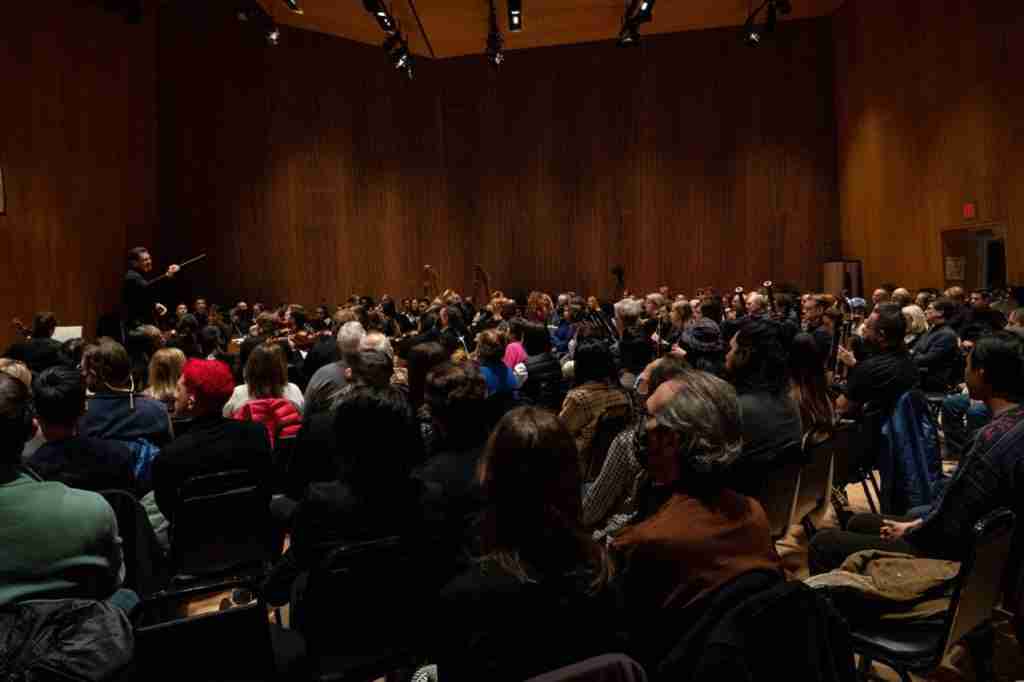
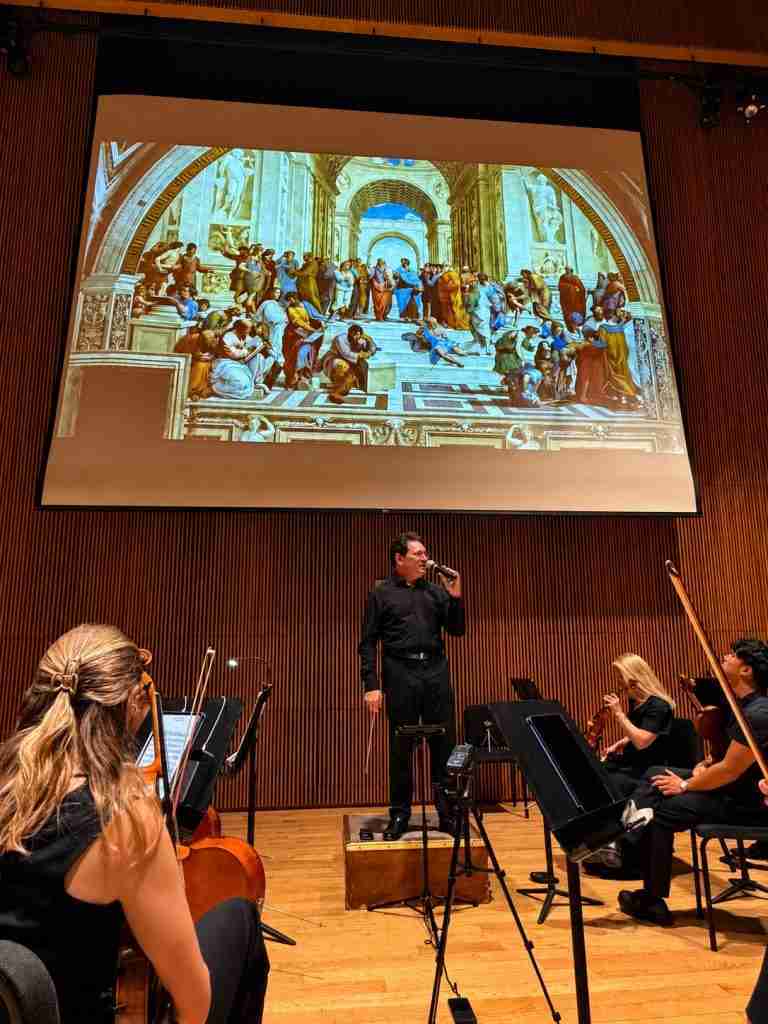
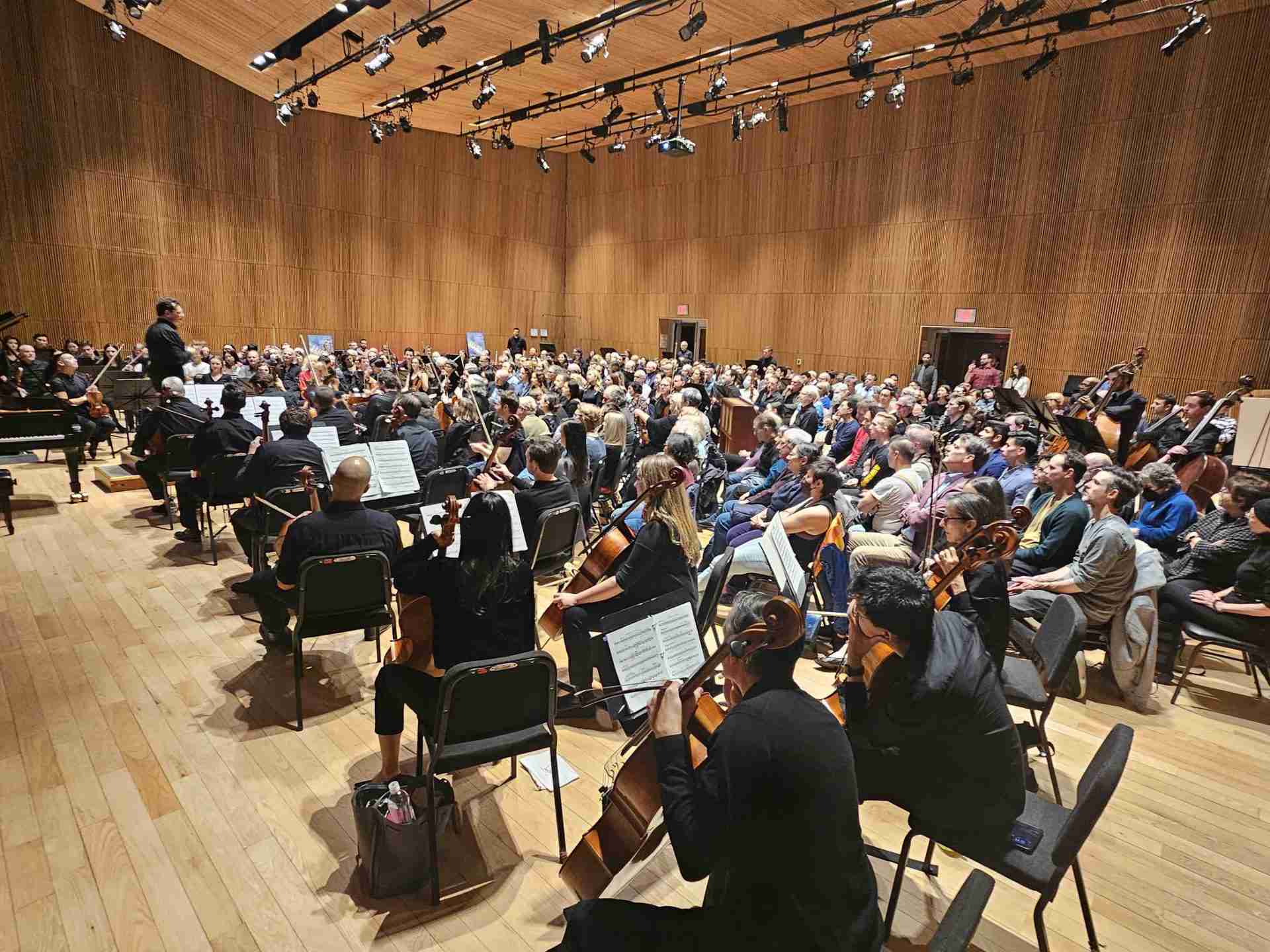
Anderson, whose experience with the PACS InsideOut concert format gives her particular insight into the question, points to something the audience may take for granted: “I think, because of the InsideOut format, there are already so many barriers removed between the orchestra and the audience. But I would like to impress upon audience members and everyone else the level of preparation and care toward the process of arriving at a concert.”
Carroll’s closing words carry the weight of a decade’s experience and resonate as this survey’s most complete summation:
“Maestro Bernard creates an environment that epitomizes the magic of music making. He is a brilliant leader who encourages us to make the notes on the page come to life with purpose and passion. As special as he makes the art of music making for us musicians, he does the same for the audience. He connects what we are doing on the stage to the audience’s experience. His love for the work, respect for the orchestra members, and commitment to a high-caliber audience experience are why he deserves to be the Conductor of the Year.” — Madeleine Carroll, viola
What a Platinum Performance Sounds Like: Bernard on the Finished Work
Asked, finally, what he listens for when he steps back and hears a finished recording — the take that will become the permanent record — Bernard’s answer brings the circle of this portrait to a close. It is the answer of a conductor for whom the technical and the emotional are not separate categories, and for whom the audience’s experience is the ultimate measure of every rehearsal hour spent.
“For me, the most successful performance or recording speaks to the audience and listener. Speaking requires intention, clarity, and voice — all of which are the objectives of every minute of every rehearsal. And when I hear this in our recordings, I feel both proud of each musician and grateful for the opportunity to create a lasting record of our way with this score.” — David Bernard
* * *
A Platinum Prize in Proper Perspective
The European Classical Music Awards Annual Grand Prix 2025 has recognized in David Bernard something the musicians of the Park Avenue Chamber Symphony have long known: that this is a conductor of exceptional gifts, whose accomplishments are inseparable from the community of musicians he has gathered, shaped, and — in Bernstein’s word — made them want to play.
The Platinum Prize and the Conductor of the Year designation are worthy honors. But they are, finally, only the most recent articulation of a truth that can be heard in every measure the PACS commits to record, and felt in every concert they give. It is audible in Nealon’s voice when he says he started to cry during the Mahler. It is present in Robertson’s transformed understanding of what his instrument can be. Schulmeister’s declaration states that this is the most gratifying musical experience of his career. And it is stated most plainly by the conductor himself, in his conviction that the best performance and the empowered musician are not competing goals but the same goal — reached together, from inside the music, on the way to its inevitable silence.
— E.A.K.
David Bernard: The Maestro From the Inside Out
The Park Avenue Chamber Symphony
David Bernard, Music Director and Conductor
Website: chambersymphony.com
Email: info@chambersymphony.com
Performance Venue: DiMenna Center for Classical Music, 450 West 37th Street, New York, NY 10018
Tickets for the 2025–2026 Season: Purchase Tickets on Eventbrite
Donate to the PACS: Make a Tax-Deductible Donation
Upcoming Concerts: View the Full 2025–2026 Season Schedule
The Park Avenue Chamber Symphony is a 501(c)(3) nonprofit organization. All donations are tax-deductible to the extent permitted by law. PACS events are made possible in part by public funds from the New York State Council on the Arts, with the support of the Office of the Governor and the New York State Legislature, and by private funds from generous individuals.