
What emerges when musical theater’s most intimate devils meet Stravinsky’s most deceptive angel? What happens when this encounter unfolds in the loving embrace of a community that understands, perhaps better than most Manhattan venues, that great art requires not grandeur but truth?
On a sultry August evening in the Shelter Island School Auditorium, something extraordinary transpired. Here, under the auspices of the Shelter Island Friends of Music, David Bernard and his magnificent Park Avenue Chamber Symphony presented Stravinsky’s L’histoire du Soldat with such luminous artistry that the work’s century-old themes felt urgently, achingly contemporary.
The Devil’s Bargain: Context and Creation
The Soldier’s Tale emerged from Stravinsky’s own pact with necessity. Stranded in wartime Switzerland, financially desperate, and cut off from his usual Russian and Parisian networks, the composer conceived this chamber work as touring entertainment. This piece could survive on sheer creative wit rather than orchestral opulence. The 1918 influenza pandemic ultimately scuttled Stravinsky’s modest touring dreams, much as our own recent pandemic reminded us of art’s simultaneously fragile and essential natures.
From these constraints emerged what many consider Stravinsky’s most perfectly integrated theatrical work—a piece that represents “a complete change of paradigm” following the horrors of the Great War. The work’s seven-instrument ensemble, deliberately modeled on American jazz bands while filtered through Stravinsky’s revolutionary harmonic language, created something entirely unprecedented in classical music.
Most significantly, The Soldier’s Tale “straddles the divide between the competing ideals of reversion to traditionalism and the rejection of tradition.” The work’s “Grand Chorale” recalls Bach’s harmonic procedures, albeit with modern dissonances. In contrast, the “Dance du Diable” and the “Triumphal March” recall the grotesque aggression of The Rite, with their use of the extreme registers of each instrument, their unrelenting dissonance, and their abandonment of tradition.
Maestro Bernard’s Revelatory Leadership: Navigating Stravinsky’s Technical Labyrinth
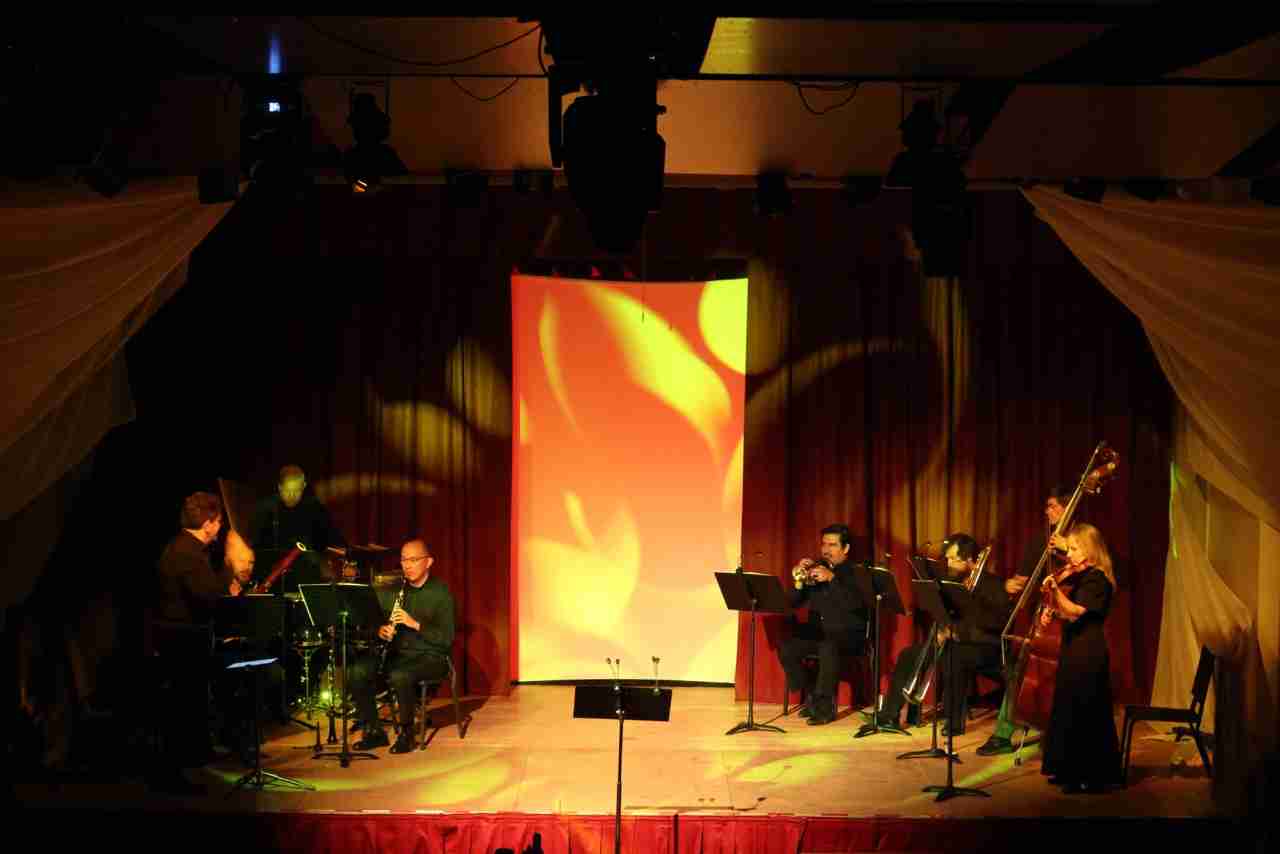
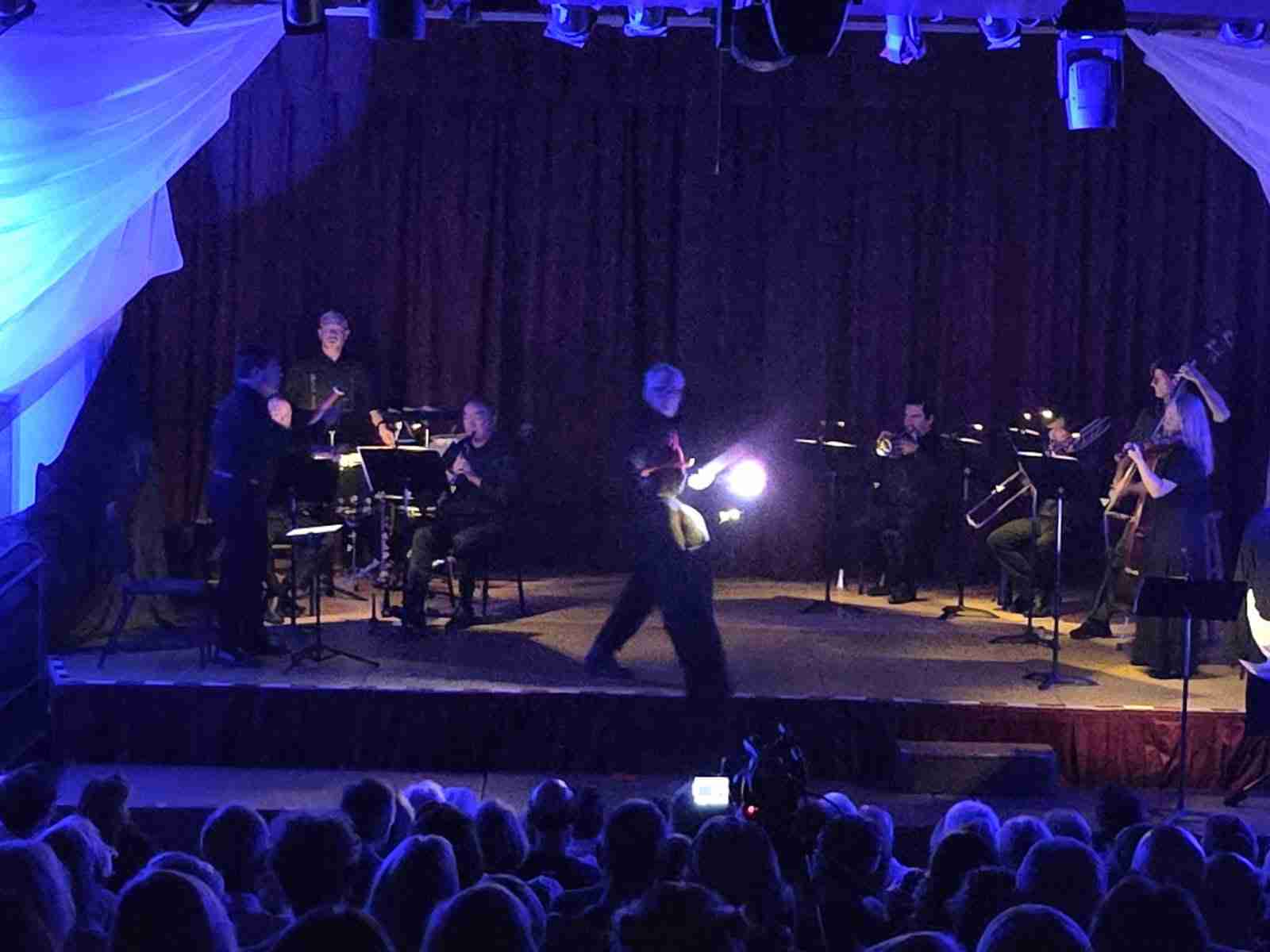
Under David Bernard’s direction, the Park Avenue Chamber Symphony musicians made familiar music sound freshly minted while conquering some of the most demanding challenges in the chamber music repertoire. Bernard’s interpretation revealed why Gramophone magazine has praised his recordings for their “intensity, spontaneity, propulsive rhythm, textural clarity, dynamic control, and well-judged phrasing.” His approach to Stravinsky’s challenging score demonstrated the same “dramatic and incisive conducting” that has earned him recognition across four continents.
The technical demands of The Soldier’s Tale are formidable. Stravinsky’s score reveals his chief technical traits: bitonality (two voices, each in different keys), rhythmic disruption, dislocation and asymmetry, as well as the telltale prevalence of a diversity of short motifs repeated in layered ostinati. These polytonal structures, where competing pitch centers create harmonic tension without resolution, require musicians to maintain absolute intonational integrity while navigating constantly shifting metrical terrain.
Álfheiður Sæmundsson’s violin performance proved particularly masterful in confronting the instrument’s central dramatic burden. Her violin must serve as the lynchpin of the entire drama: the soldier’s violin (complete with little cadenza), a metaphor for the soul that he will ultimately lose. The technical challenges include exposed solo cadenzas and the need to maintain perfect intonational accuracy while navigating Stravinsky’s bitonal harmonic structures—particularly treacherous in the “Little Concert” section, where the violin establishes precise tuning relationships with the other instruments.
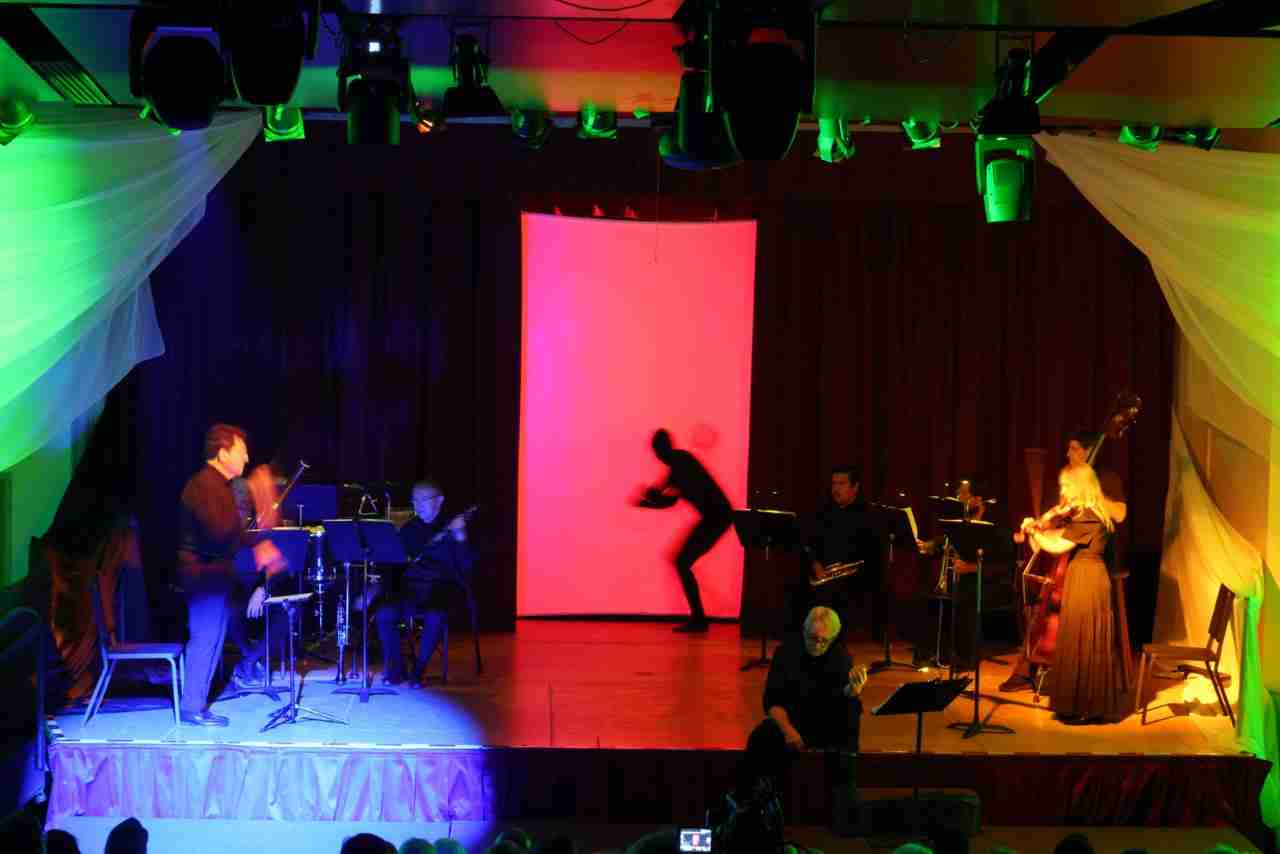
Alex Yu‘s clarinet work demonstrated exceptional command of some of Stravinsky’s most demanding woodwind writing. The clarinet’s role requires absolute rhythmic precision, particularly through Stravinsky’s constant meter changes, while maintaining the jazz influences Stravinsky absorbed from written scores rather than live performances. Yu’s performance in the crucial “Pastorale” movement, where the particular challenge of intonation with the clarinet, achieved a delicate balance between technical accuracy and expressive musicality.
James Marshall’s bassoon playing navigated some of the instrument’s most treacherous passages in the repertoire. The “Pastorale” movement presents specific intonational challenges requiring ultra-careful listening and flexing to match the clarinet, while the “Ragtime” movement—with its tempo marking of 192 to the eighth and constant meter changes can easily become what is sometimes called a “‘ragged’ ragtime.” Marshall’s performance demonstrated the technical mastery required to execute extensive passages involving only two notes, high F# and high G#, while maintaining perfect ensemble coordination.
Mario Correa’s trumpet work exemplified the brass challenges inherent in Stravinsky’s jazz-influenced writing. The score’s demands include not only the technical precision required for the rhythmically complex passages but also the stylistic authenticity needed to evoke the tango, waltz, and ragtime idioms that Stravinsky, despite never having heard jazz performed live, incorporated into his harmonic language.
Bruce Leggett-Flynn: A Tour de Force of Theatrical Virtuosity
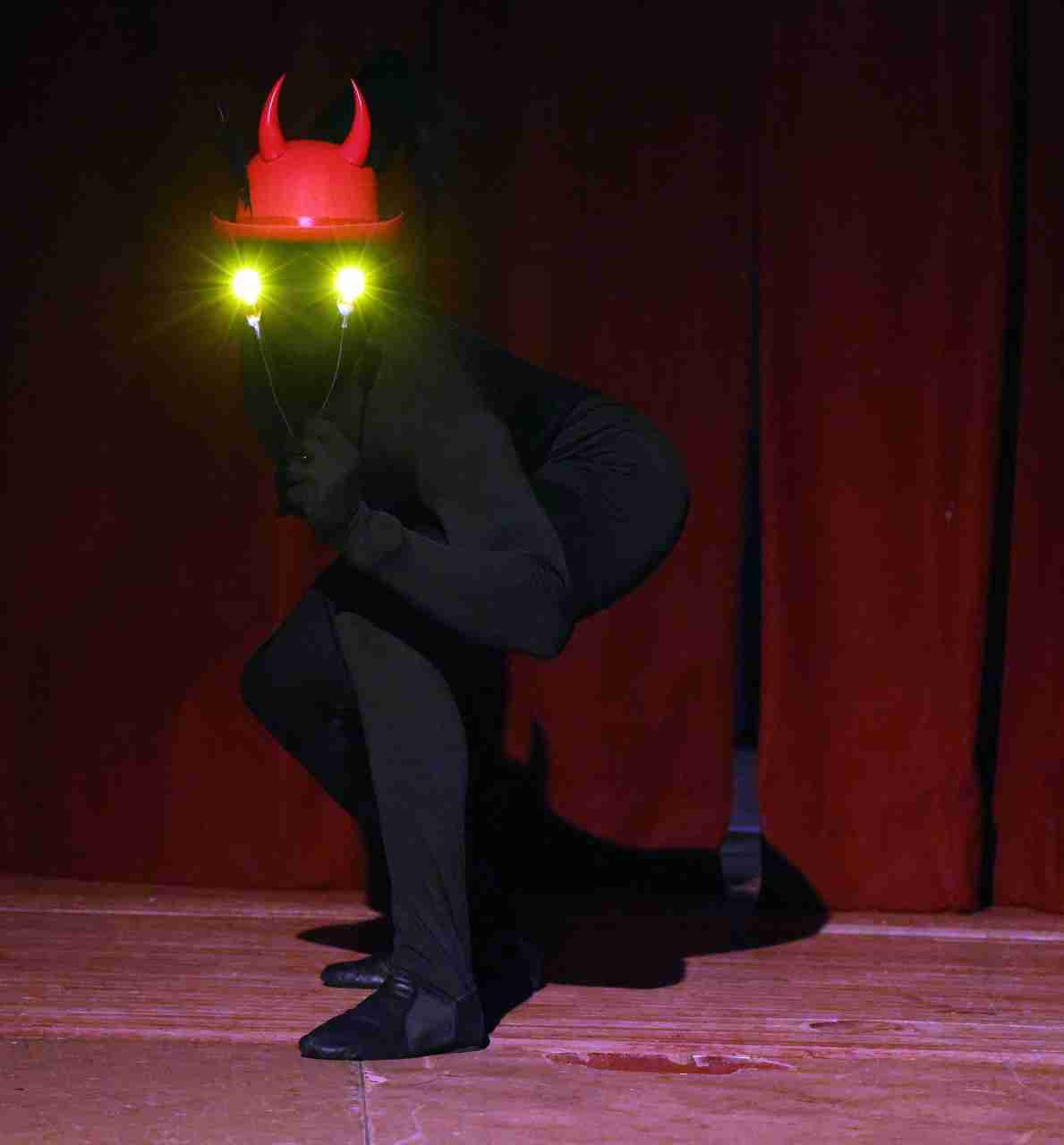
The evening’s revelation was undoubtedly Bruce Leggett-Flynn, whose solo inhabitation of every speaking role—Narrator, Soldier, Devil, and all the Devil’s various disguises—proved nothing short of miraculous. This British actor, whose background spans rugby fields and nightclub stages, brought a specificity and theatrical intelligence to each character that illuminated every corner of Ramuz’s text.
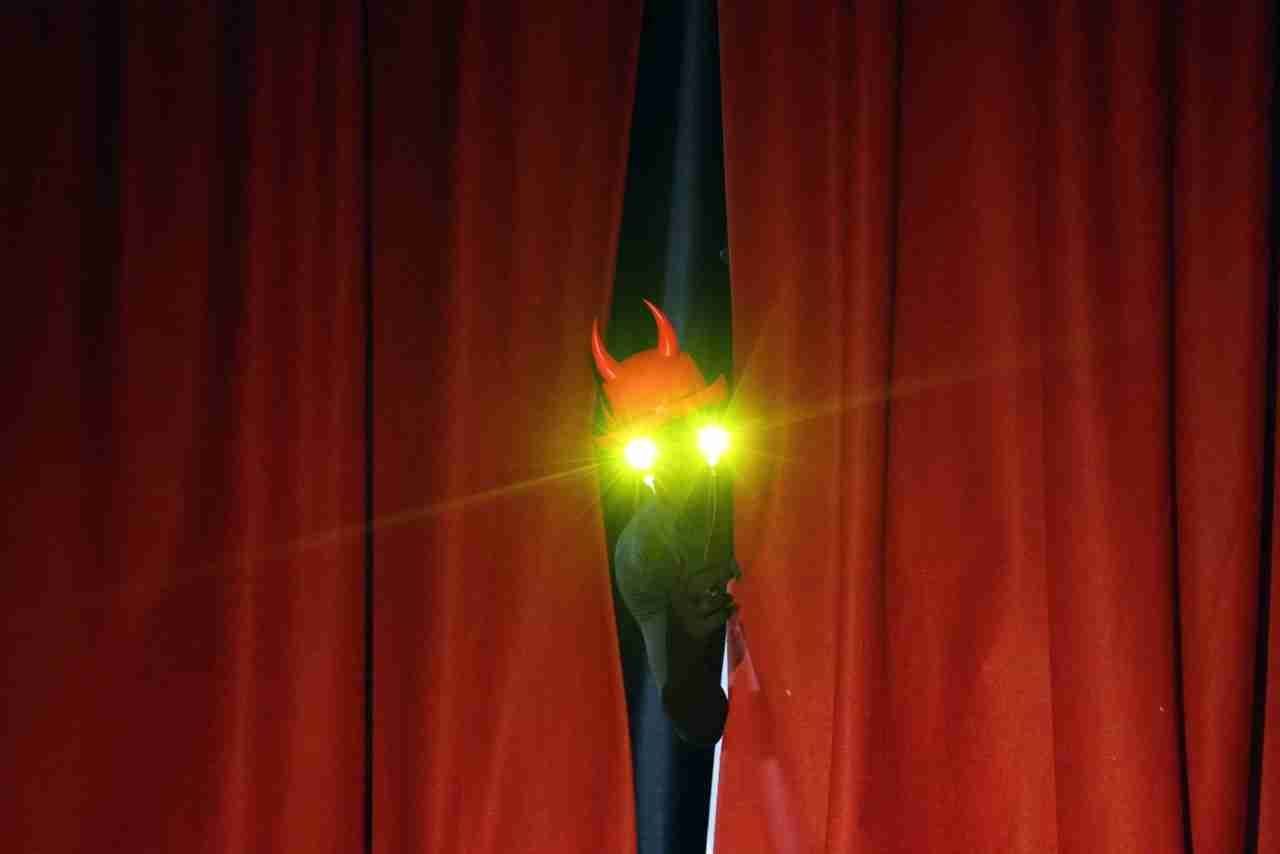
Leggett-Flynn’s Devil was particularly memorable—not the cartoonish tempter of lesser productions, but rather a figure of genuine menace wrapped in seductive charm. His transitions between characters occurred with such seamless artistry that the audience never questioned the theatrical logic of his multiple personas. His final incarnation as the triumphant Devil possessed a chilling inevitability that left the audience contemplating the work’s moral complexities long after the final notes faded.
Visual Splendor: Ariel Adkins’ Surrealist Revolution
Ariel Adkins‘ production design proved a master class in theatrical imagination. As the founder of Artfully Awear, Adkins has spent years transforming clothing into storytelling tools. Her work has been featured in The New York Times, Vogue, and Forbes through collaborations with MoMA, the Guggenheim, and other significant cultural institutions worldwide.
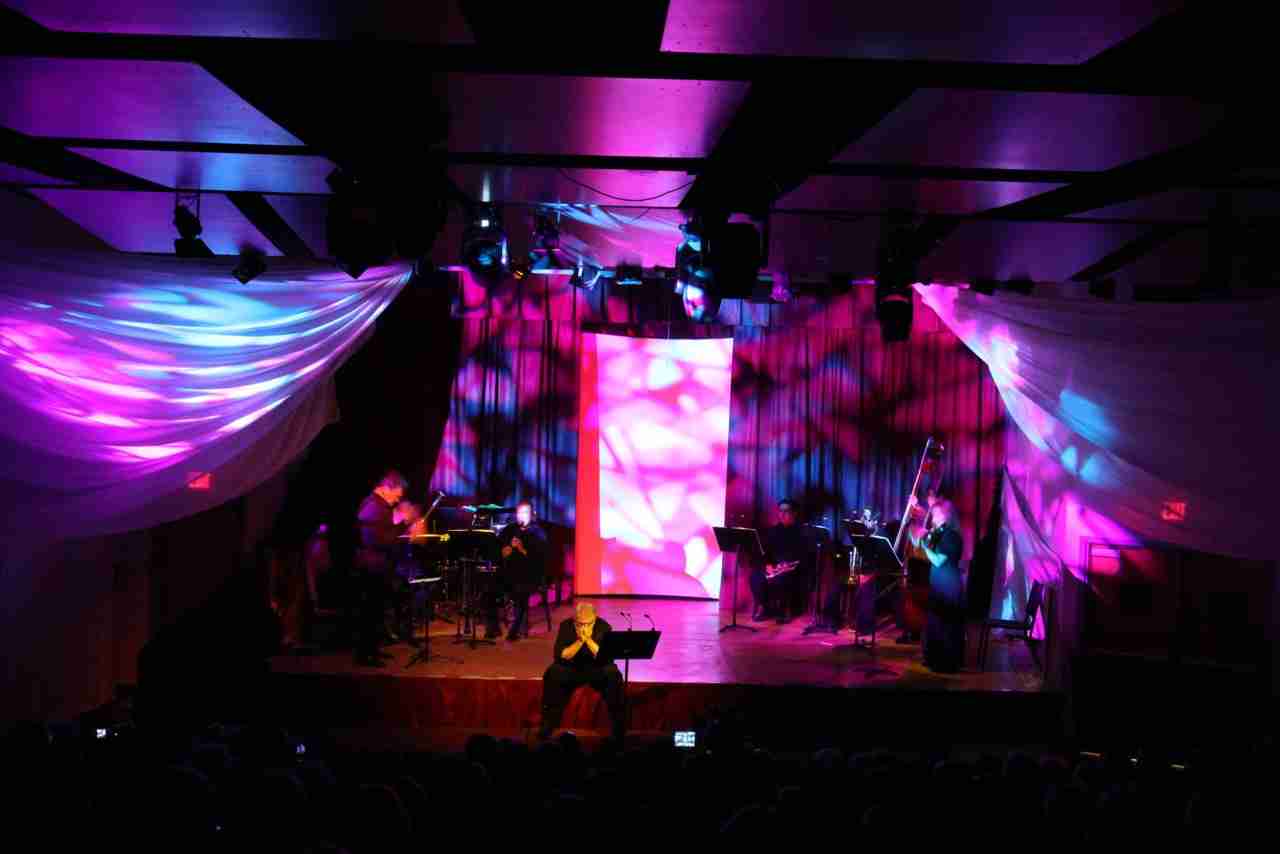
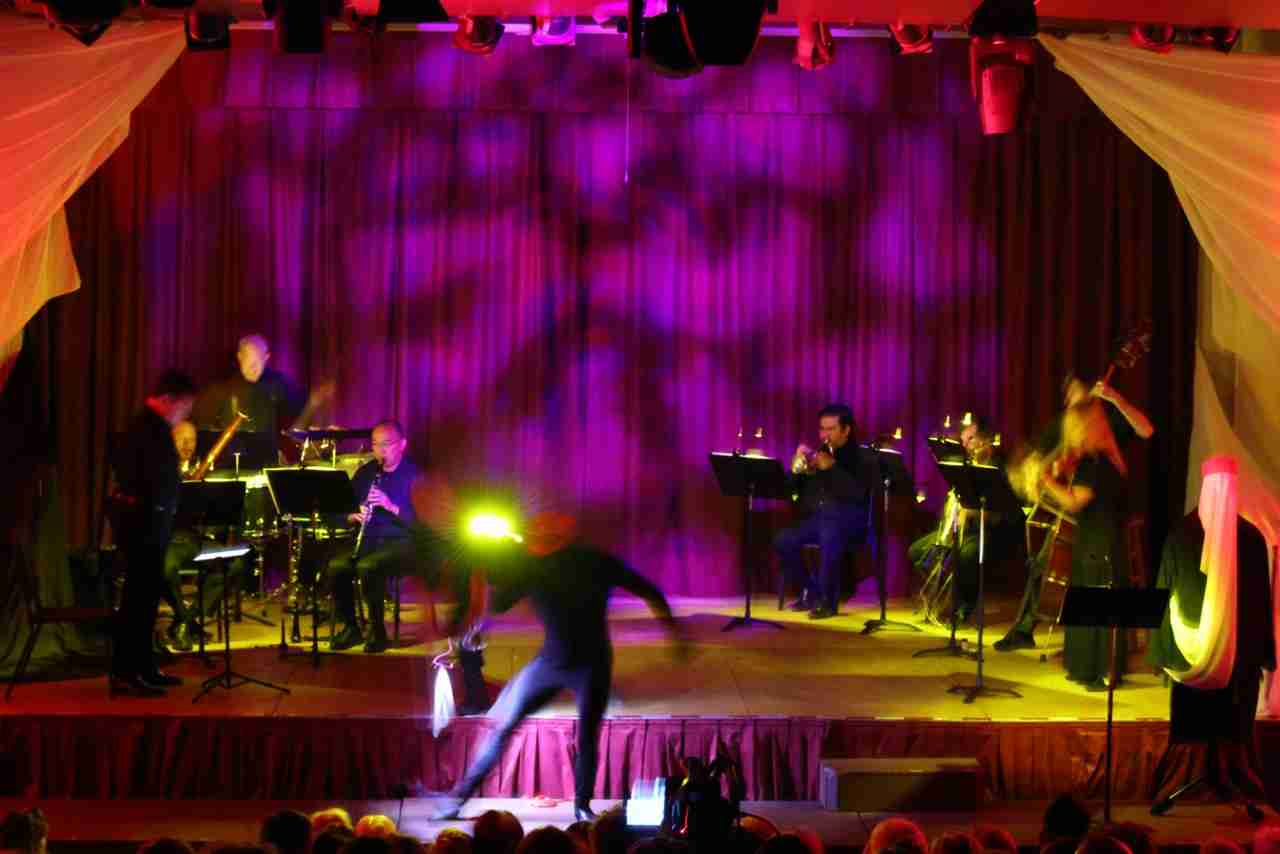
Her surrealist-inspired design concept—layers of translucent chiffon serving as both sculptural environment and projection surface—created a visual language perfectly aligned with Stravinsky’s musical modernism. The costumes’ emphasis on “illusion and fragmentation” echoed not only the composer’s ties to Surrealism but also the work’s central themes of identity and transformation. Adkins possesses that rare ability to make art more accessible” through visual storytelling—precisely what this production achieved.
The Musical Revelation: Seven Players, Infinite Worlds—Stravinsky’s Polytonal Architecture
The heart of this performance lay in Bernard’s conducting and his musicians’ responses to Stravinsky’s revolutionary harmonic language. The work’s instrumentation creates equal players in the drama—each instrumentalist becomes a character rather than a mere accompanist. What makes this particularly challenging is Stravinsky’s use of bi-quintal structures, where two perfect fifth intervals are stabilized and elaborated, creating harmonic tensions between competing pitch centers that require absolute precision from each performer.
Paul Robertson’s percussion work proved central to the drama’s psychological architecture. Arguably, the percussion has the last word in the whole piece, representing the Devil’s ultimate triumph. The technical challenges include navigating multiple editions of the percussion part, as there are differences between each edition, even those approved by Stravinsky, while maintaining the specific timbral colors Stravinsky demanded for his jazz-influenced rhythmic structures.
Ed Matin‘s trombone and Bill Nealon‘s double bass provided the harmonic foundation for Stravinsky’s bitonal experiments. The double bass faces challenges in the work’s use of layered ostinati, which create an iridescent equilibrium—repetitive patterns that must remain rhythmically absolute while supporting the harmonic tensions of Stravinsky’s competing tonal centers.
The ensemble’s mastery of Stravinsky’s metrical complexities proved particularly impressive. The work is rife with changing time signatures, demanding rock-solid steadiness from each player to prevent the ensemble from derailing. The famous “Ragtime” movement presents the ultimate test—a tempo marking of 192 to the eighth note combined with constant meter changes that can destroy lesser ensembles.
Bernard’s approach to ensemble building creates immersive music-making that engages contemporary audiences in uniquely meaningful ways. This evening’s performance demonstrated precisely why the Park Avenue Chamber Symphony has earned such critical acclaim for transforming classical music experiences through technical mastery wedded to interpretive insight.
Movement, Magic, and Meaning
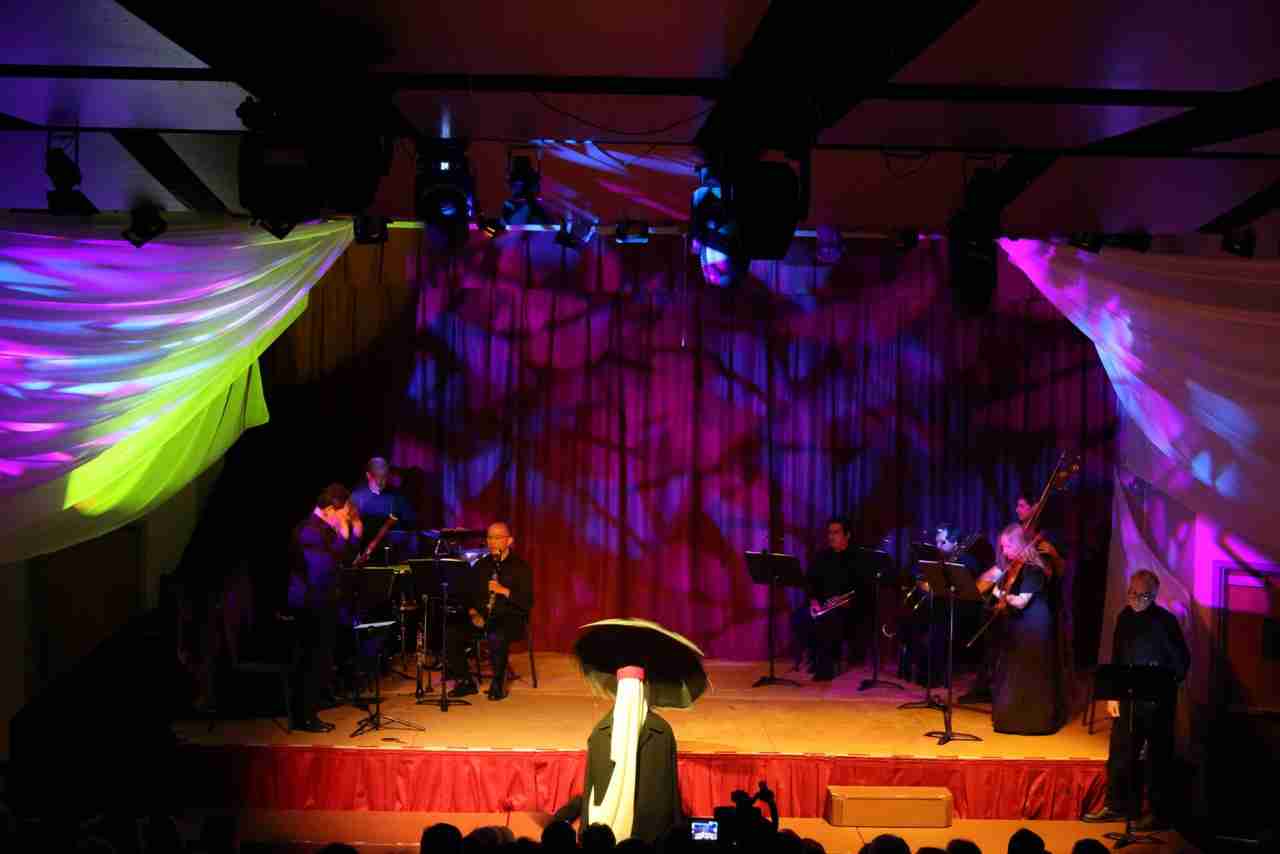
The contributions of the movement ensemble—Trent Firestine, Ariel Adkins, and nine-year-old Natali Leon—added layers of physical poetry to the musical storytelling. Their presence reminded us that Stravinsky conceived this work as a multimedia theater piece, not concert music with incidental staging.
Young Natali Leon’s participation particularly moved the audience, suggesting that great art crosses generational boundaries when presented with authentic artistic commitment. Her involvement embodied the Shelter Island Friends of Music‘s mission to bring “world-renowned artists and rising stars” together in the service of musical excellence.
Technical Excellence in Service of Art
The production team’s contributions proved equally essential. John Kaasik’s lighting design created atmospheric support that enhanced rather than overwhelmed the intimate scale. At the same time, James Marshall’s direction demonstrated the sophisticated understanding of musical theater that comes from deep experience in both music and drama. Sara Mundy’s stage management ensured seamless transitions that maintained the work’s essential flow and continuity.
The Deeper Resonances: Why This Soldier’s Tale Matters Now
What made this performance extraordinary was its recognition that The Soldier’s Tale speaks directly to our contemporary moment. Stravinsky’s Faustian tale about a soldier who trades his authentic self for material success resonates with poignancy in our age of digital distraction and commodified culture.
The work’s themes of exile, displacement, and the search for authentic human connection resonate powerfully with audiences still processing their own recent experiences of isolation and loss. I propose that the most meaningful artistic experiences often emerge when performers and audiences recognize their shared humanity through the transformative power of great art.
A Community Triumph
This performance exemplified everything that makes Shelter Island Friends of Music such a vital cultural institution. Their commitment to presenting “world-class cultural performances, free of charge” creates precisely the kind of community-centered artmaking that nurtures both artists and audiences. Their partnership with the Park Avenue Chamber Symphony demonstrates how musical excellence and community engagement can coexist beautifully.
The Front Row Center has documented that the most memorable musical experiences often occur when “modern life meets a gentler, more connected past”—precisely what transpired in this intimate school auditorium setting.
The Lasting Impact
As the final notes of the “Triumphal March of the Devil” faded and the audience erupted in applause, one sensed that something genuinely special had occurred. This was not merely a successful performance of a challenging work, but rather a reminder of why live music-making remains irreplaceable in our increasingly digital world.
David Bernard’s vision of classical music as accessible, immediate, and emotionally transformative found perfect expression in this evening’s artmaking. His innovative approaches to audience engagement—evidenced throughout the Park Avenue Chamber Symphony’s 25-year history—continue to demonstrate that traditional concert formats need not be abandoned, but rather reimagined with greater humanity and artistic integrity.
The Art of Necessary Magic
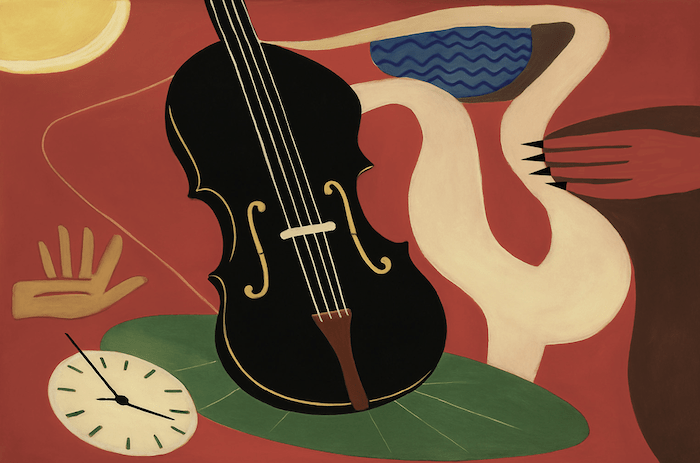
This Soldier’s Tale succeeded because everyone involved understood that Stravinsky’s masterpiece demands not just musical competence but theatrical courage and emotional truthfulness. Opening Night Online has observed that the most remarkable performances achieve that rare synthesis where technical mastery serves emotional authenticity—where tradition and innovation coexist without contradiction.
On this August evening, Bruce Leggett-Flynn, Ariel Adkins, David Bernard, and the extraordinary musicians of the Park Avenue Chamber Symphony reminded us why live performance remains essential: it creates shared experiences that no recording, however excellent, can replicate.
They demonstrated that the most profound art often emerges not from abundance but from constraint—from artists who understand that limitations can become sources of creative liberation. They proved that community-based artmaking, when approached with appropriate seriousness and love, can achieve the highest levels of artistic excellence.
Shelter Island Friends of Music and institutions like it represent something precious in our cultural landscape: spaces where art serves community and community nurtures art, where professional excellence meets human warmth, and where the transformative power of great music can touch hearts and change lives. For those fortunate enough to witness this Soldier’s Tale, the memory will linger like the best kind of devil’s bargain—one where the exchange enriched rather than impoverished the soul, where art’s ancient magic proved once again its capacity to make us more fully human.
It is worth noting that James Marshall, who served as both director and principal bassoonist for this production, brings a unique perspective as a resident of Shelter Island. His dual role—guiding the theatrical vision while navigating the formidable technical challenges of Stravinsky’s bassoon writing—exemplifies an artistic versatility that makes community-based music-making so vital to our cultural landscape.
Maestro Bernard’s Illuminating Post-Concert Discourse
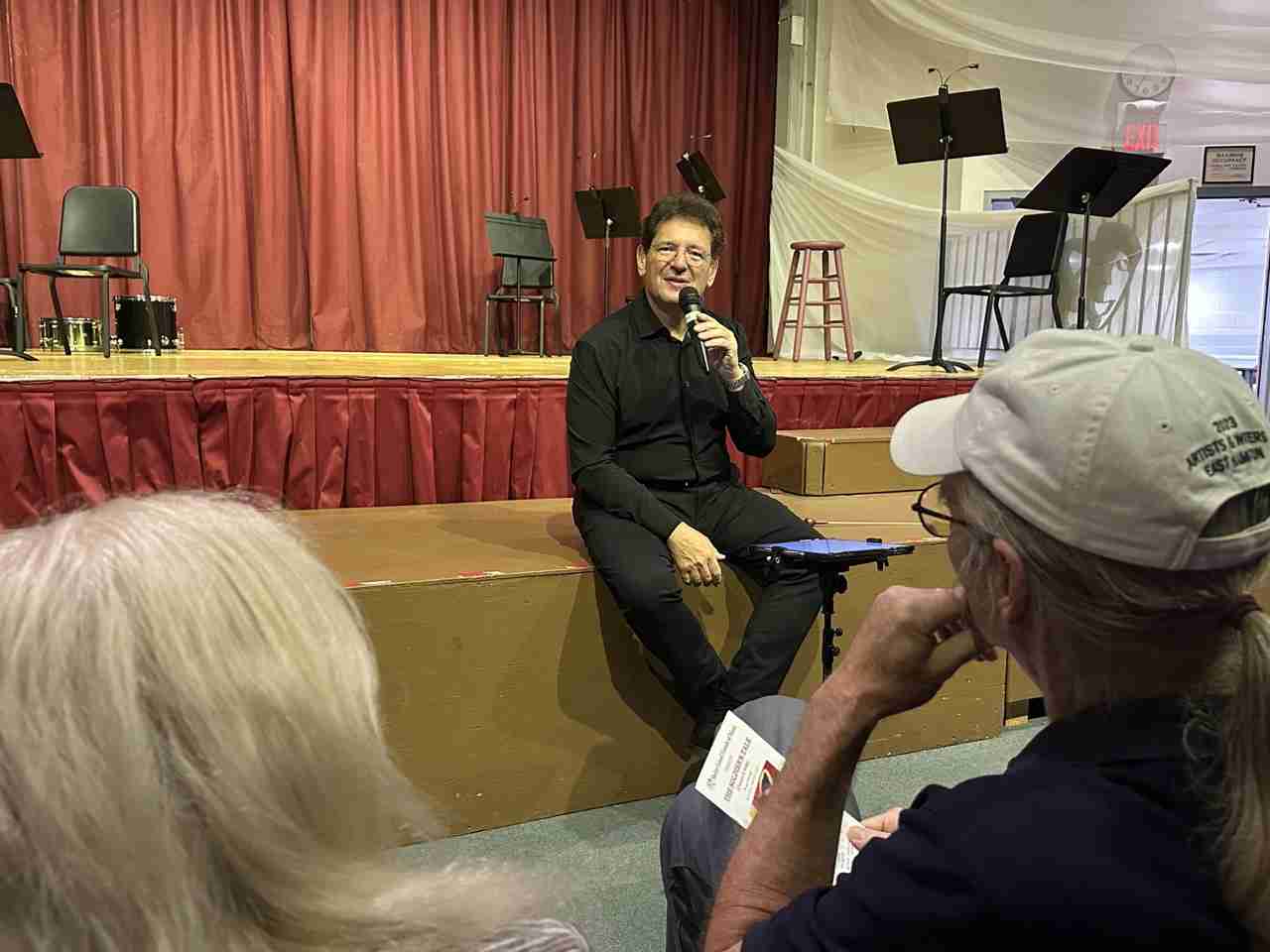
Following the performance, David Bernard offered the audience an illuminating post-concert discussion revealing the philosophical currents of Stravinsky’s masterpiece. Speaking to an attentive gathering of music lovers, Bernard explored how the composer’s revolutionary approach to form and harmony creates what he termed “musical realism”—art that reflects life as it truly is, rather than as we might wish it to be.
“Stravinsky’s genius,” Bernard explained, “lies in his combination of traditional forms—marches, even Bach chorales—with dissonance and irregular meters to create a full picture of depth and realism.” This approach, he noted, stands in stark contrast to classical music’s tendency to deliver “an aural picture of an idealized world.” Instead, Stravinsky gives us life unvarnished, much as Picasso’s visual abstractions distort familiar forms to reveal more profound truths about human experience.
Bernard’s analysis proved particularly insightful regarding the work’s use of chorales as “points of introspection where the underlying meaning is revealed.” These sections employ the familiar forms of Bach chorales to create moments of reflection that contrast sharply with the everyday urgency of the marches. Yet even in these contemplative passages, Stravinsky’s incorporation of dissonance ensures that we remain grounded in the real world rather than ascending to some ethereal realm of pure beauty.
The evening’s most fascinating revelation concerned the work’s controversial final percussion coda. Bernard posed the central interpretive question that has divided performers and scholars for decades: Should the ending utilize a crescendo or a decrescendo? While Stravinsky explicitly indicated a decrescendo—”essentially a slow extinguishing of light indicating the soldier’s loss”—many performers have chosen a crescendo to emphasize the Devil’s triumph. This interpretive choice, Bernard suggested, fundamentally alters the work’s meaning, transforming a meditation on human frailty into a celebration of evil’s victory.
The discussion illuminated not only Stravinsky’s compositional philosophy but the broader questions that make The Soldier’s Tale enduringly relevant. In an age when traditional certainties seem increasingly fragile, the work’s unflinching examination of moral compromise and spiritual loss resonates with particular urgency.
Stravinsky’s Timeless Fable Reborn on Shelter Island
The Artists
Park Avenue Chamber Symphony
David Bernard — Conductor
Álfheiður Sæmundsson — Violin
Alex Yu — Clarinet
Mario Correa — Trumpet
Bill Nealon — Double Bass
James Marshall — Bassoon
Ed Matin — Trombone
Paul Robertson — Percussion
The Soldier’s Tale Cast
Bruce Leggett-Flynn — Narrator, Soldier, Devil (Little Old Man, Army Officer, Peddler Woman, Violin Virtuoso), Town Crier, Irish Soldier, Sentry, King, Princess
Trent Firestine, Ariel Adkins, Natali Leon — Movement Ensemble
Production Team
Ariel Adkins — Production Design
James Marshall — Director
John Kaasik — Lighting Design
Sara Mundy — Stage Manager
To learn more about the Park Avenue Chamber Symphony and their innovative approaches to classical music, visit their website or explore their critically acclaimed recordings. Support the vital work of Shelter Island Friends of Music by attending their upcoming concerts and contributing to their mission of bringing world-class music to their community.