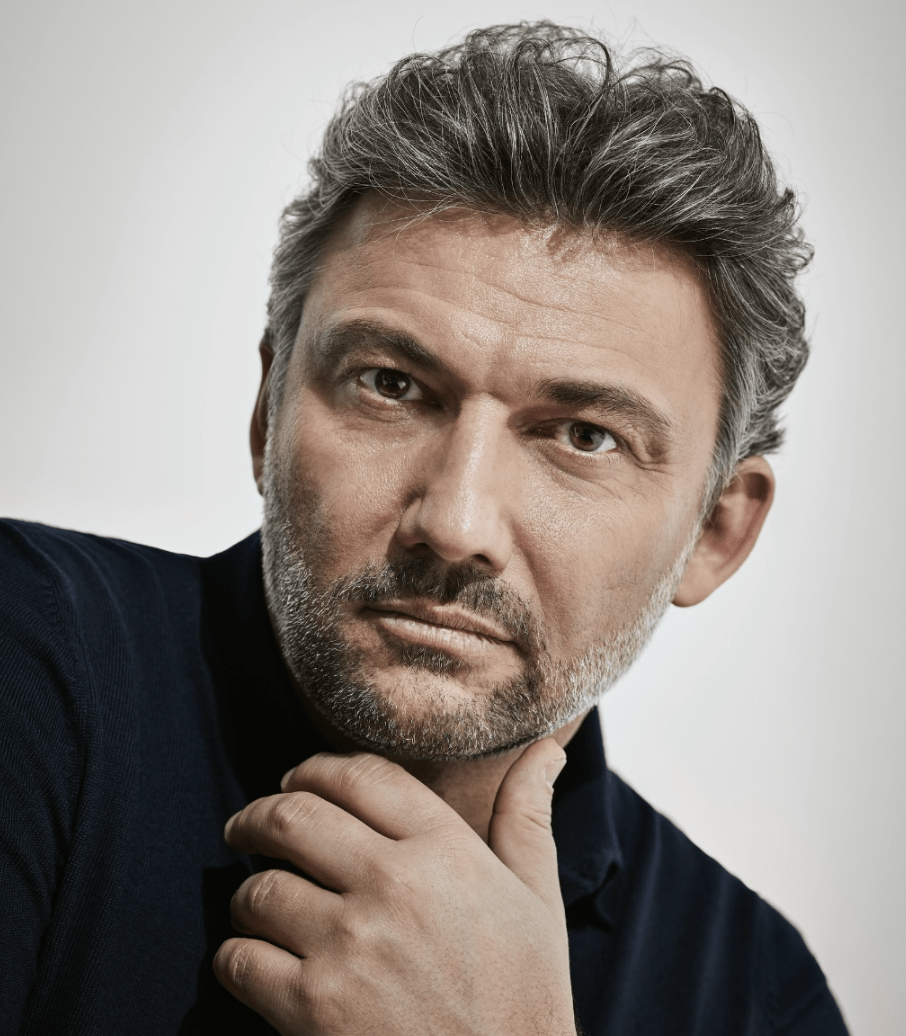
Some tenors sing beautifully. Others can fill an opera house with thrilling sound. Jonas Kaufmann does something harder — he makes us believe the man who is singing.
Please listen to the Video just below as you read this article.
Born in Munich on July 10, 1969, and trained at that city’s Hochschule für Musik und Theater, Kaufmann has emerged as one of the defining tenors of his generation, his career carrying him through virtually every important opera house in the world. Yet celebrity has never been the most interesting thing about him. The voice is. Dark, burnished, almost baritonal in its lower reaches, it can open without warning into a brilliance that seems to arrive from somewhere else entirely. Even that, though, explains only part of his hold on an audience, because Kaufmann is finally an actor who happens to own an extraordinary instrument — and that distinction matters more than it may sound.
From Munich to the World’s Great Opera Houses
After graduating in 1994, Kaufmann worked intensively with American baritone Michael Rhodes, whose coaching he has since described as enormous good fortune; Rhodes helped him find the covered, forward placement that gives the voice its characteristic shadow. Early engagements led to Zurich, where, from 2000, he built a repertoire in the unglamorous, indispensable way singers once did — role by role, season by season — and where his international career gathered momentum. Covent Garden followed in 2004, the Metropolitan Opera in 2006 as Alfredo opposite Angela Gheorghiu, and after that La Scala, the Vienna State Opera, the Paris Opera and the Bavarian State Opera.
His repertoire became unusually broad. Kaufmann has sung Don José in Carmen, Werther, Florestan in Fidelio, and Wagner’s Siegmund, Lohengrin, Parsifal and Tannhäuser. His Italian roles include Verdi’s Otello, Radamès in Aida, Andrea Chénier, and Puccini’s Calaf and Cavaradossi — the last of which the Bavarian State Opera lists among the many major assignments he has undertaken with the company.
Moving credibly among Wagner, Verdi, Puccini and the French repertoire requires more than stamina. Each demands a different relationship between language, color and dramatic articulation: the long-breathed German line that must be declaimed without being barked, the Italian phrase that lives or dies on the vowel, the French mélodie that asks for restraint at precisely the moment an Italian composer would ask for release. Kaufmann seems genuinely interested in that relationship, and nowhere is his interest more audible than in Puccini.
“Recondita armonia” — Beauty Before the Storm
Puccini wastes little time introducing Mario Cavaradossi. Three chords — brutal, unprepared, a tritone apart — open Tosca before a word is sung; they belong to Baron Scarpia, and Puccini has fired them at us long before we know whose they are. The gun, in other words, is already loaded when the curtain rises.
We are in Rome in June 1800. Cavaradossi, a painter and a political liberal, is at work inside the church of Sant’Andrea della Valle on a portrait of Mary Magdalene. The face he has given her was inspired by a beautiful, fair-haired, blue-eyed woman he noticed praying there on successive days: the Marchesa Attavanti. More consequentially, she is the sister of the escaped political prisoner Cesare Angelotti — a connection whose danger Cavaradossi does not yet begin to grasp.
He pauses over the canvas. Then he takes out a miniature of his lover, the celebrated singer Floria Tosca. The two women could hardly be less alike; the woman in the painting is fair and blue-eyed, while Tosca is dark of hair and dark of eye. And yet these clashing beauties consent to live together in the artist’s imagination. That is the recondita armonia, the hidden harmony, of which Cavaradossi sings — a lovely dramatic conceit, an entrance aria about painting, beauty and love, delivered while the Sacristan grumbles his scandalized counterpoint a few feet away. It is also, quietly, a setup.
Kaufmann’s Cavaradossi
This is where Kaufmann becomes particularly interesting. “Recondita armonia” can very easily become a tenor showpiece, and it has everything the occasion requires: a sweeping Puccinian melody, romantic ardor, and a glorious climactic B-flat. Kaufmann gives us all of that. But he also gives us a painter.
Listen to the opening phrases. There is something inward about them, a sense of a man thinking aloud rather than performing for a house of three thousand — which is not a small distinction, since it establishes at once that the aria is happening to Cavaradossi rather than being offered up by him. He studies color, complexion, the particular facts of physical beauty, and one woman begins to dissolve into another in his mind.
Then something changes, and art gives way to love. Kaufmann lets the dark center of the voice widen by degrees, the tone acquiring heat well before it acquires heroism, so that by the time Cavaradossi declares that his one thought is Tosca, contemplation has ripened into passion. The famous high note consequently means something. It is not simply a high note; it is the destination of a thought. That is Kaufmann at his best — technique in the service of character rather than in competition with it.
Puccini Has Already Told Us What Will Happen
There is another reason this brief aria matters. Tosca will shortly arrive at the church, see the fair-haired woman on Cavaradossi’s canvas, and become jealous. That seemingly harmless jealousy will give Scarpia precisely the weapon he needs, for Scarpia understands people, and more particularly, their weaknesses. He will work on Tosca’s love, her jealousy, and her fear. Angelotti’s escape will draw Cavaradossi into political danger; Cavaradossi will be tortured; Tosca will be cornered; Scarpia will be killed. And before the curtain descends, both lovers will be dead.
So there is something almost cruel about the beauty of “Recondita armonia.” For a few minutes, Cavaradossi is simply an artist standing before his canvas, thinking about the woman he loves. He does not know what is coming. We do. That knowledge changes the aria, and a tenor who understands as much sings it differently.
Hearing Kaufmann Live
Kaufmann remains very much an active international performer, and the coming season offers American audiences an unusually apt opportunity to hear him. On October 8, 2026, he joins Kirill Petrenko and the Berliner Philharmoniker for Carnegie Hall’s Opening Night Gala, an all-Italian evening framed by the overture to Verdi’s La forza del destino and Respighi’s Fountains of Rome and Pines of Rome, with arias drawn from Cilea, Giordano and Leoncavallo.
Readers of this article, however, will find something still more enticing a month later. On November 13 and 15, 2026, Kaufmann returns to Carnegie Hall as Mario Cavaradossi in
Tosca, with Gustavo Dudamel conducting the New York Philharmonic in concert performances alongside Marina Rebeka in the title role and Ludovic Tézier as Scarpia. The performances are given on November 13 at 7:30 p.m. and November 15 at 2:00 p.m. The concert presentation strips away the church, the Palazzo Farnese, and the battlements of the Castel Sant’Angelo; what remains is what Kaufmann does best: making a character out of sound alone.
In Europe, he sings the title role of Verdi’s
Otello at the Vienna State Opera beginning October 26, in Adrian Noble’s production under Bertrand de Billy, with Luca Salsi as Iago and Nicole Car as Desdemona, and with further performances running into November. In spring 2027 he returns to the Bavarian State Opera as Wagner’s
Tannhäuser in Romeo Castellucci’s staging, conducted by Nathalie Stutzmann, beginning April 25. His engagements are listed on the
official Jonas Kaufmann website and on the
Bavarian State Opera and
Vienna State Opera sites.
The Artist and the Man
Great singers have a perennial temptation to measure everything by the obvious things. How high was the note? How long did he hold it? How loudly did he sing? How beautiful was the sound? Those things matter, and no one who has sat in a hall while a voice of this size opens up will pretend otherwise. But opera becomes something more when we stop hearing a tenor singing Cavaradossi and begin hearing Cavaradossi himself.
That is what Kaufmann can accomplish. In “Recondita armonia” the transformation happens almost imperceptibly: a painter looks at his canvas, compares two beautiful women, thinks about color — and then thinks about Tosca. Suddenly he is no longer discussing art. He is in love.
And well beyond the church doors, though Cavaradossi cannot possibly know it, Puccini has already set the tragedy in motion.