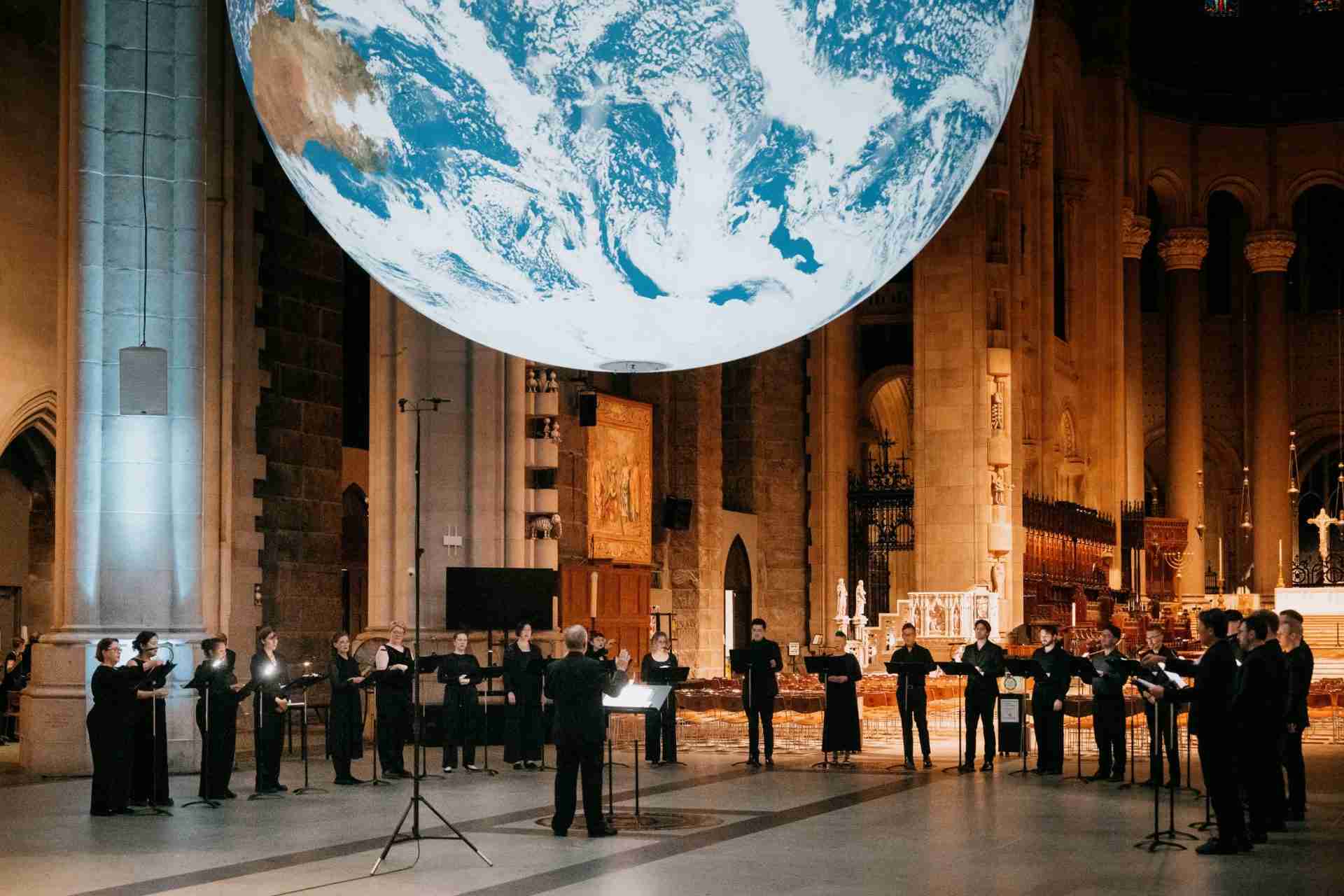

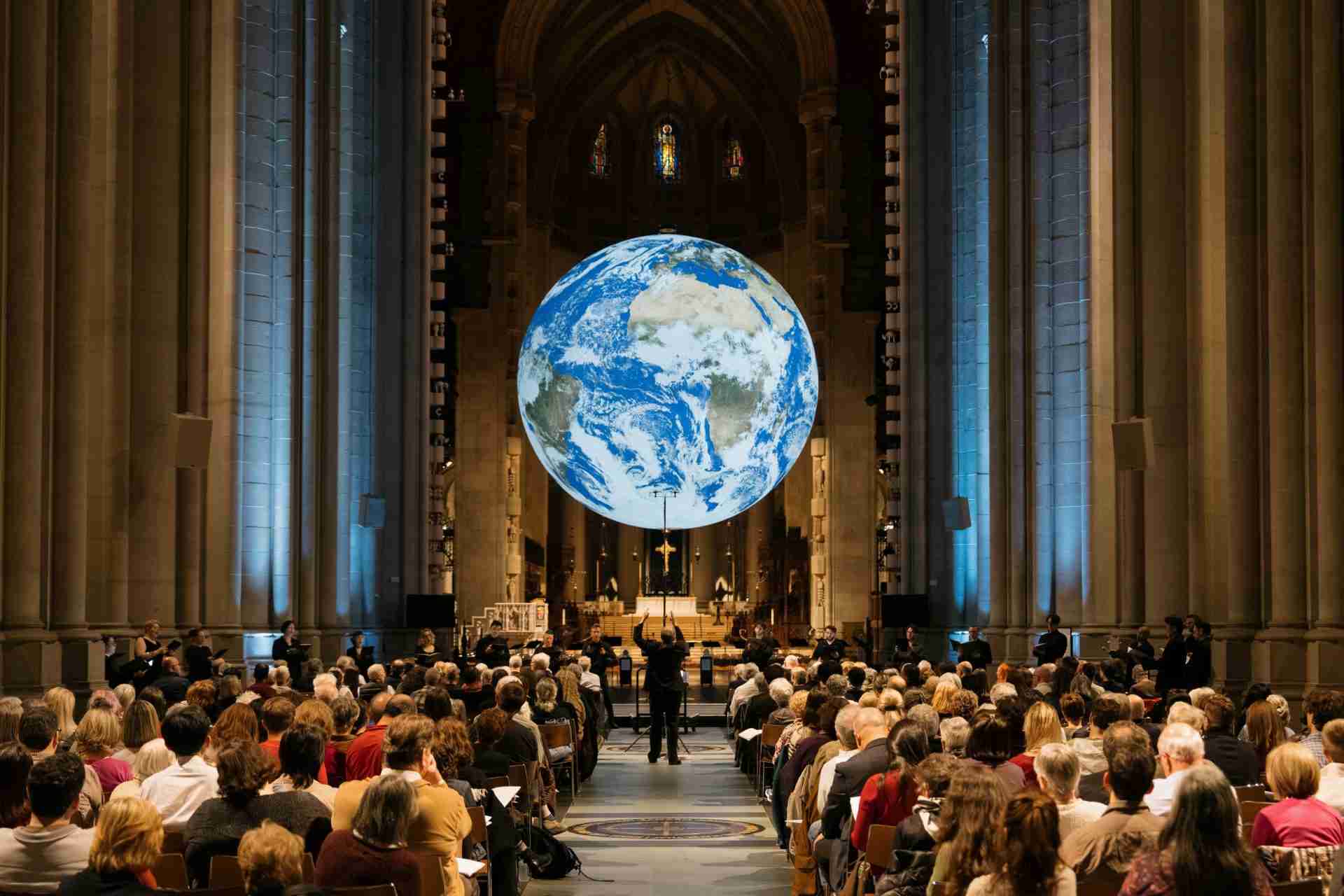
One enters the nave of The Cathedral of St. John the Divine and promptly forgets to breathe. There, hovering amid the dim vastness, turns Gaia, Luke Jerram‘s twenty-three-foot illuminated Earth, stitched together from NASA imagery and revolving with the unhurried patience of something that has beheld empires come and go. It is our planet as the astronauts saw it from the moon, the vision that writer Frank White named the Overview Effect, and here it floated beneath stone vaults raised for eternity. One appeared small, certainly, yet curiously held, as though the building itself had cupped its hands around the world.
Into this setting stepped Musica Sacra and its Music Director, Kent Tritle, on Wednesday, October 7, for SurRound: The Earth Remembers, a sixty-minute program arranged, like a well-made symphony, in three movements: Splendor & Interconnection, Lament & Fracture, and Reconciliation & Renewal.
Splendor & Interconnection: Beauty Before, Behind, Above
Gregg Smith, Meredith Monk, and Jean Mouton
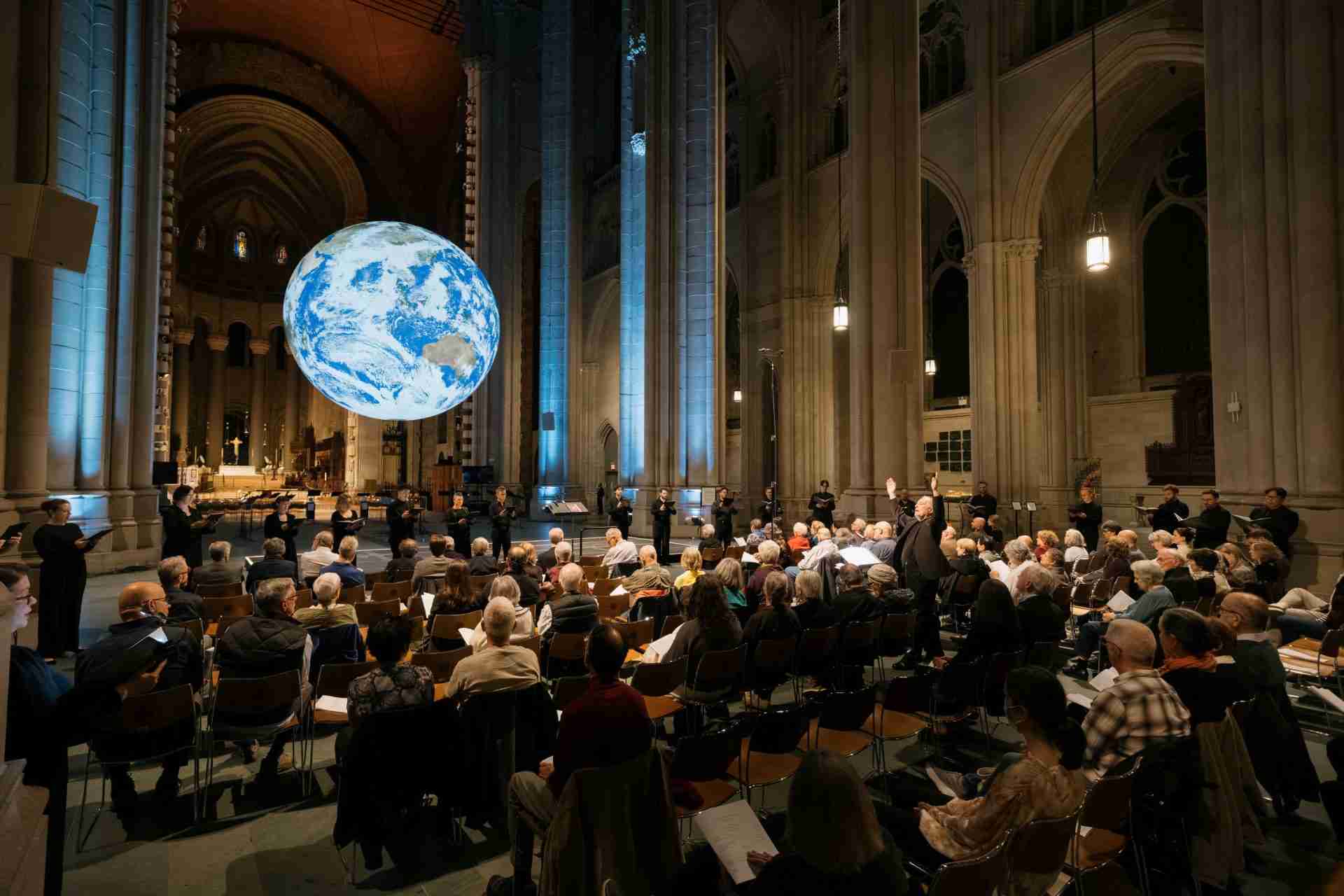
The choir entered unseen from behind the orb, singing Gregg Smith‘s canonic setting of the Navajo prayer Now I Walk in Beauty. The melody wandered, overlapped, and ascended in soft glissandi, a healing orison that appeared less performed than exhaled by the stones. Indeed, “SurRound” proved no mere metaphor. Singers moved among us, and the cathedral’s famously generous acoustics wrapped every listener in a cocoon of sound, so beauty was quite literally before, behind, above, and below us, exactly as the prayer promises.
Meredith Monk‘s wordless Astronaut Anthem, drawn from her opera The Games, followed with that peculiarly Monkian alchemy of the primal and the futuristic. Then, with a deft historical pivot, came Jean Mouton‘s Sancti Dei omnes from the Medici Codex of 1518. Tritle fashioned its alternating homophony and interlaced duets with crystalline transparency. Arguably, all music, ancient or new, grows from the same small seeds of interval and pulse; here, five centuries collapsed into a single breath.
From these first moments, moreover, the chorus revealed its credentials. Its synthesis was seamless, its tuning pure enough to make the cathedral’s long echo an ally rather than an adversary, and its diction so clear that Latin, French, and English alike reached the farthest seats intact. Dynamics ranged from a faintly audible murmur to a full-throated blaze, yet balance never faltered, and every crescendo seemed to rise from conviction rather than simple volume.
Lament & Fracture: The Ocean’s Long Sorrow
Robert Paterson and Christina Whitten Thomas
The middle panel turned seaward. Robert Paterson‘s Infinite Oceans rocked on overlapping lines and fragmented words (ocean, rising, sinking, siren), evoking both tidal pull and the mythic lure of Homer’s singers. Thereafter, Christina Whitten Thomas‘s Prière de la Baleine, setting Carmen Bernos de Gasztold‘s poem, gave us a whale’s prayer: wry about her own enormousness, terrified of the harpoon, longing for a plunge into eternal peace. Its humor and heartbreak arrived together, and more than one listener reached for a handkerchief.
Rautavaara’s Die Erste Elegie: The Evening’s Summit
Then appeared the summit. Einojuhani Rautavaara‘s ten-minute Die Erste Elegie sets the opening of Rainer Maria Rilke‘s Duino Elegies, conceived above the Adriatic at Duino Castle in 1912, the poet wondering whether any angel would hear him should he cry out. Rautavaara builds his setting from twelve-tone rows yet lets sweet triads bloom through them like light through stained glass. Soprano soloists Zen Wu and Elizabeth van Os floated above the texture with silvery purity and fearless intonation, their voices at once vulnerable and incandescent. Harold Schonberg, who prized interpreters who serve the score rather than themselves, would have admired Tritle’s architecture here: the long crescendo of Rilke’s “voices, voices” built patiently and released with devastating inevitability.
Reconciliation & Renewal: Singing Our Way Home
Ticheli, Shaw, and Paterson’s Gentle Apocalypse
After darkness, consolation. Frank Ticheli‘s Earth Song declares music and singing a shelter and a light, and the chorus delivered its final hallelujahs with glowing warmth. Caroline Shaw‘s and the swallow, setting Psalm 84, hummed, pattered, and sighed like autumnal rain filling the pools of the Valley of Baca: a seeker finding, at last, a nest.
Paterson returned with A Song on the End of the World, setting Czesław Miłosz‘s quietly devastating poem in which bees circle clover and porpoises leap even as the world ends unnoticed. Here, soprano Linda Jones, alto Kirsten Sollek, and tenor John Kawa painted Miłosz’s tiny miracles with exquisite specificity. Jones’s soprano gleamed, Sollek’s rich contralto lent the old prophet’s refrain an earthy gravity, and Kawa’s lyric tenor sang of fishermen and sparrows with disarming tenderness. We treasured such moments of being, those instants when the ordinary suddenly blazes with meaning; this performance proved a chain of them.
Take Peace and a Hymn from the New World
Whitten Thomas’s Take Peace, setting words attributed to Fra Giovanni Giocondo, swelled from intimate reflection to vast radiance and back to stillness. Finally, Juan Pérez Bocanegra‘s Hanacpachap cussicuinin (printed in Peru in 1631 and sung in Quechua, the earliest polyphony published in the Americas) processed us home in praise of a maternal figure who radiates care for all creation. Mother Earth, it seemed, had been listening.
Kent Tritle and Musica Sacra: A Standard of Excellence
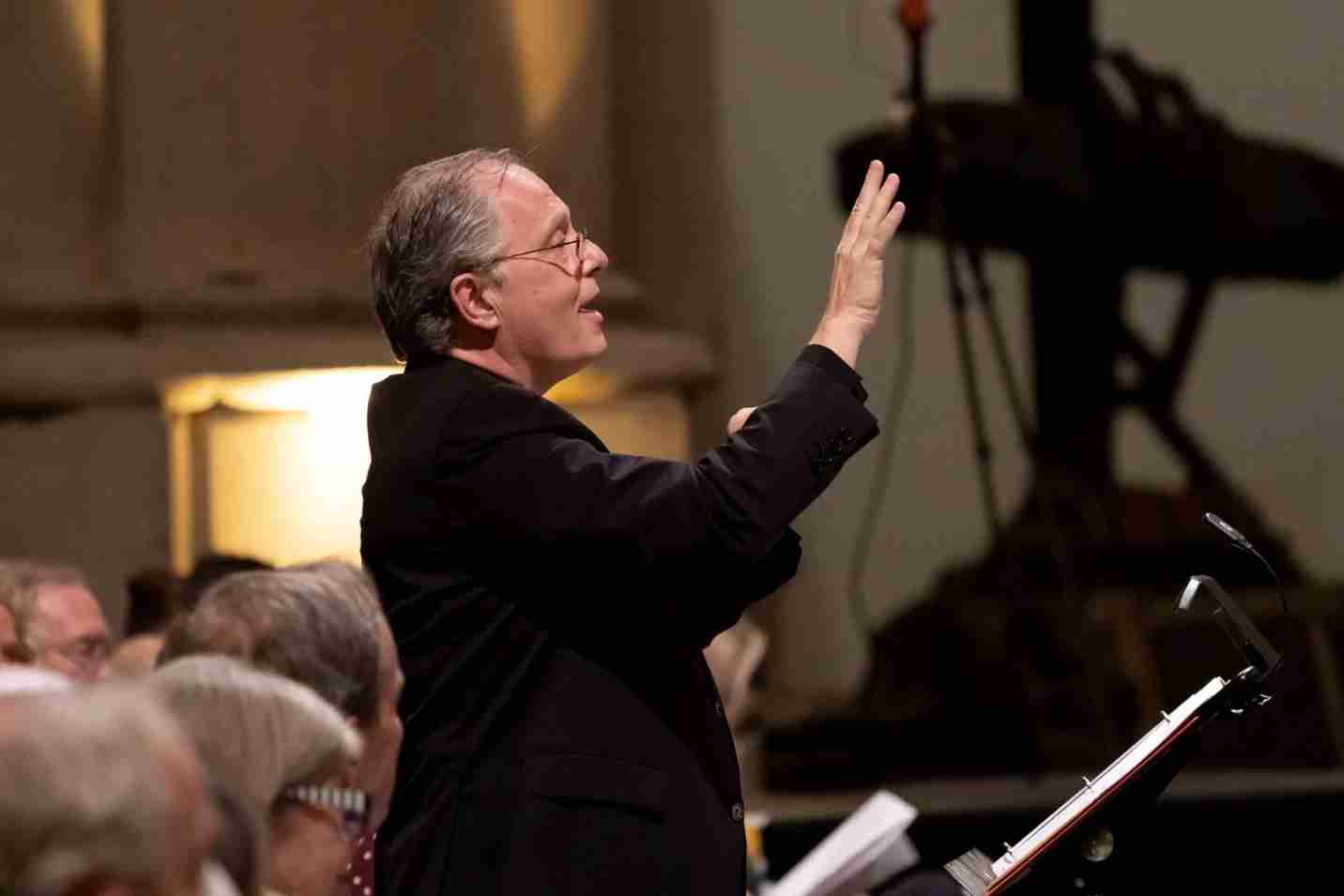
Founded in 1964 by Richard Westenburg, Musica Sacra has long set the standard for professional choral singing in New York, premiering works by Copland, Britten, Brubeck, and Persichetti, and lending its voices to the New York Philharmonic and New York City Ballet. Since 2008, Tritle has broadened that legacy from medieval chant to world premieres, driven by tireless artistic curiosity. Simultaneously Director of Cathedral Music at St. John the Divine, Music Director of the Oratorio Society of New York, organist of the New York Philharmonic, and a member of the Juilliard faculty, he conducts with exactness, economy, and expressive warmth, coaxing from his singers immaculate blend, pristine diction, dynamic nuance, and, when the music demands it, genuine dramatic fire.
A Sublime Evening Worth Remembering
Listening, I found myself recalling other choral jewels: Randall Thompson’s Alleluia, with its slow-gathering ardor, or Palestrina’s Sicut cervus, the soul as a deer longing for living water. Tonight’s music belongs in that company. Aided by Anna Lenti’s informed program notes and complete translations, SurRound: The Earth Remembers was a personal, spiritual, and artistic experience of rare grace: proof that a planet, a cathedral, and a chorus can, for one hour, share a single heartbeat
Organizations, Tickets, and Support
Musica Sacra
- O. Box 974, Lenox Hill Station, New York, NY 10021
- Ticket Hotline: 862.352.9509 · info@musicasacrany.com
- Musica Sacra 2026–27 season tickets
- Contribute to Musica Sacra
The Cathedral Church of Saint John the Divine
- 1047 Amsterdam Avenue at 112th Street, New York, NY 10025
- 212.316.7490 · stjohndivine.org
Program
- Splendor & Interconnection: Now I walk in beauty (Gregg Smith); Astronaut Anthem (Meredith Monk); Sancti Dei omnes (Jean Mouton)
- Lament & Fracture: Infinite Oceans (Robert Paterson); Prière de la Baleine (Christina Whitten Thomas); Die Erste Elegie (Einojuhani Rautavaara), Zen Wu and Elizabeth van Os, sopranos
- Reconciliation & Renewal: Earth Song (Frank Ticheli); and the swallow (Caroline Shaw); A Song on the End of the World (Robert Paterson), Linda Jones, soprano, Kirsten Sollek, alto, John Kawa, tenor; Take Peace (Christina Whitten Thomas); Hanacpachap cussicuinin (Juan Pérez Bocanegra)
- Musica Sacra Chorus, Kent Tritle, Music Director · Margery Daley, Choral Contractor · Program notes by Anna Lenti