Outside, the thermometer had plunged to single digits—the kind of merciless February evening that sends even the heartiest New Yorkers retreating to their radiators. Nevertheless, those who braved the arctic chill and made their way to the DiMenna Center for Classical Music on West 37th Street were rewarded with something far warmer than any furnace could provide. The Park Avenue Chamber Symphony (PACS), under the baton of its visionary Music Director David Bernard, presented “Sublime Schubert,” a program of staggering beauty and intellectual depth that transformed the hall into a sanctuary of tonal radiance and communal warmth. Indeed, by the time the first pianissimo tremolo of the Unfinished Symphony sparkled through the room, every last shiver had been replaced by a quiet, collective gasp of wonder.
Active Inhabitants of the Orchestral Soundscape
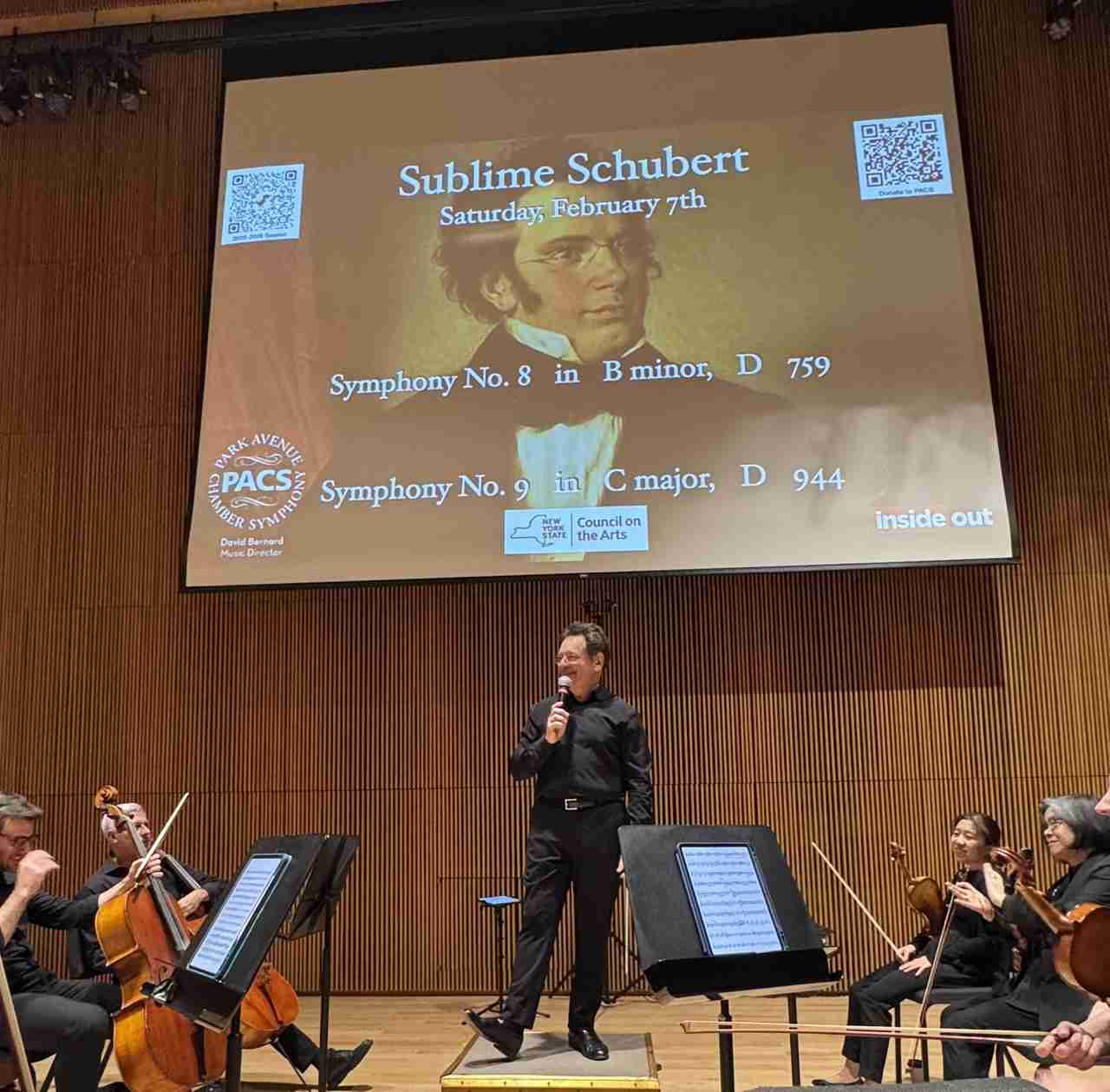
Maestro Bernard, with his characteristic geniality and pedagogical flair, opened the evening with warm welcomes and introductions, setting the stage for what would prove to be an extraordinary immersive experience. Moreover, his remarks served as a gentle overture of their own—contextualizing the music, illuminating the genius of Franz Schubert, and, most importantly, inviting the audience to participate not merely as passive listeners but as active inhabitants of the orchestral soundscape. Clearly, the truest engagement with music demands not distance but proximity—and proximity, in every conceivable sense, was precisely what this evening delivered.
Inside the Sound: The InsideOut Concert Experience as the Ultimate Quadraphonic Journey
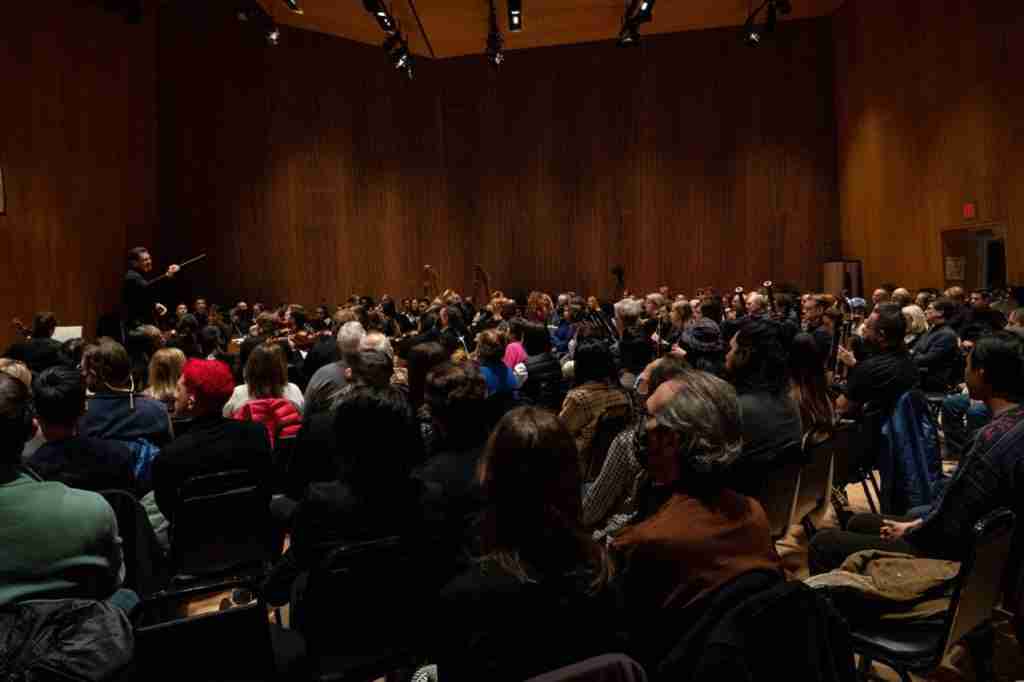
What distinguishes a PACS concert from virtually any other orchestral event in New York City is the patented InsideOut Concerts® format, pioneered and perfected by Bernard himself. Rather than the conventional proscenium arrangement—with its implicit barrier between performer and listener—the InsideOut model disperses the audience among the musicians of a 100-plus-member orchestra. The result is nothing less than the ultimate quadraphonic stereo experience, a total immersion in orchestral polyphony that renders even the finest home audio system a pale imitation. Consequently, every fortissimo is visceral, every pianissimo intimate, and every harmonic overtone palpable as it travels through the air and, quite literally, through your body.
Music Education and Musical Rapture Need Not Be Adversaries
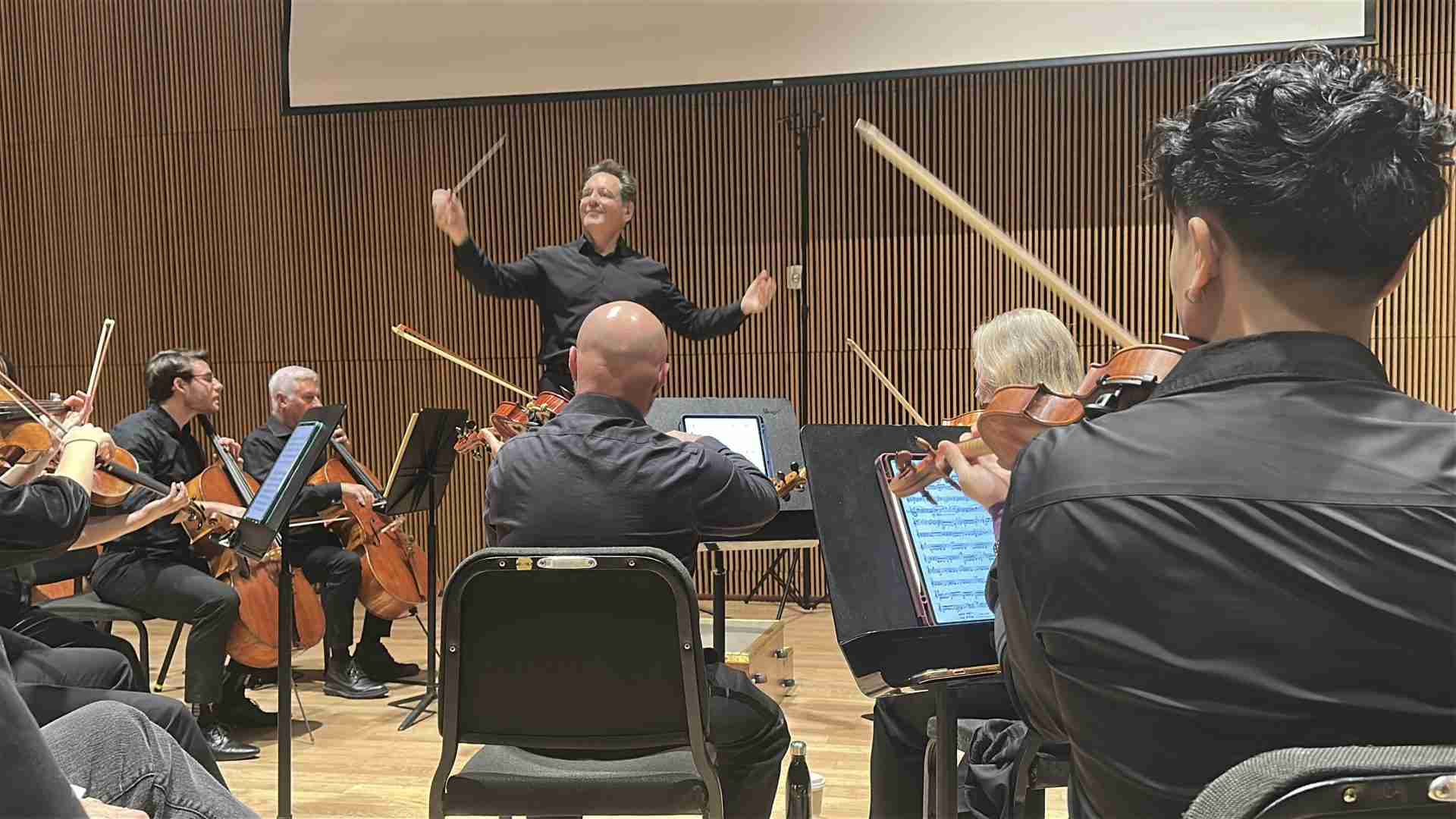
Bernard encouraged audience members to look around throughout the concert, take photographs, and observe the musicianship unfolding in every direction. Furthermore, he invited individual sections of the orchestra to hold up their instruments for identification. To illuminate key passages, the orchestra performed brief excerpts. This revelatory approach—part master class, part theatrical experience, part sacred ritual—recalls what Leonard Bernstein championed in his legendary Young People’s Concerts: the conviction that music education and musical rapture need not be adversaries but can, in fact, be exquisite allies. Just as cinema devised IMAX to intensify its art form, and theater devised site-specific productions to dissolve the fourth wall, so InsideOut stands as classical music’s answer—its own revolution of intimacy and immersion.
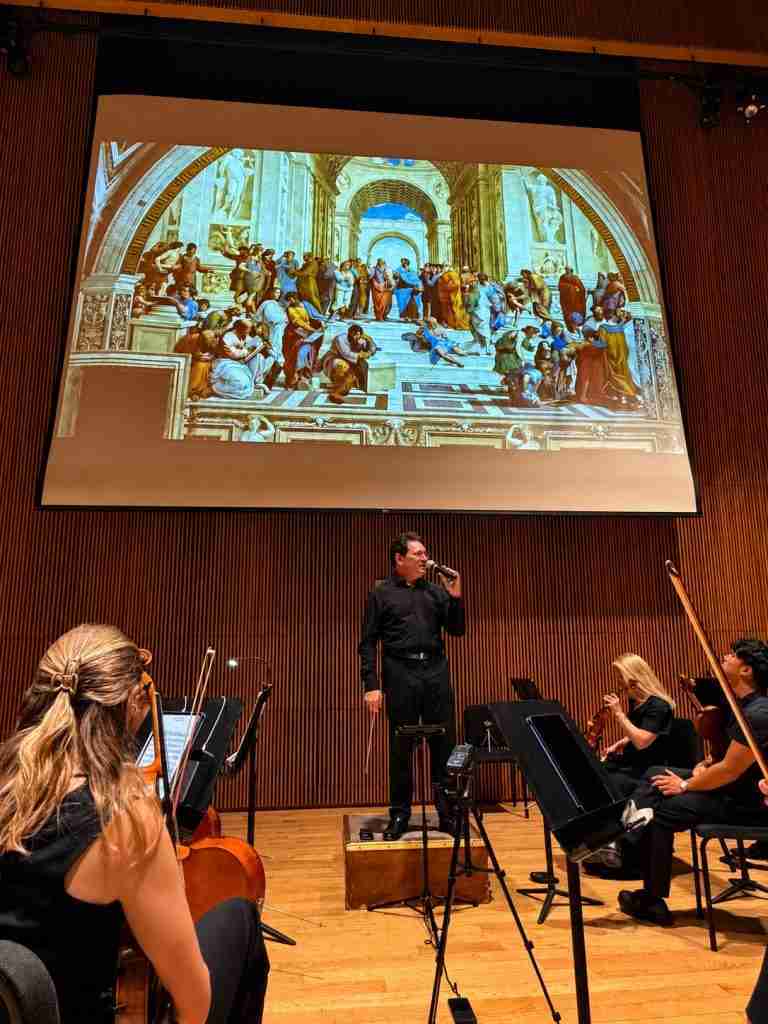
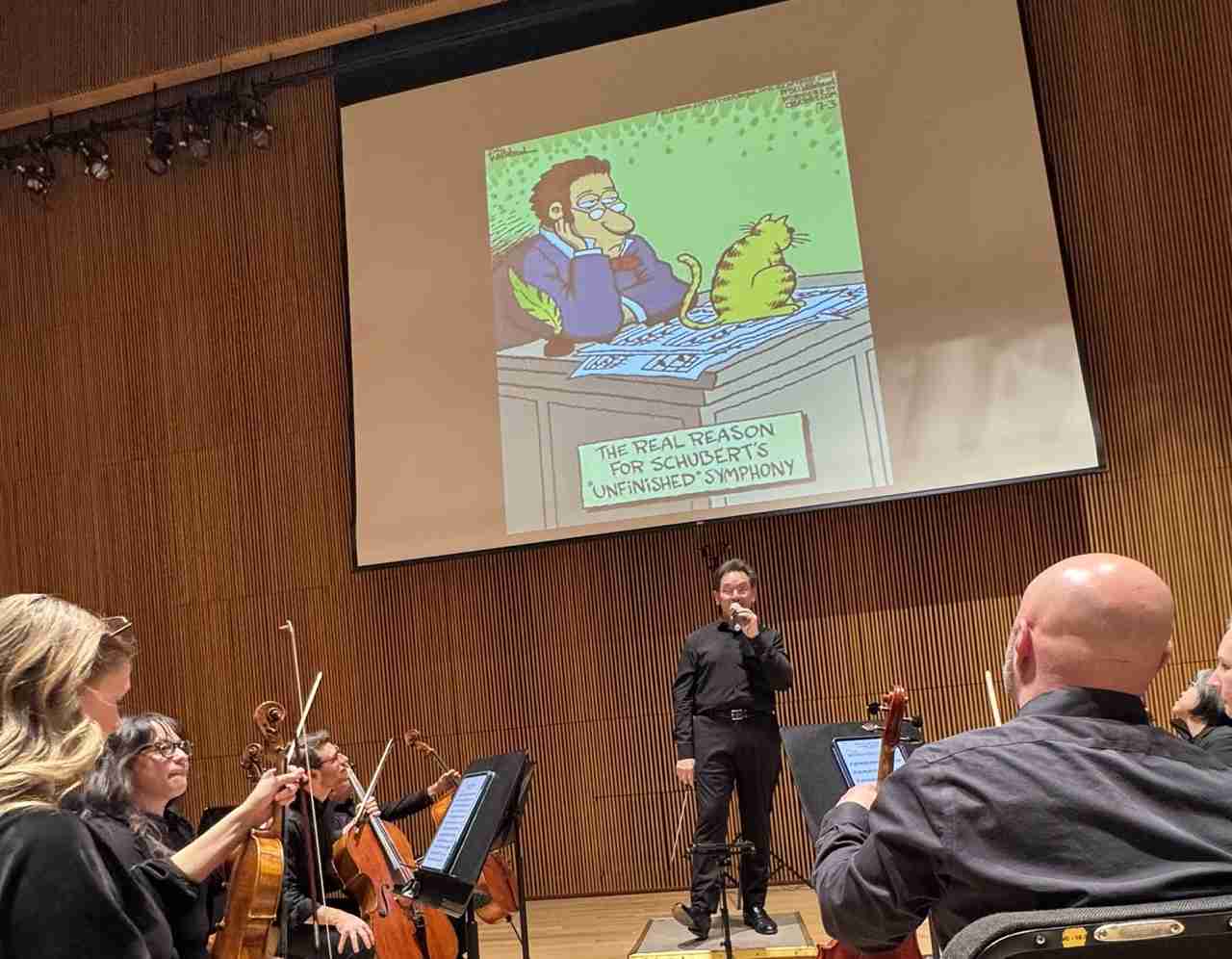
Additionally, Maestro Bernard enriched the immersive tapestry with yet another sensory dimension: a large projection screen displaying evocative scenes, historical imagery, and contextual text throughout the performance. This visual counterpoint served as a luminous companion to the orchestral narrative, offering audiences biographical vignettes of Schubert’s world, structural annotations illuminating thematic development, and atmospheric imagery that deepened the emotional resonance of each movement. Far from distracting, these projections functioned as a kind of visual programme note — a silent docent guiding the eye while the ear remained enraptured. The effect was holistic and transporting, transforming the concert into a genuinely multisensory experience that honored both the intellect and the imagination.
Unwavering Devotion to Craft
One of the most arresting aspects of sitting within the orchestra is the opportunity to watch the faces of both musicians and fellow audience members. The musicians, generally appearing dispassionate on the surface, are in truth burning with intense concentration, particularly during the more technically demanding passages. Yet when the music alights into a tender, Romantic venture—a lyrical second theme, a sighing appoggiatura—some musicians gently smile, a quiet acknowledgment of beauty passing through their hands and breath. The audience members, by contrast, are openly expressive, their faces registering wonder, contemplation, and at times a kind of luminous melancholy that only Schubert can provoke. It takes thousands of hours of preparation and an unwavering devotion to craft to perform orchestral music at this level, and those hours were manifest in every phrase the PACS delivered this evening.
A Young Man’s Torso, Perfectly Formed: The Symphony No. 8 in B Minor (“Unfinished”)
The evening began with Schubert’s Symphony No. 8 in B Minor, the celebrated “Unfinished,” and here Bernard made a decision both generous and symbolically resonant. He honored this work—written by a young man overflowing with melodic invention—by placing it in the hands of another young man: his son, James Bernard, who served as guest conductor for the performance. It was a gesture at once paternal and artistic, a passing of the baton (literally) mirroring the essential spirit of Schubertian fellowship and mentorship.

Thematic Metamorphosis
Before the downbeat, Maestro David Bernard offered illuminating commentary on Schubert’s compositional process. He demonstrated how the melodic and harmonic material from the symphony’s haunting opening theme—that unforgettable pianissimo introduction in the cellos and basses, followed by the sighing oboe-and-clarinet duet—served as the generative seed from which Schubert constructed the entire work. This process of thematic metamorphosis, a hallmark of the Classical-Romantic bridge, was rendered even more vivid when sections of the orchestra performed the germinal motif in isolation, allowing the audience to hear the symphony’s DNA before experiencing it in full orchestral bloom.
Luminous Orchestration
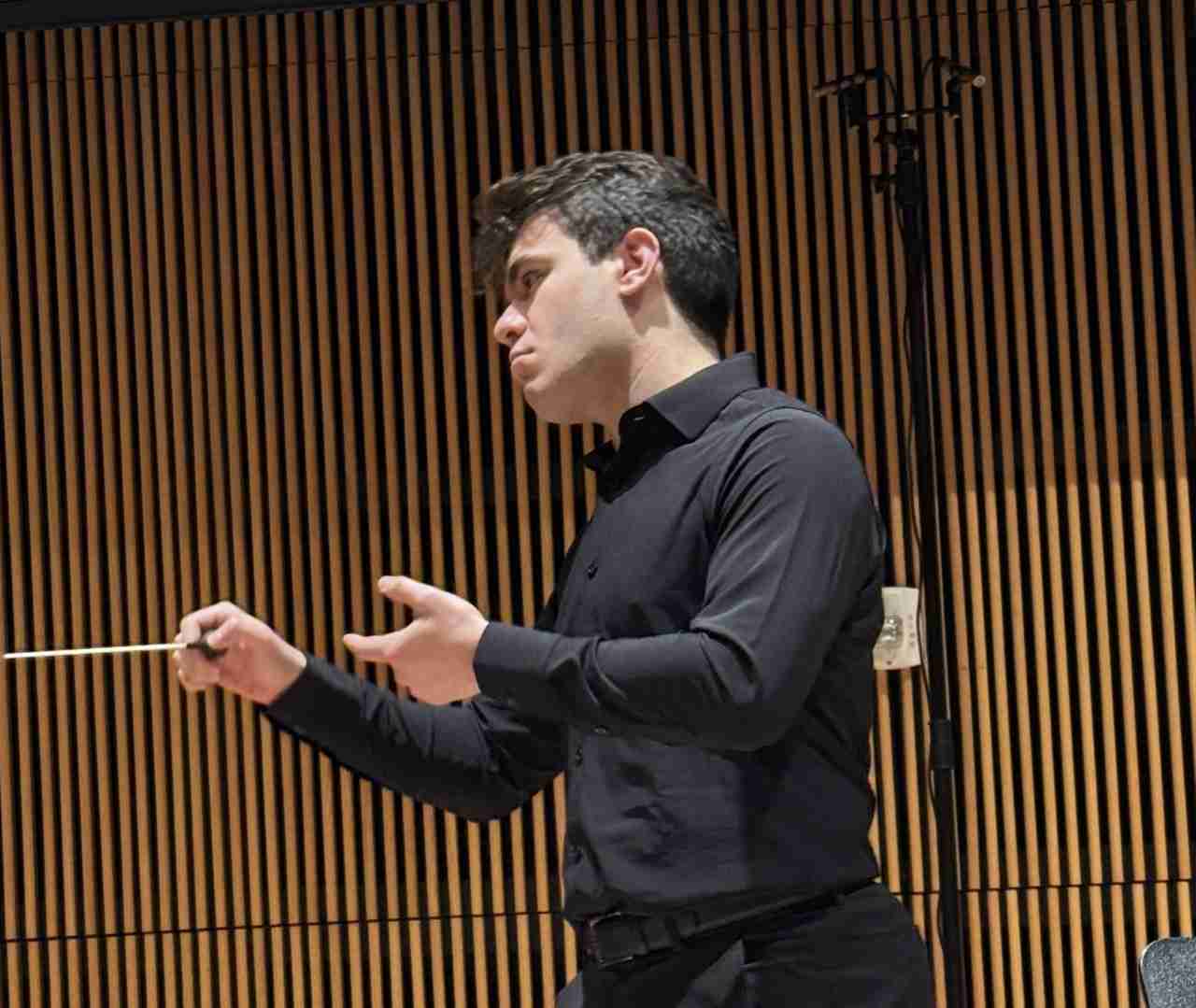
James Bernard took the podium with the aplomb of a conductor far beyond his years. His cues were clear and confident; his expression was articulate; his command of dynamics and articulation conveyed the kind of gestural authority that elicited an immediate, musical response from the players. The Allegro moderato first movement unfolded with a brooding tensile strength—the low strings providing a subterranean rumble. At the same time, the woodwinds sang their plaintive cantilena above, a dialogue of shadow and light that Schubert managed with an emotional directness that anticipates the Romantic era’s full flowering. The Andante con moto second movement, meanwhile, arrived like a consolation—its long-breathed melodies and luminous orchestration bathing the room in a glow of serene melancholy.
Rich Orchestral Sonority and Virtuosic Command
David Bernard also noted the poignant historical context: Schubert never heard these works performed live. In his era, orchestral resources were scarce and expensive, and it was Beethoven—towering in reputation and influence—who commanded the forces necessary for premieres of large-scale works. Consequently, Schubert composed in a kind of magnificent isolation, and Bernard opined that this solitude may have emboldened the composer to write passages of exceptional difficulty—passages that only the most accomplished orchestras could realize. It is a bittersweet irony that the PACS, with their inimitable rich orchestral sonority and virtuosic command, were now bringing these works to vibrant, breathing life in exactly the manner Schubert himself never experienced.
Heavenly Length and Earthly Triumph: The Symphony No. 9 in C Major (“The Great”)
Before launching into the second half of the program, David Bernard returned to the podium to share additional insights into Schubert’s life and creative world. He spoke movingly of the Schubertiads—those intimate salon gatherings where the composer and his small circle of devoted admirers made music, recited poetry, and nourished one another’s artistic spirits. These evenings, Bernard explained, were the crucible in which much of Schubert’s chamber music was forged, and they offer an indispensable window into the mind of a composer who died at the devastating age of thirty-one, leaving behind a catalogue of over a thousand works of breathtaking lyrical beauty. As the great critic Harold C. Schonberg once observed in his magisterial survey of the great composers, Schubert possessed an inexhaustible melodic gift that seemed to flow as naturally and continuously as a mountain stream—and the “Great” C Major Symphony represents that stream at full flood.
A Thematic Wellspring
The Symphony No. 9 in C Major is, by any reckoning, a monumental work—Schubert’s capstone orchestral achievement, a composition of what Robert Schumann famously described as “heavenly length.” Bernard introduced the work by having the orchestra perform the celebrated opening horn theme once again, that noble, arching melody that serves as the thematic wellspring for the entire four-movement edifice. This holistic programming approach—showing the audience the architectural blueprint before unveiling the completed cathedral—gave the performance an extraordinary sense of narrative coherence and intellectual transparency.
A Marvel of Sustained Lyricism
And then the symphony began in earnest, and it was magnificent. David Bernard’s conducting was its usual expressive, precise, and deeply artistic self—a masterclass in orchestral leadership. His rubato was judicious, his accelerandi thrilling, his pianissimi gossamer-thin and achingly beautiful. The first movement’s sonata-form exposition unfolded with grandeur and rhythmic vitality; the Andante con moto second movement was a marvel of sustained lyricism, with the oboe soloists and the strings trading phrases of devastating tenderness; the scherzo blazed with rustic energy and contrapuntal wit; and the finale—that titanic, surging Allegro vivace—built to a peroration of genuine orchestral triumph.
Richly Burnished Sonority
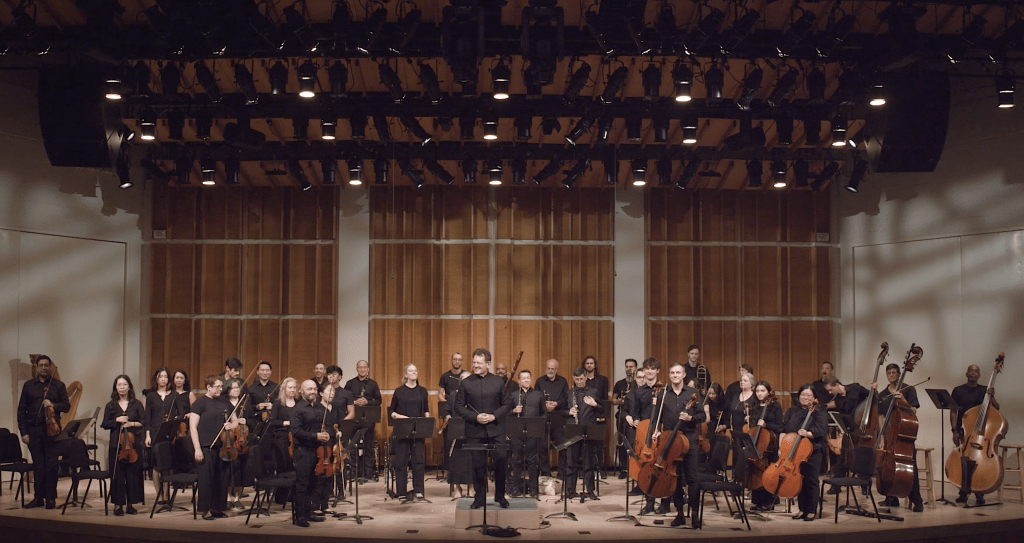
Throughout this demanding work, the PACS musicians prevailed with remarkable aplomb. The woodwind section displayed impeccable intonation and a singing legato. The brass, particularly in the horn passages that are the symphony’s lifeblood, projected with warmth and heroic resonance. The strings—from the shimmering tremolandi of the first violins to the muscular, propulsive eighth-note figures in the cellos and basses—delivered the kind of richly burnished sonority that has become a PACS hallmark. And the timpanist anchored the rhythmic foundations with precision and dramatic flair, particularly in the finale’s electrifying coda. Considering the symphony’s length and formidable technical demands, the orchestra’s sustained concentration and musical cohesion were nothing short of exemplary.
A Holistic Vision: Bernard’s Gift for Musical Storytelling
What elevates a PACS InsideOut Concert from mere performance to genuine artistic event is Maestro Bernard’s extraordinary gift for musical storytelling. His spoken commentary throughout the evening was never pedantic or gratuitous; rather, it was illuminating, engaging, and suffused with a palpable love for the music and a sincere desire to share it with everyone in the room. He described his goal as providing the audience with a “holistic” view of Schubert’s music. This approach encompassed not only the sonic experience of the works but also their biographical context, compositional architecture, and emotional depth.
Artist Conversations
This pedagogical generosity recalls the great tradition of musical lecturing that stretches from the 92nd Street Y’s legendary programming—an institution whose decades of pre-concert talks, master classes, and artist conversations have done immeasurable service to music education in New York—to Bernstein’s televised explorations of symphonic form. And now, with its steadfast mission to enrich communal life through the arts, the PACS exemplifies the belief that great music thrives when it is not cloistered but shared, not merely performed but explained, contextualized, and brought into dialogue with its listeners’ lives. Bernard’s InsideOut Concerts operate in precisely this spirit, and the results—judging by the rapt attention and audible delight of this evening’s audience—speak for themselves.
The DiMenna Center: A Jewel Box for Immersive Music-Making
A word must be said about the venue itself. The DiMenna Center for Classical Music, located at 450 West 37th Street in the heart of Hell’s Kitchen, is New York City’s only acoustically optimized space dedicated exclusively to classical music rehearsal, recording, and performance. Opened in 2011 as the permanent home of the Orchestra of St. Luke’s, the Center has since welcomed more than 100,000 visitors and over 400 ensembles. Its warm, resonant acoustics and flexible seating configurations make it an ideal home for the InsideOut format, and the space’s intimacy ensures that every nuance of the orchestra’s playing registers with clarity and emotional impact.
Schubert’s Eternal Song: Why This Music Still Matters
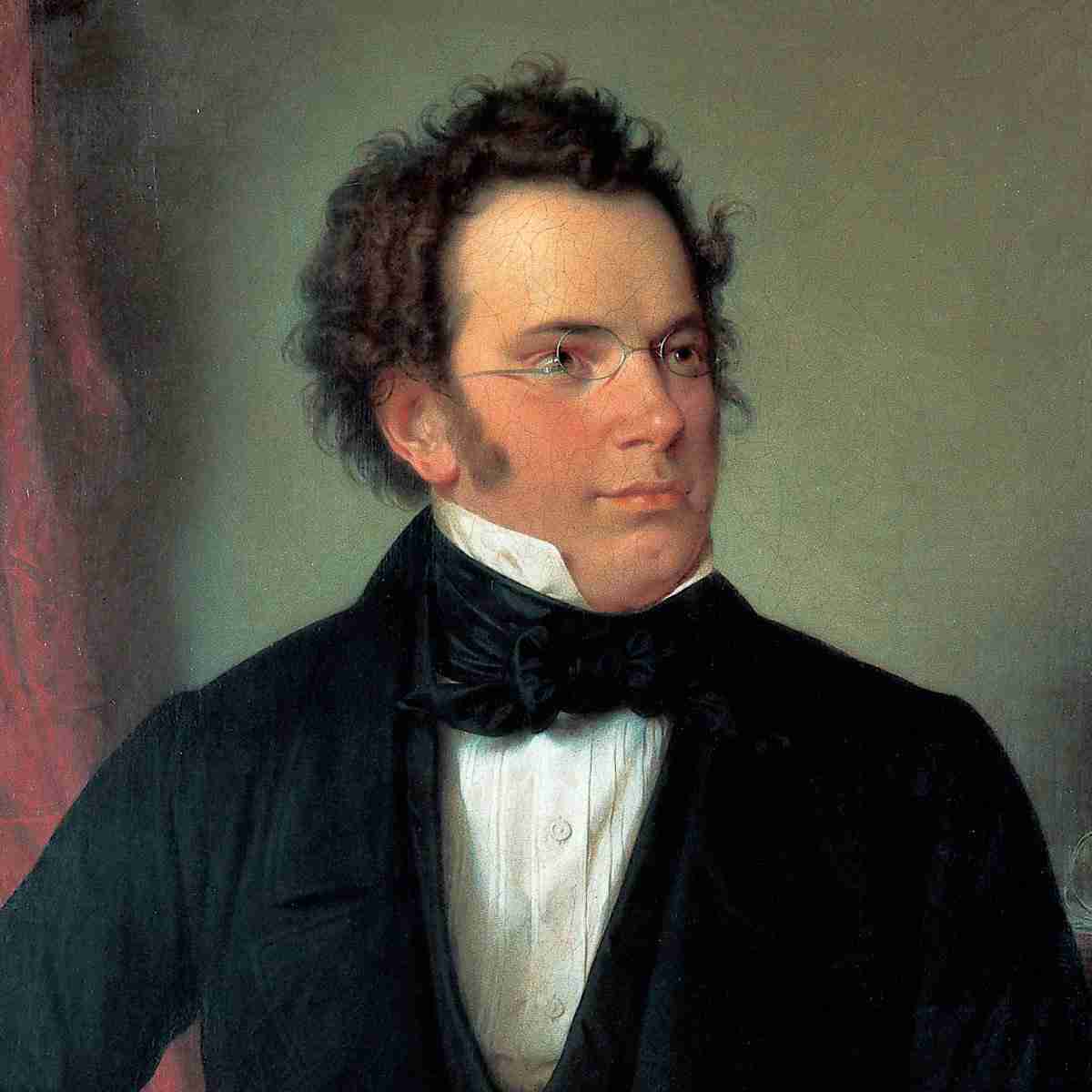
Franz Schubert, who died in 1828 at the age of thirty-one, left behind a body of work of astonishing breadth and emotional depth—over six hundred songs, numerous chamber works, piano sonatas, masses, operas, and nine symphonies. He was, as Schumann recognized with prophetic clarity when he unearthed the “Great” C Major Symphony in 1839, a composer whose music bore within it “the core of everlasting youth.” It took roughly four decades after Schubert’s death for the world to recognize his full genius, and his influence ultimately rippled through the work of Brahms, Dvořák, Bruckner, and Mahler. If he was not the first of the Romantics—that distinction belongs more properly to Weber—he was, in the words of the great critics, the first lyric poet of music, a designation that rings truer with every passing generation.
As Inevitable as Birdsong at Dawn
There is in Schubert’s music a quality of interior luminescence—a way of catching the fleeting impressions of consciousness and fixing them in sound that is akin to the stream-of-consciousness technique in literature. His melodies arrive not as constructed things but as natural phenomena, as inevitable as birdsong at dawn, and yet they carry within them a piercing awareness of transience that gives them their peculiar, aching beauty. To sit inside the orchestra and feel these melodies pass through you—through the vibration of nearby strings, the breath of a neighboring oboist, the resonance of a French horn bell pointed directly at you—is to experience Schubert’s music in the most intimate and revelatory way possible. It is, in a word, transformative.
An Invitation to Experience Music Anew
This was, from first note to last, an evening of solid musicianship and inspired artistry, replete with the PACS’s inimitable rich orchestral sound. Maestro David Bernard, commanding and eloquent at the helm, demonstrated once again why he has been called “the Johnny Appleseed of Classical Music”—a champion and evangelist for an art form that too many have written off as inaccessible or irrelevant. James Bernard, stepping confidently into the spotlight, proved himself a conductor of genuine promise and musical sensitivity. And the men and women of the Park Avenue Chamber Symphony played with the kind of devotion, precision, and heartfelt expression that honors not only the composer but the art of music itself.
Single-Composer Deep Dives
If you have not yet experienced an InsideOut Concert, do not wait. The PACS’s 2025–2026 season, “Immersions and Explorations,” promises more evenings of this caliber—programs built around single-composer deep dives that draw audiences into broader, deeper perspectives on the masterworks. Classical music, at its best, is not a museum piece but a living, breathing, communal act of beauty and meaning. The Park Avenue Chamber Symphony, under David Bernard’s inspired leadership, proves this truth anew with every performance.

Sublime Schubert: A Radiant Immersive Masterclass by the Park Avenue Chamber Symphony
About the Park Avenue Chamber Symphony
David Bernard, Music Director and Conductor
Website: chambersymphony.com
Email: info@chambersymphony.com
Performance Venue: DiMenna Center for Classical Music, 450 West 37th Street, New York, NY 10018
Tickets for the 2025–2026 Season: Purchase Tickets on Eventbrite
Donate to the PACS: Make a Tax-Deductible Donation
Upcoming Concerts: View the Full 2025–2026 Season Schedule
The Park Avenue Chamber Symphony is a 501(c)(3) nonprofit organization. All donations are tax-deductible to the extent permitted by law. PACS events are made possible in part by public funds from the New York State Council on the Arts, with the support of the Office of the Governor and the New York State Legislature, and by private funds from generous individuals.