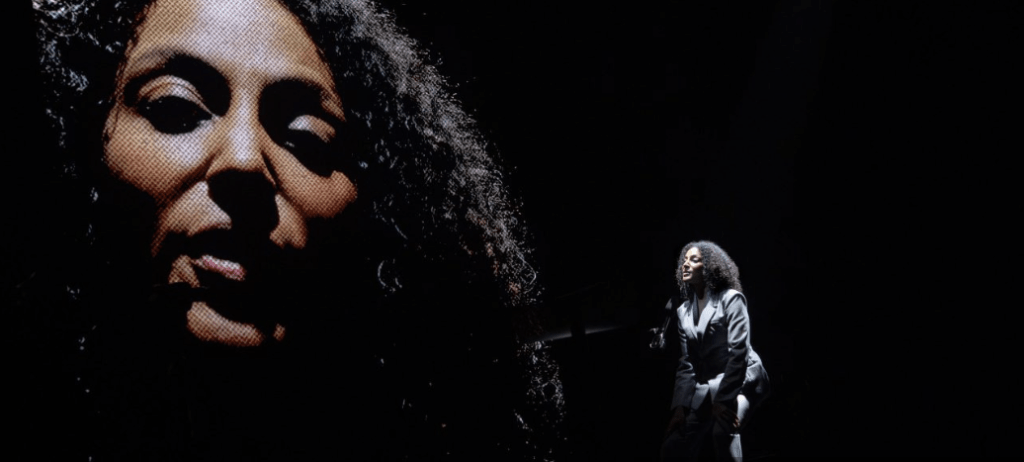
When memory becomes theatre, we discover Patricia Lynn’s audacious reimagining of the Dracula Myth in a meta-theatrical investigation.
A Critical Examination of Truth, Testimony, and Theatrical Transformation
In the hallowed tradition of theatrical innovation that has marked A.R.T./New York’s commitment to provocative dramaturgy, Patricia Lynn’s The Truth About Transylvania emerges as an extraordinary work of ambition and intellectual rigor. Under the astute direction of Jacob Titus, this world premiere at the Mezzanine Theatre achieves what few contemporary works dare attempt: a complete reconceptualization of the vampire myth through the lens of feminist epistemology and postmodern theatrical form.
As the audience settled in, they were wrapped in tone-setting music like “Paint it Black,” performed by Ciara, and “Bela Lugosi is Dead”, by CHVFCHES.
Lynn, who describes herself as a gothic feminist playwright, aims to reclaim the traditionalist genre by writing contemporary Gothic plays that ask provocative questions about women and society today. This self-awareness manifests brilliantly in her latest work, which transforms Bram Stoker’s canonical text into a meta-theatrical investigation of truth, trauma, and the treacherous terrain of memory.

The Architecture of Disbelief: A Theatrical Conceit
The production’s central conceit—a livestreamed testimony in which Jonathan Harker and his wife, Millie Bell, attempt to prove Count Dracula’s existence—represents a masterstroke of contemporary relevance. Mark Weatherup Jr.’s portrayal of John Harker transcends mere character work; it becomes an excavation of masculine vulnerability rarely witnessed on the American stage. His opening gambit with the “Truth Chair”—a familial instrument of patriarchal interrogation—establishes the production’s central dialectic between inherited authority and experiential knowledge.
Weatherup’s performance champions the kind of psychological realism that transforms melodrama into a serious artistic endeavor, never sacrificing intellectual complexity for emotional effect. When John confesses his complicity in Dracula’s escape—”I let him walk away. And I knew what he would do. How many people he’d… And I didn’t care”—Weatherup delivers these lines with a devastating quietude that recalls the finest moments of naturalistic drama. Here is acting that serves the dual purpose of entertainment and enlightenment, drawing audiences into moral complexities while maintaining theatrical vitality.
The Feminist Reclamation: Millie Bell as Truth-Seeker
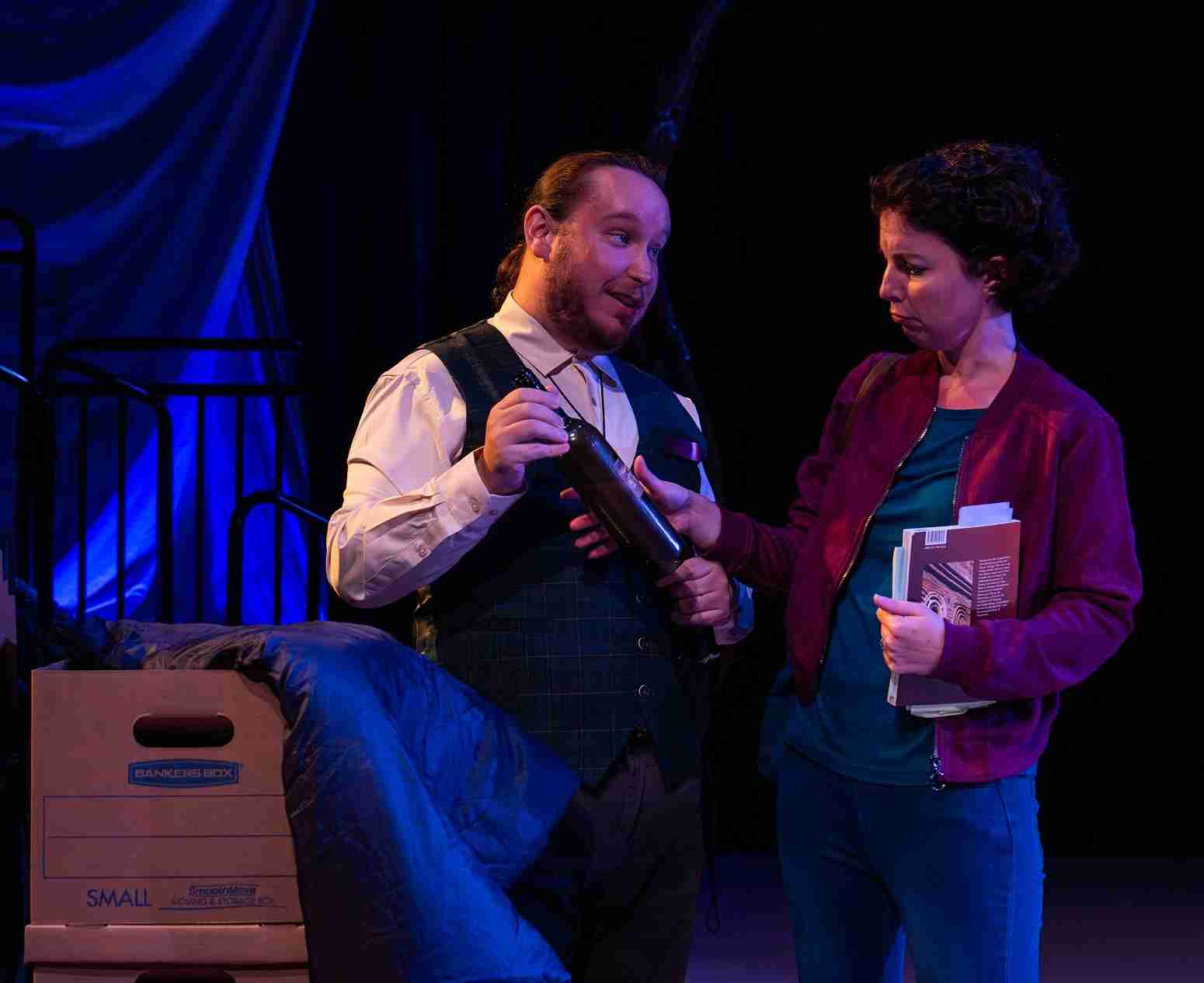
Patricia Lynn, performing her own creation as Millie Bell, embodies what might be termed the intellectual “life force” of the play. Her dual role as playwright-performer represents a theatrical audacity that recalls the tradition of artist-provocateurs who use the stage as a platform for both artistic expression and social commentary.
Lynn’s Millie is no mere victim awaiting rescue; she is an etymology-obsessed intellectual warrior, wielding language as both shield and weapon. Her monologue about childhood monsters and the dictionary—”I’d pick a word, any word. And I’d look up its etymology. I’d find its meaning. Which helped me find my meaning”—represents theatrical writing of the highest order. Furthermore, the character’s linguistic precision serves as a counterpoint to the epistemological uncertainty that pervades the narrative.
The play distinguishes itself by combining intellectual debate with theatrical entertainment. When Millie challenges the very premise of their testimonial enterprise—”Just because something feels real, feels true inside your head, your heart too, that doesn’t mean it’s the truth”—Lynn delivers a philosophical proposition that uses wit and dialectical reasoning to illuminate profound social questions while keeping audiences thoroughly engaged.
The Villain as Vaudevillian: Van Helsing Reimagined
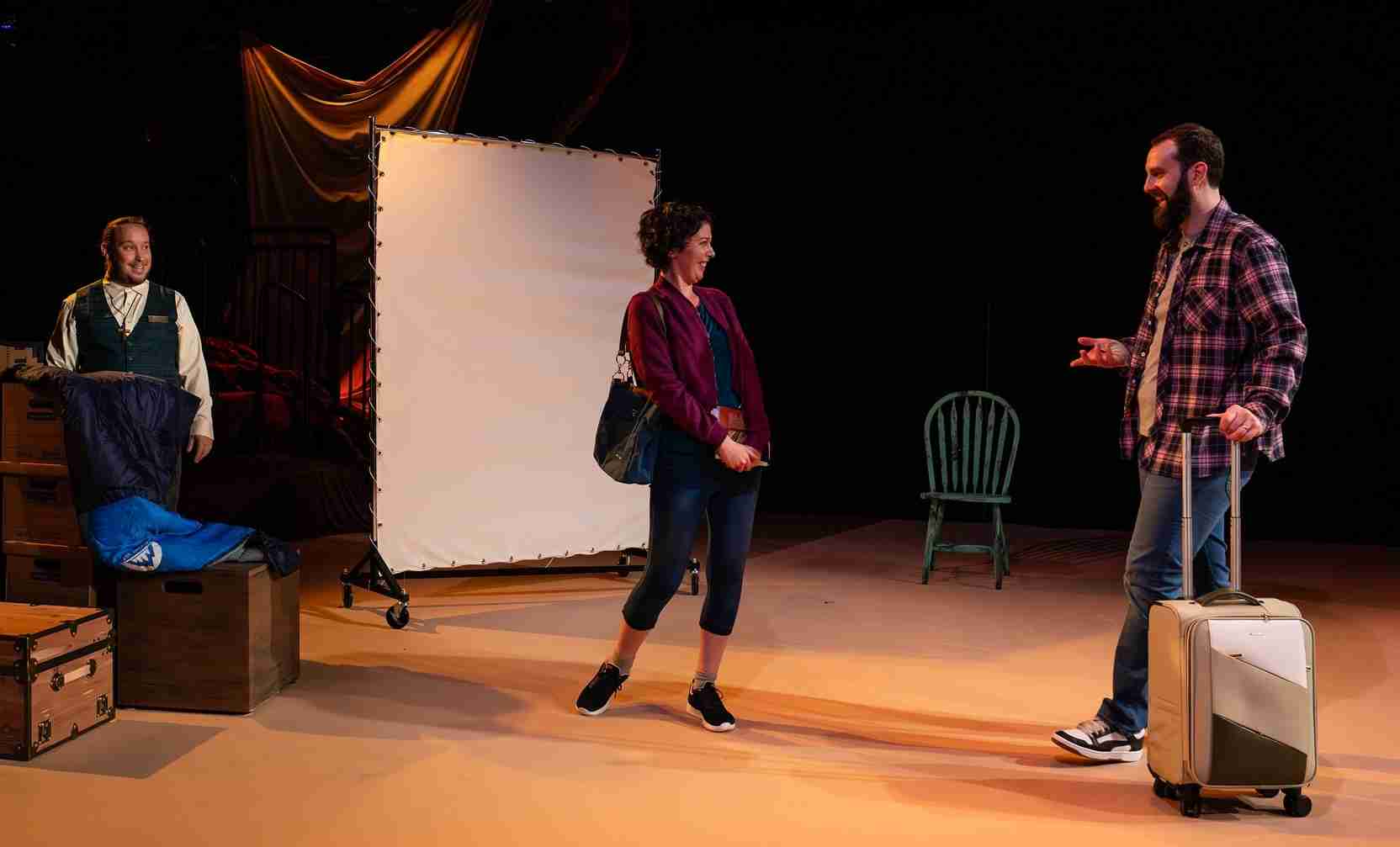
Miles Purinton’s interpretation of Van Helsing represents perhaps the production’s most radical departure from tradition. No longer the sage vampire hunter of Victorian lore, this Van Helsing emerges as a postmodern charlatan, a meta-theatrical manipulator whose repeated invocation of The Usual Suspects—”The greatest trick the devil pulled was convincing the world he did not exist”—becomes increasingly sinister with each iteration.
Moreover, Purinton navigates this complex characterization with remarkable dexterity, particularly in the climactic revelation scene where Van Helsing’s machinations are exposed. His delivery of the line “A man must do what a man must do, and if no one believes this man, he must go to extremes” carries echoes of Victorian masculinity’s destructive certainties, critiquing the very foundations of patriarchal authority with sardonic precision.
The Monster in Shadows: David Israeli’s Enigmatic Count
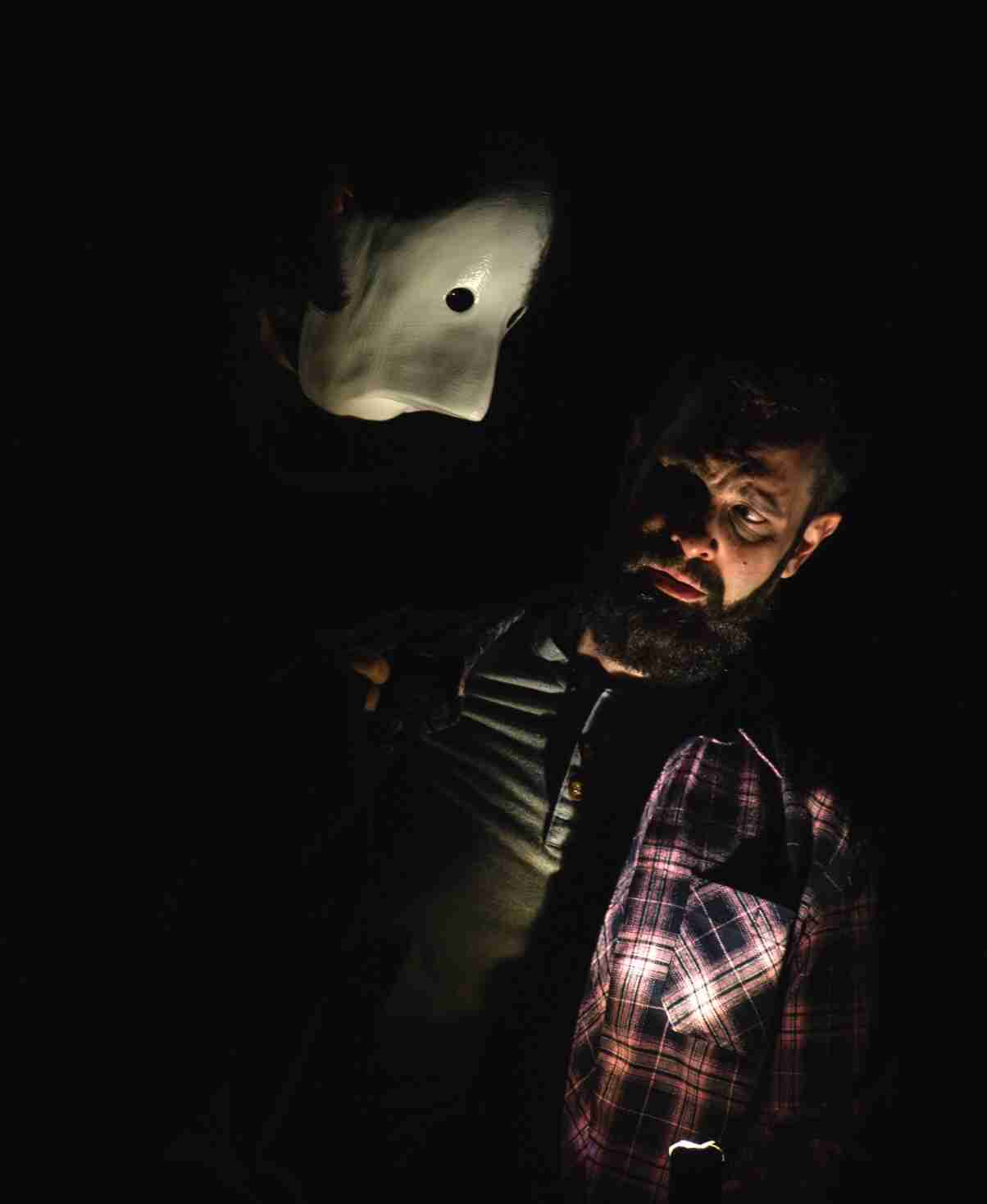
David Israeli’s Count Dracula presents a fascinating theatrical paradox: a presence felt most powerfully in absence. Israeli’s largely wordless performance relies on physicality and atmosphere, creating what might be termed a negative space around which the other characters orbit. Subsequently, his few verbal exchanges—delivered through an ingenious vocal displacement technique that echoes from all corners of the theater—transform simple greetings into ontological threats.
The scene where Dracula presents his “homework” to John—a melancholic essay about loving “the shadow, the shade”—provides Israeli with his most substantial dramatic moment. Consequently, the actor invests these simple words with centuries of existential weight, suggesting depths that the play’s meta-theatrical framework simultaneously reveals and conceals.
Technical Mastery in Service of Thematic Complexity
The production’s technical elements deserve particular commendation. Austin Boyle’s lighting design creates a chiaroscuro effect that would have delighted the Symbolists, while Randall Benichak’s sound design—particularly the recurring wolf howls that only certain characters can hear—adds layers of psychological uncertainty to an already complex narrative structure.
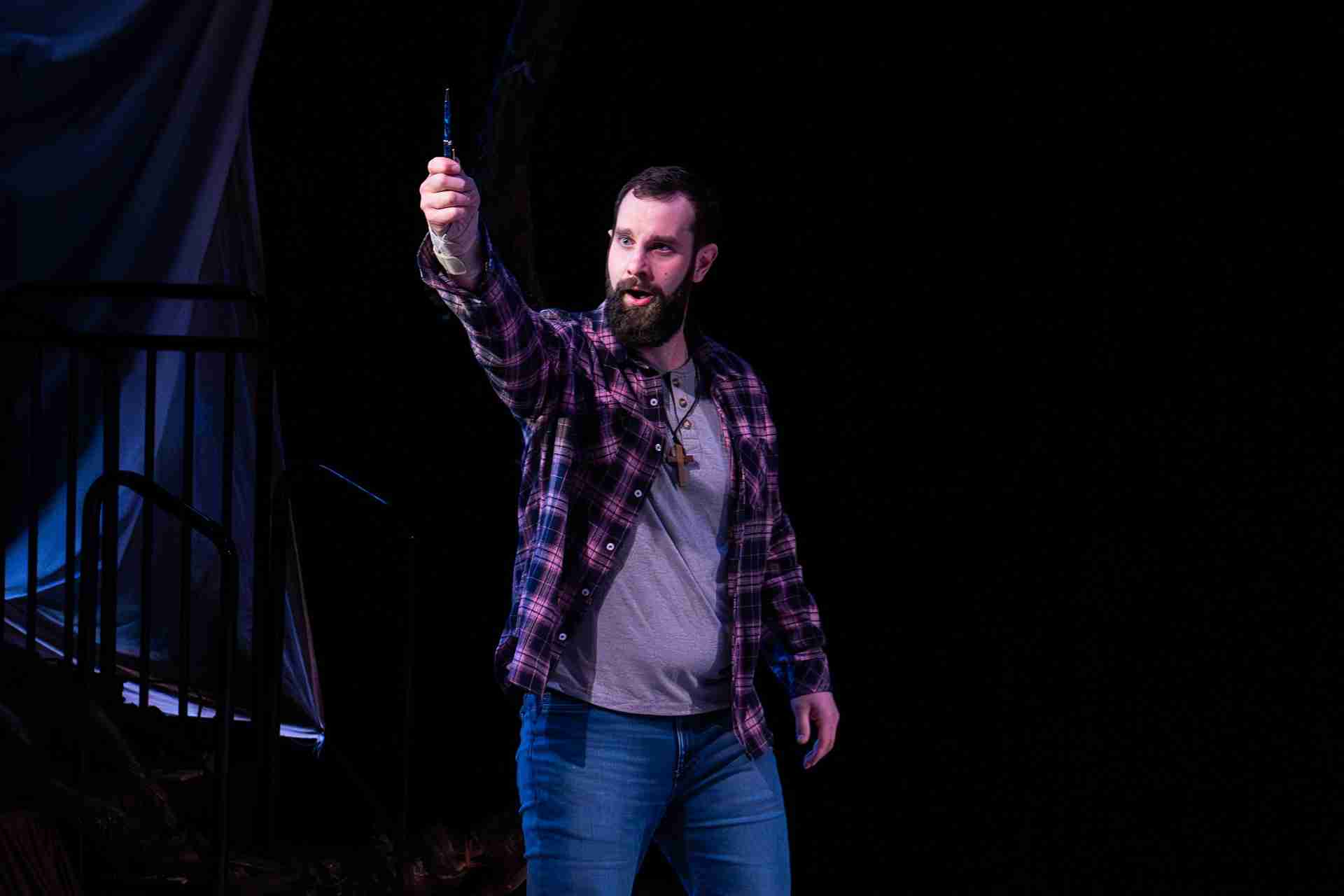
Additionally, Al Foote III’s fight choreography achieves a balletic violence that serves the play’s thematic concerns about complicity and action. The climactic double stabbing of Van Helsing—Millie with her stake, John with his pen—becomes a potent visual metaphor for the intersection of feminine agency and masculine tradition.
Stage manager Heather Olmstead orchestrates these elements with invisible precision, maintaining the production’s breakneck pace while allowing moments of genuine emotional resonance to breathe.
Philosophical Depths and Theatrical Heights
What elevates The Truth About Transylvania beyond mere clever deconstruction is Lynn’s genuine engagement with fundamental questions of epistemology and ethics. The play’s exploration of testimony, truth, and trauma resonates with contemporary concerns about narrative authority and believability, particularly in cases of gendered violence.
Lynn’s writing style, compared to the Brontë sisters’, creates stories of passion, love, and morality that carry the realism of our time while remaining ageless. This Gothic sensibility, filtered through a distinctly 21st-century consciousness, produces moments of startling theatrical power.
Furthermore, the production exemplifies how contemporary theater can transform from mere entertainment into a serious artistic and intellectual endeavor, addressing social consciousness through clever language and wit while educating, challenging, and enlightening audiences. The play’s treatment of the vampire myth as a metaphor for patriarchal violence and gaslighting achieves this dual purpose brilliantly. Yet Lynn never allows didacticism to overwhelm dramatic necessity; the play remains, at its core, a gripping theatrical experience.
Illustration de Pierre Falké. Public domain, via Wikimedia Commons
Contemporary Resonance and Classical Structure
The genius of Lynn’s construction lies in its simultaneous embrace and subversion of classical dramatic unities. While the action unfolds in real time during a single livestream session, the narrative spirals across multiple temporal planes—from the couple’s traumatic vacation in Romania to John’s imprisonment in Castle Dracula, from childhood memories to present-day reckonings.
This temporal fluidity serves the play’s central investigation of memory’s reliability. When John admits he cannot remember how he escaped the castle or returned to Millie, the admission becomes more than a plot device—it transforms into a meditation on trauma’s effect on narrative coherence. Subsequently, the audience must grapple with the same uncertainties that plague the characters: What constitutes proof? Whose testimony carries authority? Can truth exist independent of belief?
The production operates on the principle that theater should present ideas through dramatic conflict rather than clear moral absolutes. The villain proves as conscientious as the hero, if not more so, raising the essential question of which character truly represents good or evil. This moral complexity, presented through sophisticated dialogue and intellectual rigor, marks the work as belonging to the tradition of serious modern drama.
The Language of Modern Gothic
Lynn’s dialogue achieves that rare theatrical alchemy where intellectual sophistication meets emotional authenticity. Characters speak with grammatical diversity and varied accents, reflecting the many ways we navigate the English language. The text possesses an almost musical quality—a joyousness in language that elevates even the darkest moments with linguistic playfulness.
Consider John’s confession about his father: “He invited Millie over. Sat her down in that stupid Truth Chair of his. Cross-examined her like she was a hostile witness.” The colloquial “stupid” colliding with the formal legal terminology creates a linguistic tension that mirrors the character’s psychological state. This attention to vocal texture and rhythm transforms exposition into an aria, argument into a duet.
A Testament to Off-Broadway’s Vitality
The production exemplifies the vital role that Off-Broadway continues to play in American theater. Unencumbered by commercial pressures that might demand a more conventional treatment of the Dracula myth, A.R.T./New York Theatres has provided Lynn and her collaborators the freedom to experiment, to provoke, and ultimately to triumph.
A.R.T./New York, established in 1972, has served as an indispensable cornerstone for not-for-profit theatre, supporting organizations from playwriting collectives to pioneering independent artists Art-newyorkArt-newyork. This production stands as proof of that mission’s ongoing relevance.
The intimate black-box space proves perfect for the production’s needs, creating a claustrophobic atmosphere that serves both the livestream conceit and the Gothic atmosphere. The audience becomes complicit witnesses, our proximity to the action eliminating the comfortable distance that traditional proscenium staging might provide.
Minor Reservations in a Major Achievement
If there are weaknesses in this otherwise exemplary production, they lie in occasional moments of meta-theatrical excess. The repeated references to livestreaming and social media, while thematically relevant, occasionally risk dating the material. Additionally, the play’s 90-minute runtime, while admirably economical, might benefit from slight expansion to allow specific philosophical arguments more breathing room.
Nevertheless, these are minor blemishes on what is fundamentally a work of theatrical excellence. Lynn has created a play that satisfies on multiple levels: as a Gothic thriller, a feminist manifesto, a philosophical inquiry, and pure theatrical entertainment. The work never loses sight of the theater’s dual obligation to instruct and delight, maintaining dramatic momentum even as it explores complex intellectual territory.

Necessary for Our Times
The Truth About Transylvania stands as essential viewing for anyone invested in the future of American theater. The production’s partnership with the New York Blood Center for the October 29 performance adds a layer of civic engagement, transforming theatrical attendance into literal life-saving action—a gesture toward theater’s potential for genuine social impact.
In an era when truth itself has become contested terrain, Lynn’s play offers not answers but better questions. Moreover, it reminds us of that theater, at its finest, remains our most vital forum for collective interrogation of our deepest fears and most troubling certainties. The production asks us to consider not merely whether vampires exist, but what it means to believe, to testify, and to trust in an age of radical uncertainty.
As the lights fade on the ambiguous final tableau—a laugh echoing in darkness, a presence stepping into the room—we are left not with resolution but with productive disquiet. This is theater that follows you home, that whispers in the darkness, that makes you question the very ground beneath your feet. In other words, this is precisely the theater we need: provocative, intelligent, emotionally resonant, and unafraid to confront the monsters—both literal and metaphorical—that haunt our contemporary moment.
The Truth About Transylvania: A Gothic Triumph at the Mezzanine Theatre
CAST
Jonathan Harker: Mark Weatherup Jr.
Millie Bell: Patricia Lynn
Van Helsing/The Concierge: Miles Purinton
Count Dracula: David Israeli
ARTISTIC TEAM
Playwright: Patricia Lynn
Director: Jacob Titus
Stage Manager: Heather Olmstead
Sound Designer: Randall Benichak
Lighting Designer: Austin Boyle
Associate Lighting Designer: Micah Dominguez-Schatz
Technical Director: Hannah Polaski
Fight Choreographer: Al Foote III
Vocal Coach: Natalie Hegg
Mask/Movement Consultant: Patrick T. Horn
Scenic Crew: Sadi Bimwala, Jen Fedus, Clare O’Connell, Emma Thomson, Sydnei Williams
Electricians: Mal Hoeland, Emily Jones, Emily Poole, Sam Saliba, Sawyer Smith
House Managers: Robert Maisonett, Robert Mercado
Box Office Staff: AJ Baldwin, Dave Dausch, Robert Maisonett
Producers: Patricia Lynn, Alejandra Venancio
Press Representative: Andrea Alton/Alton PR
Theater Information:
A.R.T./New York Theatres
502 West 53rd Street, New York, NY 10019
Phone: (212) 594-0422
Tickets and Information
Runtime is about 100 minutes without intermission.