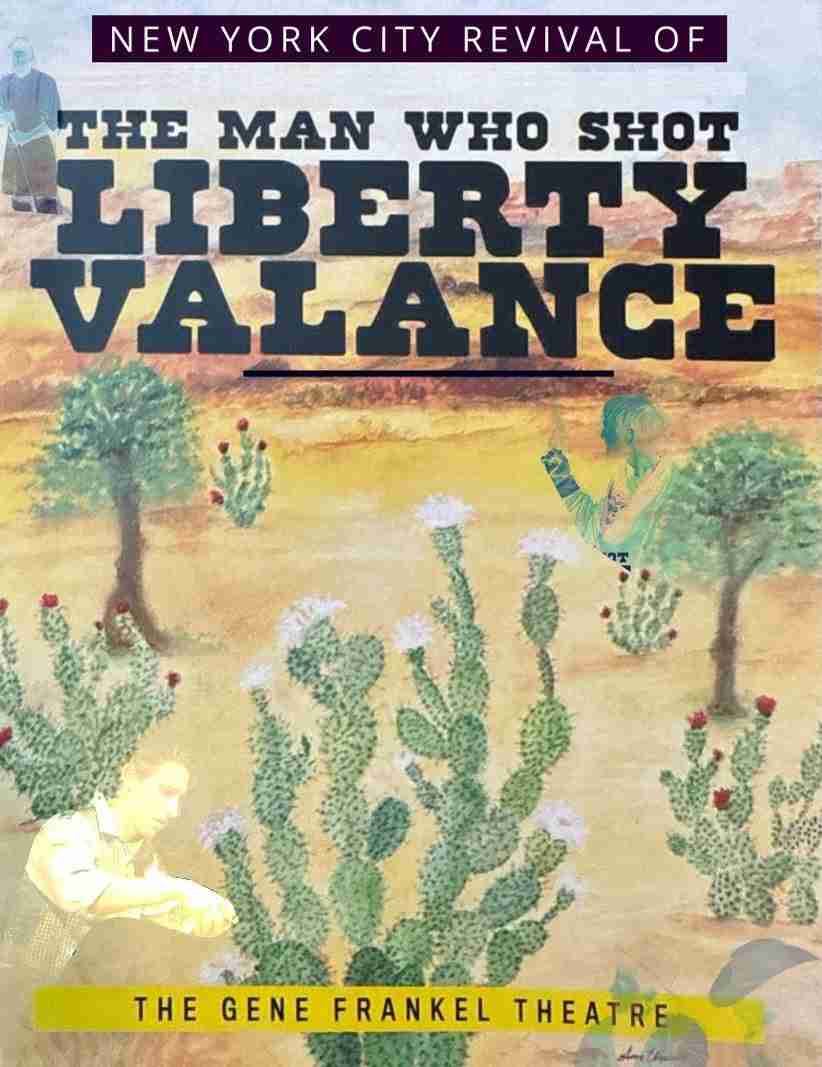

The Gene Frankel Theatre is where fact surrenders to legend and ideals confront the barrel of a gun.
Jethro Compton’s stage adaptation of The Man Who Shot Liberty Valance returns with a vengeance not of blood, but of conscience. Based on Dorothy M. Johnson’s short story that inspired John Ford’s 1962 cinematic parable starring James Stewart and John Wayne, this production, directed with muscular delicacy by Thomas R. Gordon, unveils itself as a finely tuned meditation on moral architecture: its fragility, its failures, and its strange triumphs.
The Sound of a Nation’s Conscience: Johnny Cash and the Sonic Landscape
Before a single line is uttered or a pistol drawn, the production establishes its spiritual geography through sound. Audience members are welcomed into the twilight of the American frontier by the unmistakable timbre of Johnny Cash’s voice—resonant, weathered, and unrelentingly sincere. These recordings, judiciously placed at the top of the show and during scene transitions, do not function merely as atmospheric adornments. Instead, they serve as emotional footnotes to the unfolding narrative. From themes of redemption and regret to justice and vengeance, Cash’s music—soaked in gospel, grit, and gravel—amplifies the play’s more profound philosophical musings. His songs do not interrupt the drama; they prefigure and echo it, as though the man in black himself was strumming chords beneath the floorboards of Twotrees. In this way, the production’s sparse but potent use of music roots the audience not just in time and place, but in mood and meaning.
The Western Reborn: Not Gunsmoke, but the Smoke of Ethical Reckoning
Let us dismiss, at the outset, any notion that this is a “Western” in the customary sense. If one seeks spectacle, one will be disappointed. If one seeks truth—elusive, wounded, profound—one will be rewarded. Here, the vast frontier is not a place of unspoiled freedom but a crucible where idealism is tempered by blood and silence.

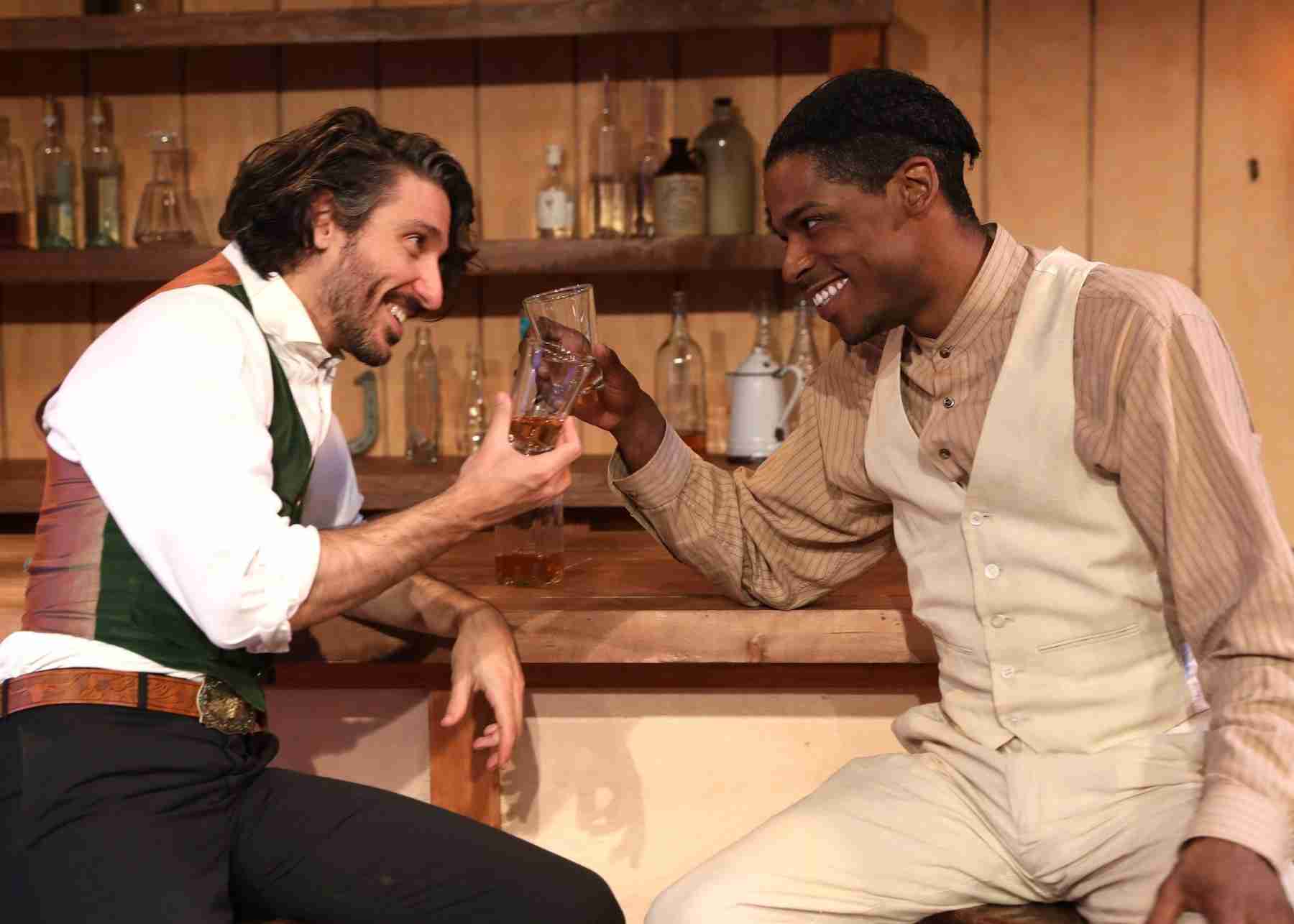
The play opens with an unconscious stranger dragged into a saloon. This, one might think, is mere melodrama. But what unfolds is something far more penetrating. Ransome Foster (played with finely wrought gravitas by Leighton Samuels) is no brawling frontiersman. He is an intellectual émigré from the East—a man whose weapons are grammar and morality. And yet it is this gentle man who, by legend or necessity, becomes the titular executioner of Liberty Valance.
Performances of Principle: Actors as Moral Instruments
Samuels, in the role of Foster, delivers not just a character but an evolution—his arc a study in reluctant transformation, from cerebral scholar to mythic symbol. His interactions with Hallie Jackson (Mari Blake) do not merely enact romance, but the philosophical courtship between hope and complex reality. Blake is simply magnificent, portraying a woman whose very survival hinges upon the preservation of dignity amidst dust and danger.
And then there is Derek Jack Chariton’s Liberty Valance—a study in pathology. This is not villainy for the sake of villainy, but rather the embodiment of amorality weaponized by fear. Chariton’s Valance is not loud but low, not erratic but eerily focused. One senses, in his performance, the quiet horror of those who destroy not from wrath but from the void.
Samuel Shurtleff’s Bert Barricune, meanwhile, radiates quiet pathos. His love for Hallie, unconsummated and perhaps unrequited, is a tragedy unto itself—a man fighting not for the woman, but for the time when he might have won her. In his eyes, the audience sees a life postponed too long.

Production Design as Ethical Environment
To speak of the stagecraft is to acknowledge how character extends beyond flesh. Nino Amari’s set does not merely suggest a saloon—it is the saloon, imbued with the scent of pine, sweat, and whiskey. Susan Yanofsky’s costuming is neither ostentatious nor self-conscious; instead, it inhabits the actors as naturally as their dialects. Reid Sullivan’s lighting, too, plays its part in this moral chiaroscuro, where truth and myth flit like shadows in a lamplit room.
And how rare, how welcome, the restraint in sound design. The gunshots are few, and precisely for that reason, they resonate. They do not startle; they conclude. They do not thrill; they judge.
A Play of Moral Dimensions: Race, Power, and the Responsibility of Narrative
As Jim “The Reverend” Mosten, Daniel Kornegay is a quiet revelation with a tender heart and spirit. But his portrayal does not plead for sympathy; it commands respect. In a land where literacy is revolution, Mosten represents the deepest threat to tyranny—hope rooted in knowledge. His fate is a moral fulcrum upon which the entire narrative pivots, and Kornegay’s performance imbues the tragedy with dignity and devastating restraint.
There is a subtextual richness in this revival that speaks powerfully to contemporary audiences. The script’s measured pacing—often verging on elongation—might, in lesser hands, seem indulgent. But here, these moments act as crucibles of anticipation, akin to the loaded silence before a verdict or the breath before a shot.
The Myth of the Gunman—and the Gunman of Myth
In its denouement, The Man Who Shot Liberty Valance resists the cheap catharsis of victory. There is no triumph here, only a sacrifice at the altar of public need. Ransome Foster does not emerge as a man reborn, but as a fabrication—an emblem, a myth carved from necessity rather than truth. It is, as George Bernard Shaw might sharply observe, the most lamentable of all metamorphoses: the surrender of the individual’s truth to the collective’s appetite for illusion.
For Shaw, such a transformation would not be tragic because it is a lie, but because it is a useful lie—a fiction palatable enough to be mistaken for virtue. In his worldview, utility masquerading as morality is the grimmest comedy of all. That Foster is celebrated not for his integrity but for the myth others require of him is no triumph of character, but a capitulation to the herd’s preference for legend over reality.
And herein lies the most subversive question of the play: Is the fiction that consoles more righteous than the truth that convicts? And if we are to “print the legend,” as the old newspaperman suggests, who becomes the real casualty—those who believe it, or those erased by it?
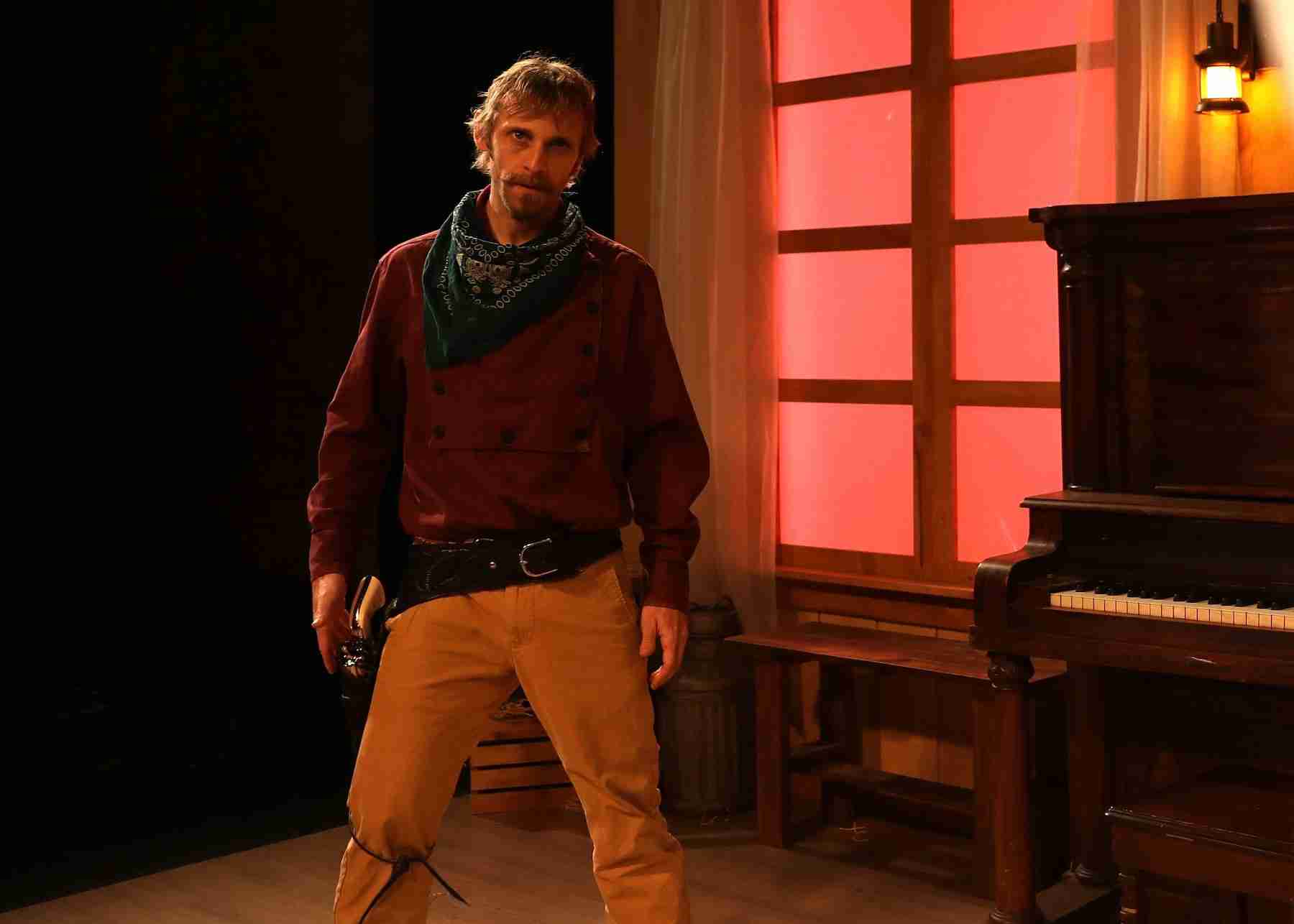
Summoning the Myth, Challenging the Truth: Come See Liberty Valance Live
Thomas R. Gordon directs with an intact moral compass. He neither glorifies nor vilifies, but allows each character—and each silence—to speak its whole truth. What results is not a play about the Old West, but about the old question: what is justice, and who gets to define it?
Thus, we experience a gripping, gorgeously acted parable of power, truth, and sacrifice.
This western isn’t about bullets—it’s about belief. The Man Who Shot Liberty Valance is vital, eloquent theatre. Do not miss it.
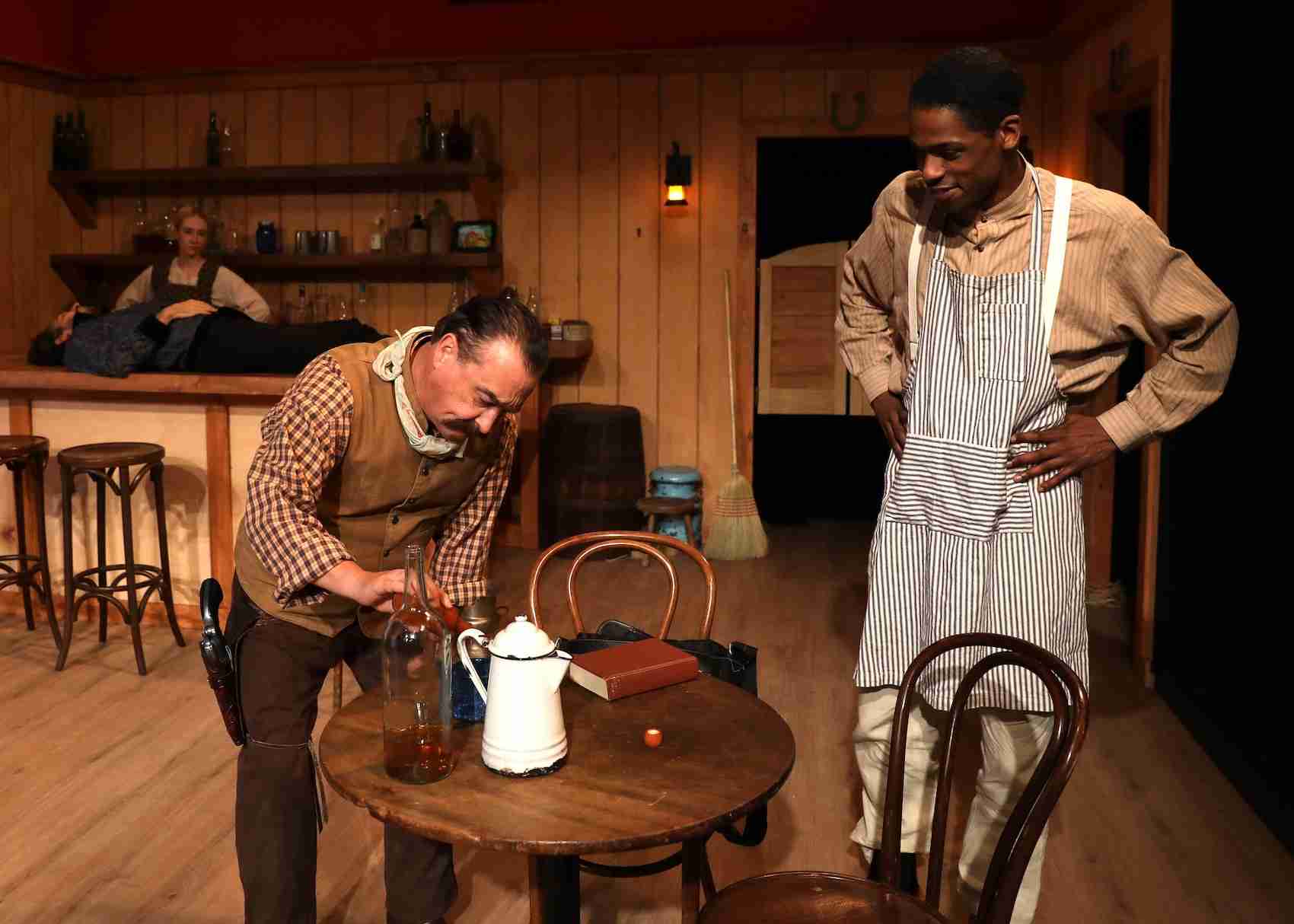
The Man Who Shot Liberty Valance
The Onomatopoeia Theatre Company
The Gene Frankel Theatre, 24 Bond Street (Between Lafayette & Bowery)
Wed-Sat at 8; Sat & Sun at 2
Through July 26, 2025
For tickets and information ($25-$35), visit Onomatopoeia
Runtime is about 120 minutes with an intermission.