Nat King Cole is one of the most towering musical figures, especially in jazz and pop. With his captivating voice and extraordinary skills as a jazz pianist, Cole carved a unique niche in the musical landscape of the 20th century. His virtuosity was about playing music and telling a story, transporting listeners into a world filled with warmth, joy, and nostalgia. Cole’s distinctive sound, deeply rooted in jazz and gospel traditions, paved the way for many, and his legacy remains as vibrant as ever. In this expanded article, we’ll explore Nat King Cole’s journey in greater detail, focusing on his style and technique, the profound emotional connection he fostered through his music, and his importance in the broader context of jazz piano. We’ll also delve deeper into the broader cultural impact of his artistry.
Early Beginnings: The Roots of Genius
Born Nathaniel Adams Coles on March 17, 1919, in Montgomery, Alabama, Nat King Cole was destined to play music. His father was a Baptist minister, and his mother, a church organist, nurtured his early exposure to music. From an early age, the piano became Cole’s closest companion.
By the age of four, he was already exploring the keys of the family piano.
His mother, Perlina Coles, gave him formal lessons, teaching him the basics of classical music and gospel hymns.
By age 15, Cole was performing professionally.
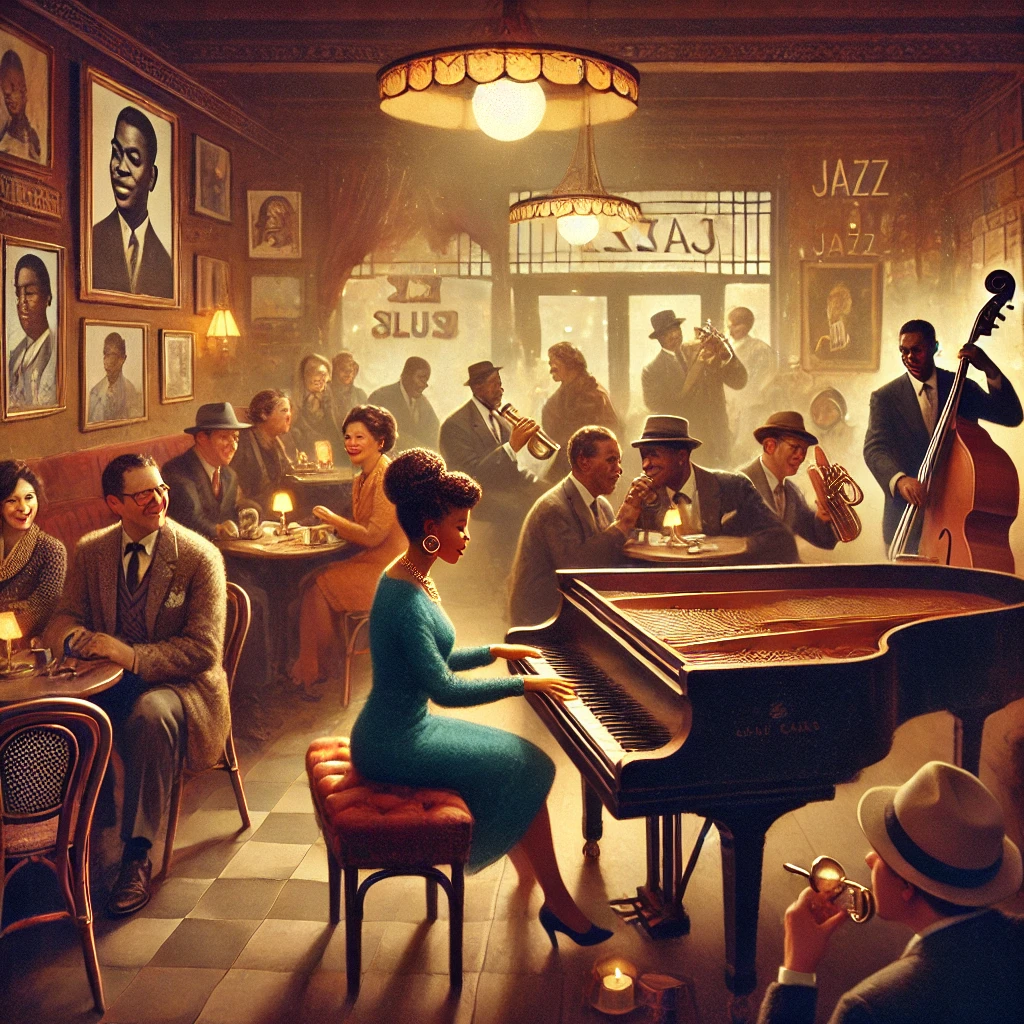
Though rooted in gospel traditions from the church, Cole’s exposure to classical music also influenced his unique approach to the piano. As he matured, his love for jazz blossomed. Fusing these styles became a key part of his identity as a musician.A warm and inviting jazz club scene from the mid-20th century with a crowd enjoying a soulful performance of jazz music. I
Nat King Cole’s Piano Style: A Closer Look
Nat King Cole’s piano playing was integral to his sound. Often regarded as one of the most sophisticated jazz pianists of his time, his technique was a seamless combination of technical brilliance, emotive touch, and melodic intuition.
Chord Voicing and Rhythmic Precision: Cole’s voicing of chords was rich and expressive, providing lush harmonic textures in his music. His left hand anchored the rhythm while his right hand played melodies that were smooth yet spontaneous. This ability to hold the rhythm with one hand while expressing lyrical melody with the other made his piano playing stand out.
Swing and Syncopation: Cole mastered the art of swing and syncopation as a jazz pianist. His playing often used rhythmic patterns that gave his music a buoyant, flowing feel. This made his performances feel vibrant and alive, even in slower tempos.
Improvisation: Like most jazz greats, Cole was a master improviser. His improvisational style was subtle, never overwhelming. Instead of the flashy and frenetic solos characteristic of bebop, Cole’s improvisations were introspective and more melodic. His solos felt like an extension of the song, always staying true to the overall emotion of the piece.
Touch and Dynamics: Cole’s touch on the piano was delicate yet strong. He could move effortlessly between soft, intimate passages and more exuberant moments without losing the emotional thread of the music. His control over dynamics gave his music a depth that drew listeners in, making them feel the emotional contours of each note.
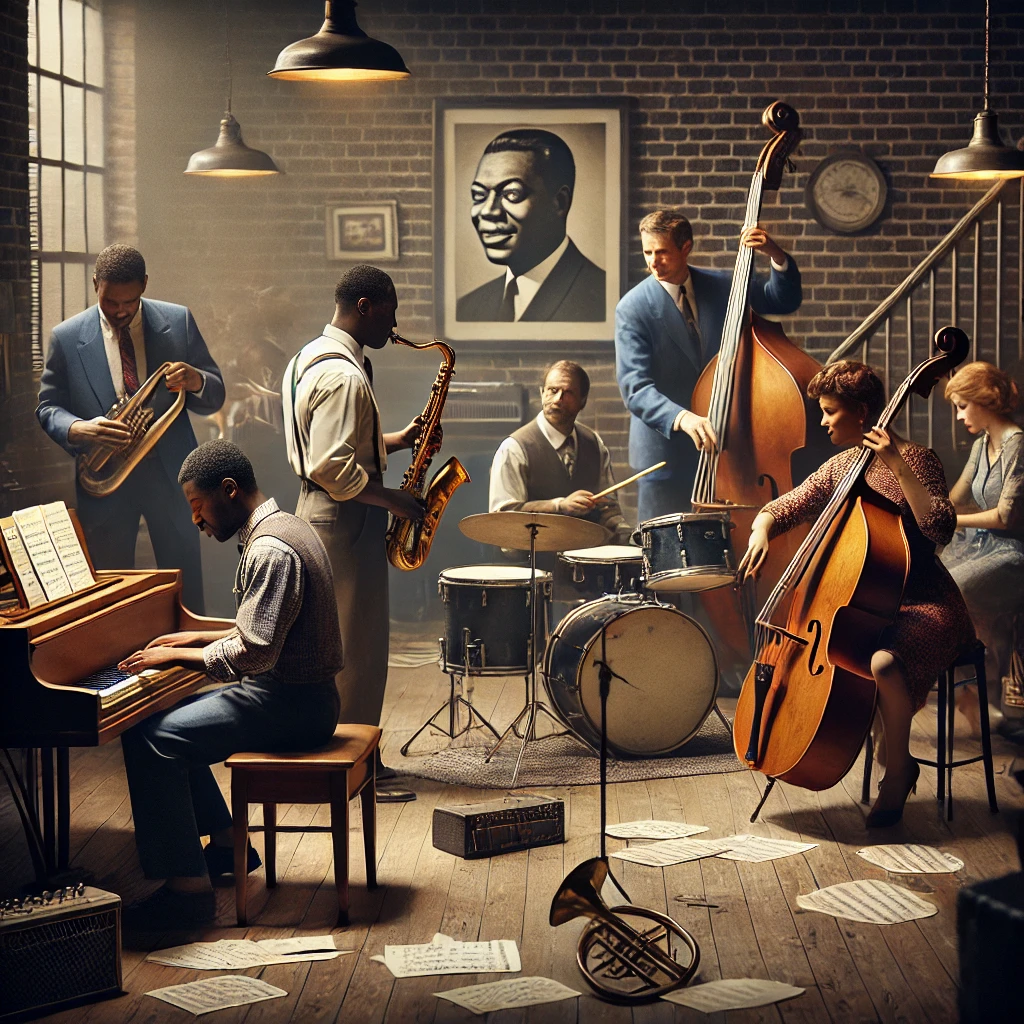
A mid-20th century jazz rehearsal scene.
Signature Songs and Techniques
Nat King Cole’s catalog is rich with examples of his piano prowess. His signature sound can be heard in many of his timeless songs, where his piano playing was both the anchor and the emotional heartbeat.
In “Unforgettable,” Cole’s playing is gentle and lyrical, perfectly complementing his velvety voice. His subtle chord changes and delicate handling of the piano melody heighten the song’s romantic mood.
“Nature Boy” stands out for its philosophical depth, and Cole’s piano performance enhances this theme with a simple yet haunting arrangement. His melancholy playing adds layers to the song’s introspective lyrics.
“Route 66” is a prime example of his upbeat swing style. Here, Cole plays with a rhythmic energy that matches the song’s excitement, giving it a sense of movement and adventure.
The Nat King Cole Trio: Redefining the Jazz Piano Trio
In 1937, Nat King Cole formed the Nat King Cole Trio, which redefined the jazz piano trio format. At a time when most jazz ensembles were large, featuring horns and drums, Cole’s trio—comprising piano, guitar, and bass—was a minimalist yet powerful setup. This gave more room for the piano to take center stage, showcasing Cole’s virtuosic playing.
Piano as the Lead Instrument: Unlike most jazz trios of the time, Cole’s group did not feature a drummer. This gave the piano the responsibility of keeping the rhythm while driving the melodic flow. Cole’s use of syncopated chords and rhythmic variations allowed the trio to maintain a full sound despite the absence of percussion.
Interaction Between Instruments: The interplay between Cole’s piano, Oscar Moore’s guitar, and Wesley Prince’s bass was seamless. Each instrument complemented the others, creating a dynamic, balanced sound. Cole’s piano often led the way, but the tight interaction between the trio was key to their success.
The trio’s music helped define the “cool jazz” movement with its relaxed yet intricate style. This was a significant departure from the louder, more frenetic energy of big bands and bebop, and it attracted listeners who preferred the smoother side of jazz.
Jazz and Beyond: A Cross-Genre Innovator
While Nat King Cole’s jazz credentials are impeccable, his appeal went far beyond the boundaries of any one genre. He was one of the first African American artists to achieve mainstream success in pop music, paving the way for future generations of Black musicians. His smooth voice and ability to blend jazz with pop sensibilities made him a household name, and his ability to cross genres without losing his unique identity was a testament to his versatility as an artist.
Pop Sensibilities: Cole was one of the first jazz artists to integrate pop into his repertoire seamlessly. Songs like “Mona Lisa” and “Too Young” topped the pop charts, showing his versatility and broad appeal. His smooth, soulful voice complemented the pop arrangements, and his piano playing added a layer of sophistication.
Traditional R&B Influence: Cole was also a precursor to rhythm and blues. His ability to weave together jazz and traditional blues elements influenced the development of early R&B. In many ways, Cole’s music blurred the lines between genres, helping to bridge the gap between jazz, pop, and R&B.
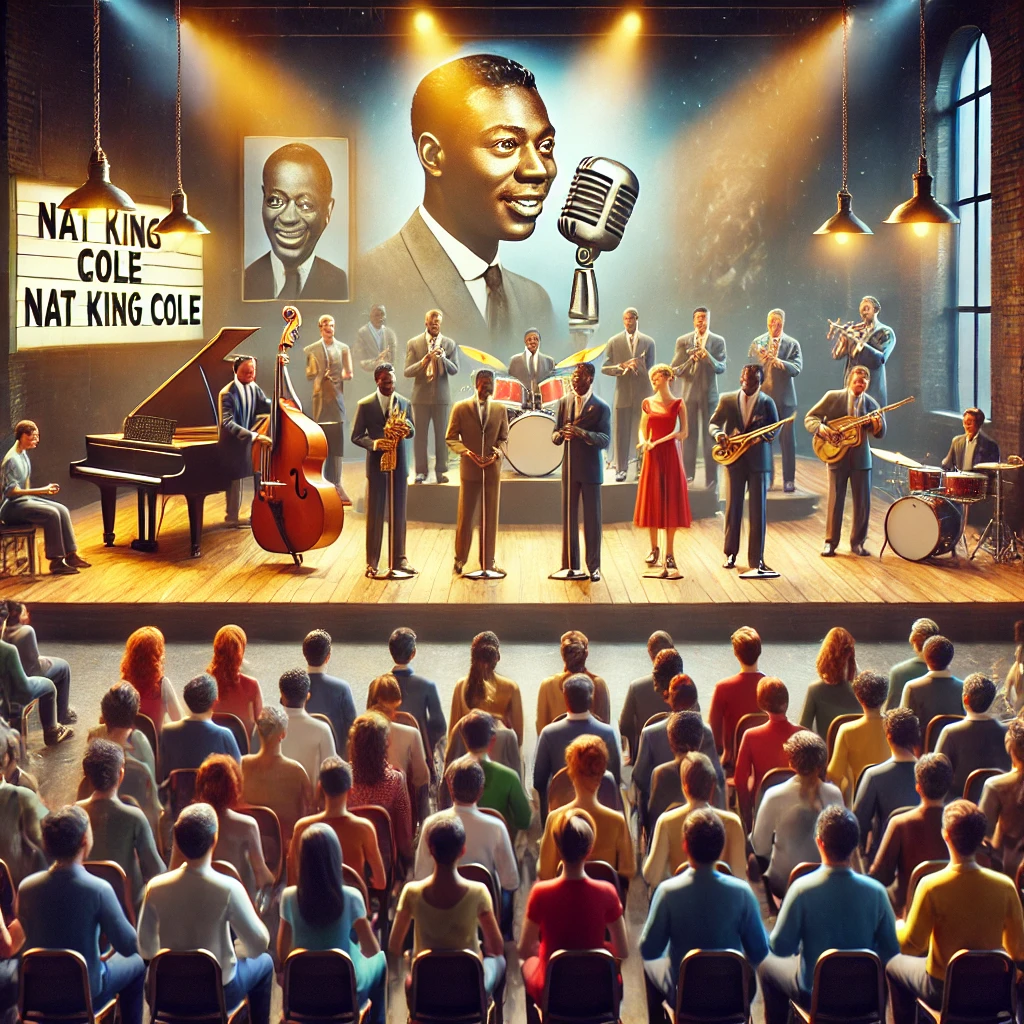
Musicians performing Nat King Cole’s jazz hits on a brightly lit stage.
Breaking Barriers: A Black Artist in a White World
Beyond his musical genius, Nat King Cole broke significant racial barriers. As an African American artist in a predominantly white industry, he faced discrimination at every turn. Despite his massive success, Cole was subjected to racist taunts and violence. He even had to confront hostility from white neighbors when he moved into an all-white neighborhood in Los Angeles.
The Nat King Cole Show: In 1956, Cole made history as the first African American to host a nationally broadcast television show, “The Nat King Cole Show.” However, despite his talent and popularity, the show struggled to find sponsors and was canceled after just one season. Cole famously remarked, “Madison Avenue is afraid of the dark,” referring to advertisers’ reluctance to support a show hosted by a Black artist.
Cultural Icon: Despite these challenges, Cole became a cultural icon. His ability to transcend racial boundaries through his music made him a trailblazer for future Black artists. He maintained his dignity and grace in the face of adversity, becoming a symbol of perseverance.
The Enduring Legacy of Nat King Cole
Nat King Cole’s legacy is one of timeless elegance, technical brilliance, and cultural significance. His influence on the jazz piano is immeasurable, as he set a standard for future jazz musicians. Beyond jazz, his contributions to pop and R&B helped to shape the musical landscape of the 20th century.
Influence on Modern Artists: Cole’s influence can be seen in the work of modern jazz pianists like Diana Krall and Harry Connick Jr., who cite him as a significant influence. His ability to blend technical skill with emotional depth remains a touchstone for many contemporary musicians.
Timeless Appeal: Decades after his death, Nat King Cole’s music continues to captivate audiences. His songs remain a staple on jazz and pop playlists, and his smooth, soothing voice remains instantly recognizable.
Tributes and Covers: Many artists, including his daughter Natalie Cole, have paid tribute to Nat King Cole’s enduring legacy. Natalie’s rendition of “Unforgettable“ with her father’s original recording stands as a testament to the lasting impact of his work.
A touching scene of an older African American jazz pianist, surrounded by young aspiring musicians, sharing stories about Nat King Cole.
Conclusion: The Unforgettable Legacy of Nat King Cole
Nat King Cole was much more than a jazz pianist. He was a pioneer, barrier-breaker, and voice transcending boundaries. His innovative approach to the piano, combining technical precision with emotional depth, set a new standard for jazz musicians. His contributions to pop and R&B further solidified his place in music history, making him one of the most influential musicians of the 20th century.
From his early beginnings in Montgomery, Alabama, to his rise as a cultural icon, Nat King Cole’s story is one of perseverance, grace, and immense talent. He remains an inspiration for musicians and listeners alike, reminding us of the power of music to bring people together, regardless of race or background.
As we reflect on his legacy, we celebrate the music he left behind and the doors he opened for future generations of artists.
If you enjoyed this article, please check out Jeff Harner Sings Cole Porter at Birdland, Gun and Powder: The Legend of the Sisters Clarke, and Exploring Nat King Cole’s Timeless Legacy.
We use cookies on our website to give you the most relevant experience by remembering your preferences and repeat visits. By clicking “Accept”, you consent to the use of ALL the cookies.
This website uses cookies to improve your experience while you navigate through the website. Out of these, the cookies that are categorized as necessary are stored on your browser as they are essential for the working of basic functionalities of the website. We also use third-party cookies that help us analyze and understand how you use this website. These cookies will be stored in your browser only with your consent. You also have the option to opt-out of these cookies. But opting out of some of these cookies may affect your browsing experience.
Necessary cookies are absolutely essential for the website to function properly. These cookies ensure basic functionalities and security features of the website, anonymously.
Cookie
Duration
Description
cookielawinfo-checkbox-analytics
11 months
This cookie is set by GDPR Cookie Consent plugin. The cookie is used to store the user consent for the cookies in the category "Analytics".
cookielawinfo-checkbox-functional
11 months
The cookie is set by GDPR cookie consent to record the user consent for the cookies in the category "Functional".
cookielawinfo-checkbox-necessary
11 months
This cookie is set by GDPR Cookie Consent plugin. The cookies is used to store the user consent for the cookies in the category "Necessary".
cookielawinfo-checkbox-others
11 months
This cookie is set by GDPR Cookie Consent plugin. The cookie is used to store the user consent for the cookies in the category "Other.
cookielawinfo-checkbox-performance
11 months
This cookie is set by GDPR Cookie Consent plugin. The cookie is used to store the user consent for the cookies in the category "Performance".
viewed_cookie_policy
11 months
The cookie is set by the GDPR Cookie Consent plugin and is used to store whether or not user has consented to the use of cookies. It does not store any personal data.
Functional cookies help to perform certain functionalities like sharing the content of the website on social media platforms, collect feedbacks, and other third-party features.
Performance cookies are used to understand and analyze the key performance indexes of the website which helps in delivering a better user experience for the visitors.
Analytical cookies are used to understand how visitors interact with the website. These cookies help provide information on metrics the number of visitors, bounce rate, traffic source, etc.
Advertisement cookies are used to provide visitors with relevant ads and marketing campaigns. These cookies track visitors across websites and collect information to provide customized ads.



One Response
complimenti. I’ve just appreciated your words, feeling, points of view, grazie
Maria Teresa