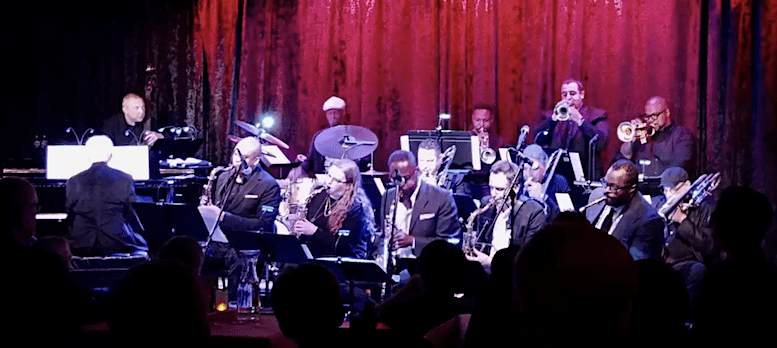

The Mingus Big Band, formed by Charles Mingus’ widow Sue Mingus, and now playing at Birdland Jazz Club, is a force to be reckoned with —emotionally charged, musically based non-stop energy. Charles Mingus, virtuoso bass player and visionary of music whose compositions transcend melody and rhythm with kinetic reimagining and human emotion, was like no other composer. He lived in a time of huge upheaval in this country through the 50s and 60s, and his compositions often addressed his disgust and anger at the total disregard for its citizens.
Charles Mingus was a jazz improviser and musical artist who painted with notes, chords, and words. His compositions cross all boundaries. This is full-bodied music—palpable, earth-shaking.

The song “Fables of Faubus,” Mingus composed in response to Arkansas governor Orval Faubus’s attempt to stop integration in his schools, known as the Little Rock Crisis. “Fables of Faubus” is as if we are descending into hell with all of its cries and bursts of flames, down into the darkness, where anger and confusion live, where the screeches of those enforcing segregation and those trying to outlaw it are heard crashing into one another. Here, a saxophone laughs and taunts, there a trumpet screeches of those tortured in the bowels of hell. Instruments all have a way of speaking. Charles Mingus wrote words for this particular song, words attacking the KKK and Nazi Fascists.
Mingus’ ode to New York, “New York Sketchbook,” is a love song to the city that would change his life forever. “New York Sketchbook” was composed for two pianos, but having only the one on Birdland’s stage, pianist David Kikoski’s more than made up for it as his hands fly across the keys, landing with precision, diving from highs to lows, from one end of the instrument to the other in but a flash. It opens with the quiet keys of the piano as if we are waking to a new day, throwing open the windows to the sounds of the streets. Early morning trucks, the gates of a store flying up, voices calling out “Mornin.” “New York Sketchbook” takes us on a memory journey. The energy and excitement of the city are palpable in this piece, reflecting the partnership we all have with the city and its inhabitants.
“This Subdues My Passion,” Mingus composed when he was 17 years old, is a beautiful sit by the fire, eyes closed, take-you-away composition.
The audience listens in pursuit of what’s next because each composition has its surprises: a trumpet solo that takes each note and pulls its sound out, in, over, and under, an alto sax solo that soars above the clouds, and a piano solo that is a majestic monstrous momentous collection with every key on the keyboard being played.
Mingus Big Band is a not-to-be-missed piece of history and a contemporary musical language that speaks to all. They are some of the grandest, best darn musicians we have. They are playing at the iconic Birdland Jazz Club, which holds a light and magic within its walls from the majesty of the music that has come before.
The Mingus Big Band celebrates Charles Mingus with a six-night run at Birdland Jazz Club
$45 tables/$35 bar + $20 food/drink minimum
TICKETS HERE