
Beckett’s Waiting for Godot: Absurdist Theater Defined
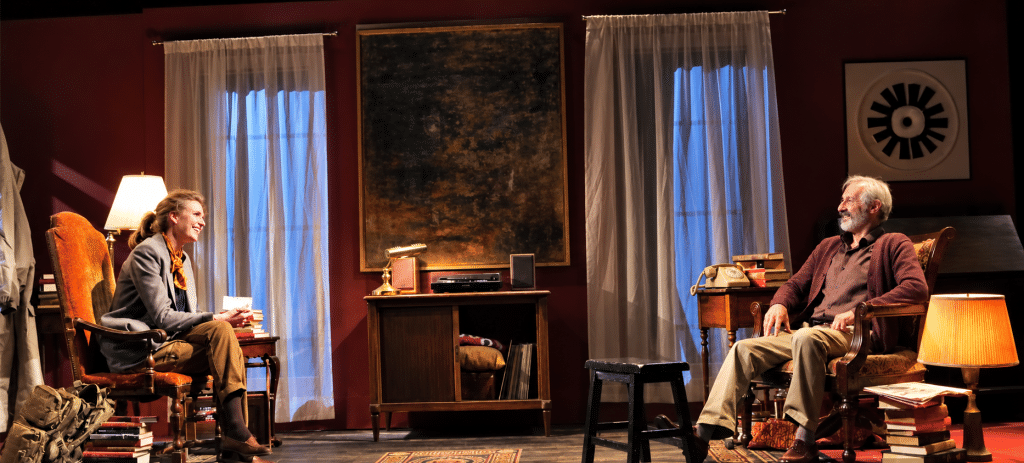
Lately, there has been a buzz about “Waiting for Godot.” You may have heard about Lucian Msamati and Ben Whishaw starring in a new production at the Theatre Royal Haymarket in 2024 or the 2023 Off-Broadway production starring Michael Shannon and Paul Sparks at the Polonsky Shakespeare Center of the Theatre for a New Audience. There’s also news that in Fall 2025, Keanu Reeves and Alex Winter will star in a Broadway production directed by Jamie Lloyd.
Renewed interest in Godot reflects humanity’s general sense of unrest as wars and tyranny continue unabated. Perhaps more so, as many people have shifted belief systems from religion to secularism. Here are some related quotes from familiar names:
Jean-Paul Sartre – “Man is condemned to be free; because once thrown into the world, he is responsible for everything he does.”
Albert Camus – “The only way to deal with an unfree world is to become so absolutely free that your very existence is an act of rebellion.”
Franz Kafka – “A first sign of the beginning of understanding is the wish to die.”
Composers have other ways of asking questions about the purpose of life. The contrasting instrument groups in Charles Ives’s music composition, The Unanswered Question, symbolize philosophical reflections on existence and life’s perpetual, unanswered mysteries.
Let’s explore Beckett’s work.
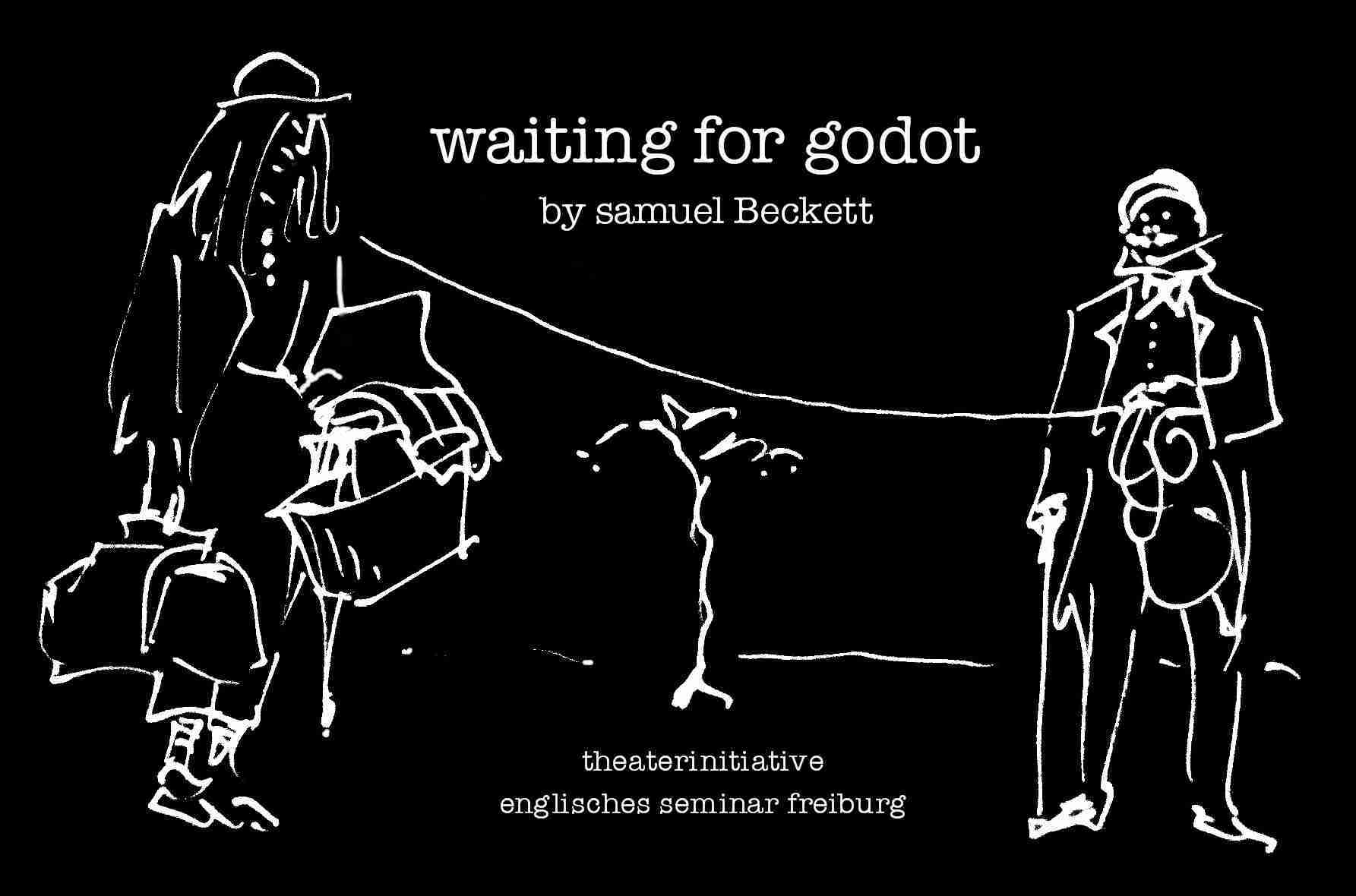
The Human Condition
Samuel Beckett, an Irish playwright born in Dublin in 1906, revolutionized theater with Waiting for Godot. Influenced by James Joyce, Beckett’s style reflects the human condition, blending despair, humor, and hope. Premiering in 1953, Waiting for Godot redefined dramatic conventions with minimalism and existentialist themes, shaped by Beckett’s experiences in war-torn Europe and profound introspection.
Vladimir and Estragon: The Complexity of Two Souls
Vladimir (Didi) and Estragon (Gogo) anchor the play’s absurdist narrative. Vladimir embodies philosophical reflection, contrasting Estragon’s immediate, physical concerns. Through existentialism, hope, and despair themes, Vladimir seeks meaning amid absurdity, as seen in his plea, “Let us not waste our time in idle discourse! Let us do something while we have the chance!”
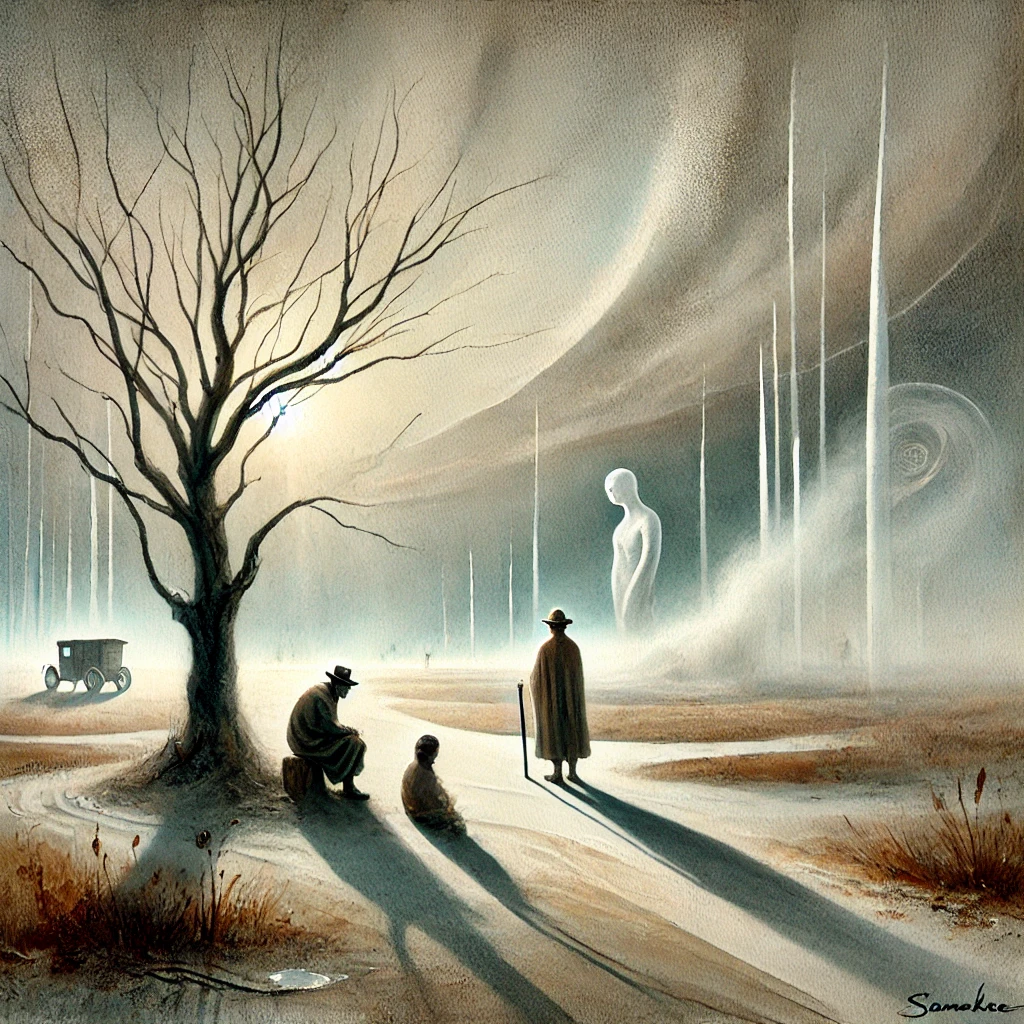
Their fragmented dialogues—near a barren tree—highlight their existential plight, but their companionship offers warmth amidst desolation, symbolizing the enduring nature of human connections. The repeated exchanges, “Let’s go,” “We can’t,” “Why not?” and “We’re waiting for Godot,” encapsulate their hopeful yet trapped state.
Pozzo and Lucky: The Paradox of Power and Servitude
Pozzo and Lucky, a master-servant duo, intrude upon the stagnant world of Vladimir and Estragon, adding complexity to the narrative. Pozzo, an authoritative figure, represents dominance and arrogance, while Lucky, his subservient counterpart, embodies submission and burden. The dynamic between them is both grotesque and tragic, exploring the dehumanizing nature of power.
Lucky’s “thinking” scene—his disjointed and incomprehensible monologue—offers a glimpse into the fragmented human mind. It underscores the futility of intellectual labor when stripped of purpose, echoing themes of despair and absurdity. Pozzo’s eventual blindness and Lucky’s increasing silence mirror the cyclical decay of power and dependence, reinforcing the play’s existential questions about identity and relationships.
Pozzo and Lucky are distorted reflections of Vladimir and Estragon’s bond. While Didi and Gogo find solace in their companionship, Pozzo and Lucky’s relationship is rooted in exploitation. Together, they underscore the play’s exploration of the human condition: freedom versus subjugation, connection versus isolation.

The Young Boy: A Messenger of Uncertainty
The young Boy, who appears at the end of each act, is a bridge between hope and despair. He conveys that Godot will arrive tomorrow—a promise perpetuating Vladimir and Estragon’s waiting. Yet, his uncertain and fleeting presence deepens the ambiguity of Godot’s existence.
The Boy symbolizes innocence, potential, and the fragility of faith. His repetitive, unchanged message reinforces the cyclical structure of the play and the futility of waiting. Through him, Beckett invites the audience to question the reliability of hope and the weight we place on external salvation.
The Mystery and Meaning of Godot
Godot remains one of literature’s great enigmas. Beckett never clarified Godot’s identity, leaving interpretations open. Some view Godot as a metaphor for salvation, God, or purpose. Others interpret Godot as a representation of futility or life’s unfulfilled promises. This ambiguity invites audiences to project their meanings, making the play personal and universal.
Beckett’s reflections suggest that Godot was not intended to represent a specific figure. In interviews, he remarked that he would have written it explicitly if he knew who Godot was. The origin of the name remains speculative. Some scholars trace it to the French word “godillot” (a type of boot), symbolizing the journey of life, while others link it to “God” or other abstract concepts.
“Nothing to be done,” Estragon laments, capturing the play’s essence of futility and perseverance. This openness elevates Waiting for Godot as a work that resonates across cultures and philosophies. Audiences become participants in the play’s meaning, engaging with its layered symbolism and existential questions.