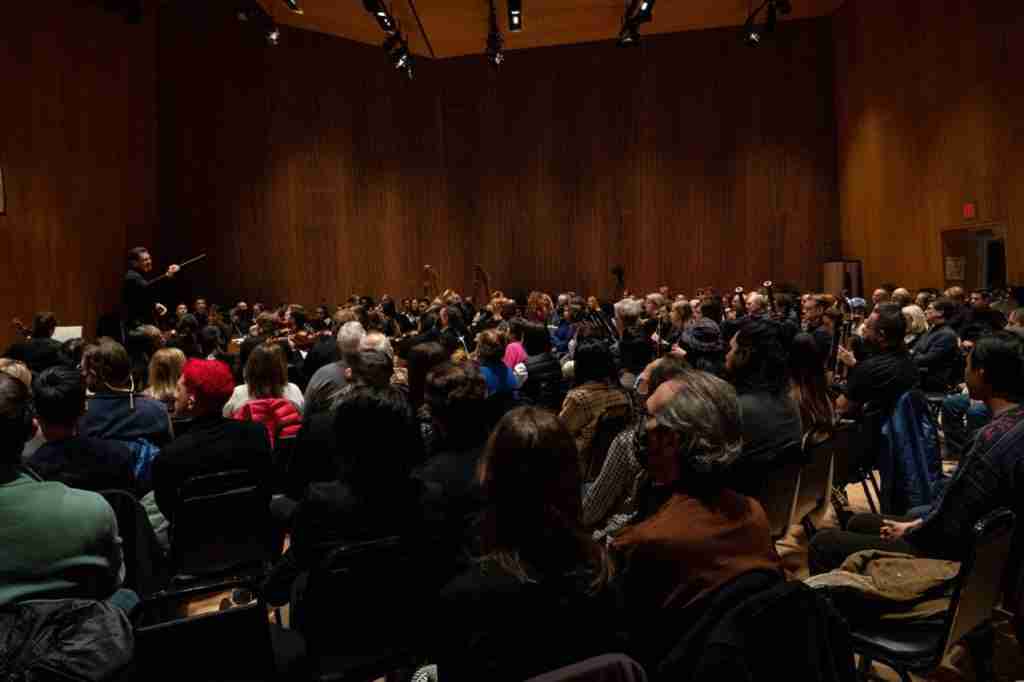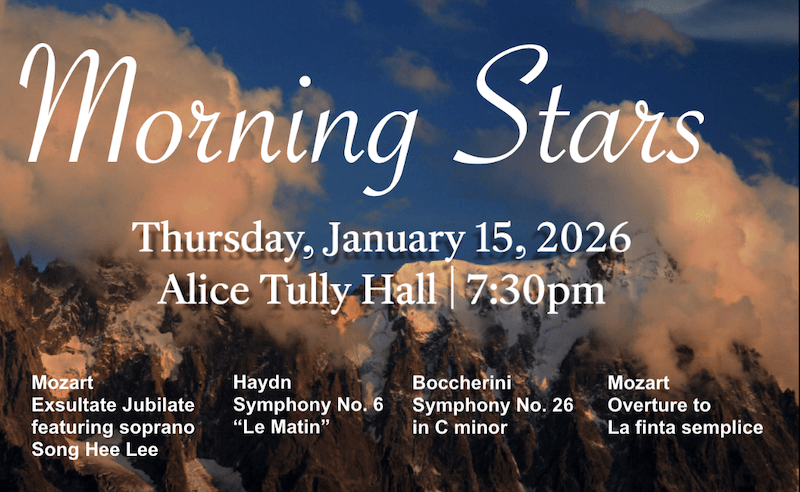

Music can transcend mere performance and become something approaching revelation. Thursday night at Alice Tully Hall was such an evening—a radiant encounter in which sound itself seemed animated by divine inspiration. The American Classical Orchestra, under the baton of its founder and artistic director, Thomas Crawford, presented “Morning Stars,” a program tracing the luminous ascent of eighteenth-century genius through the works of W. A. Mozart, Boccherini, and Haydn. What emerged was not an antiquarian exercise, but a living affirmation of artistic rectitude: historically informed, intellectually alert, and glittering with expressive purpose.
Crawford’s Illuminating Concert Preview: Scholarship Rendered with Wit and Lucidity
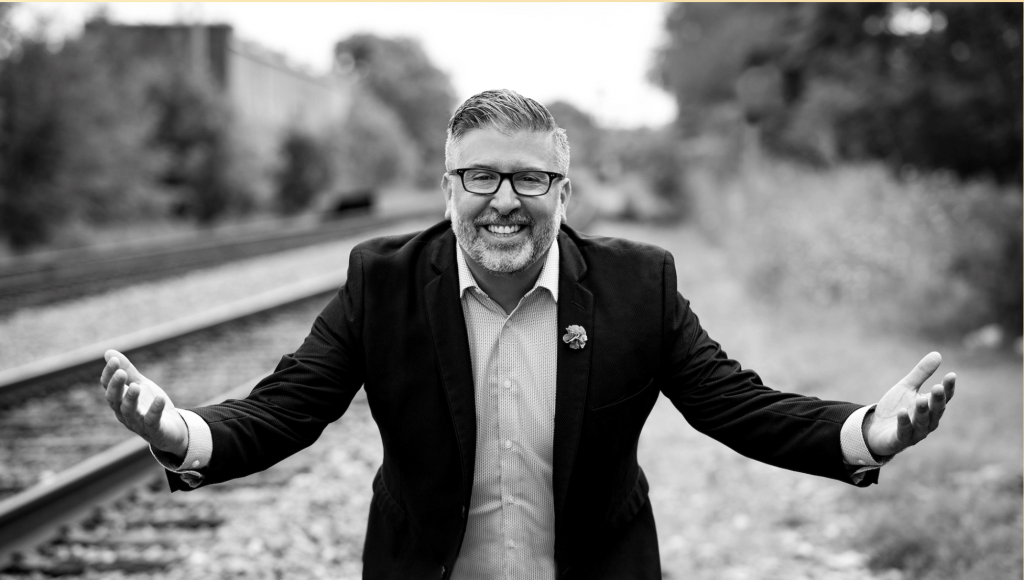
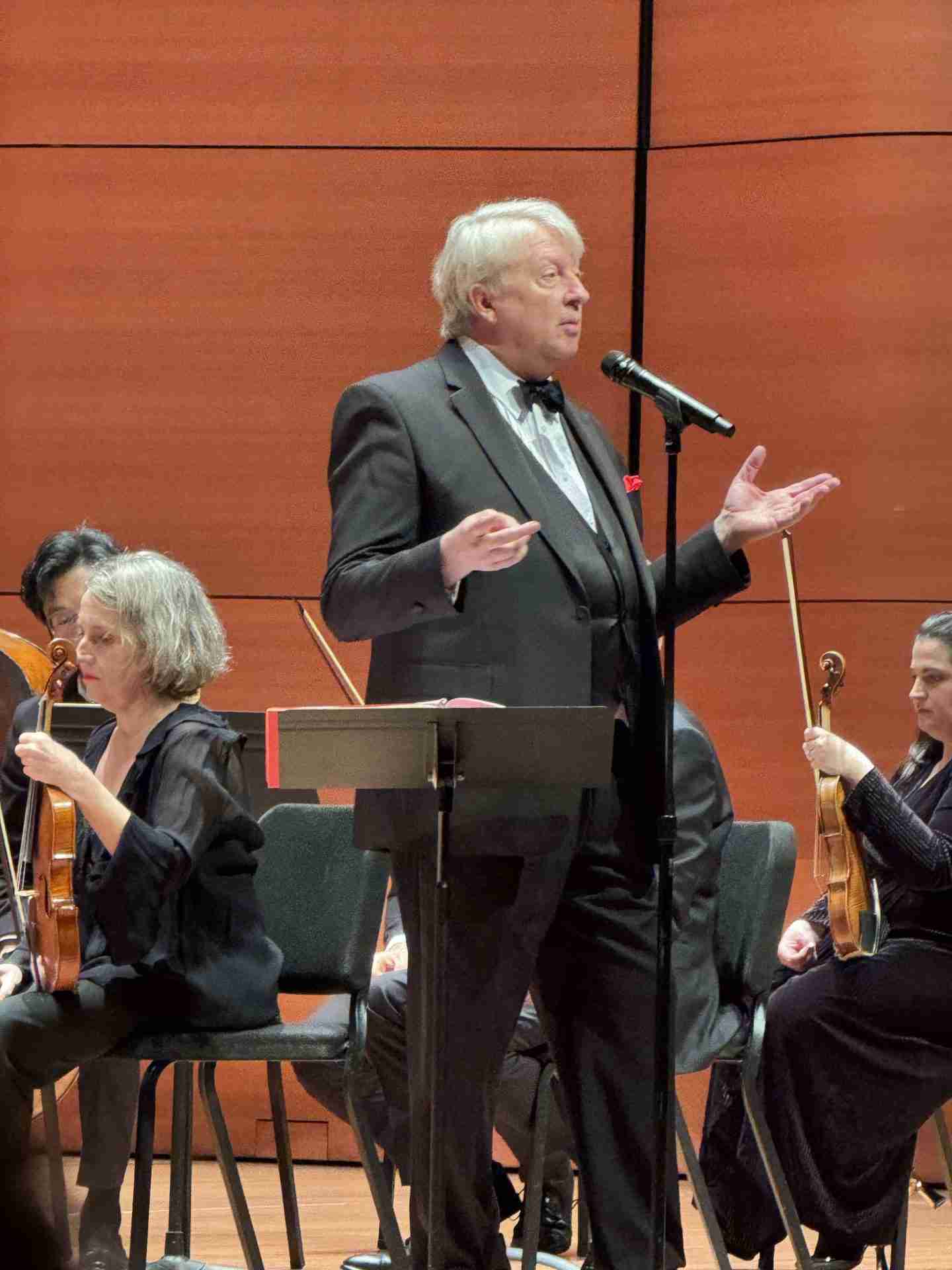
From the moment Crawford stepped before the ensemble, one sensed the particular alchemy that distinguishes an ACO evening. Following a vigorous, superbly articulated reading of Mozart‘s Overture to La finta semplice, he embarked on his signature Concert Preview. This was not bloviation but eloquent exegesis—scholarship rendered with wit, charm, and lucidity. With the ease of a raconteur and the precision of a seasoned pedagogue, Crawford illuminated each work’s provenance, stylistic grammar, expressive intention, amusing anecdotes, and historical contexts, while inviting his players to demonstrate key passages. In doing so, he made audible the syntax of music itself: music not as a decorative surface, but as a disciplined language of emotional meaning. One was reminded of Adorno‘s insistence that genuine musical understanding lies in apprehending a work’s historical truth content. Crawford’s gift is to render such understanding accessible without ever diluting its intellectual gravity.
Period Instruments and the Pursuit of Authentic Sound
The ACO‘s commitment to historically informed performance practice proved central to the evening’s character. Period instruments—gut strings, wooden winds, and valveless brass produced a sound world of translucent intelligibility and pliant warmth. Textures were transparent yet resonant; cantabile passages breathed with delicacy, while dramatic climaxes carried a pungent, almost astringent bite. This was not antiquarian pedantry, but a hermeneutic recovery of original expressive horizons. Alice Tully Hall‘s warm acoustic became an ideal vessel for this luminous palette, allowing color, articulation, and phrasing to speak with unerring precision. The orchestra’s collective sound suggested not a museum exhibit, but a living language—classical in its proportion, yet freshly articulate in its affect.
Song Hee Lee’s Transcendent Mozart: Youthful Mastery Revealed
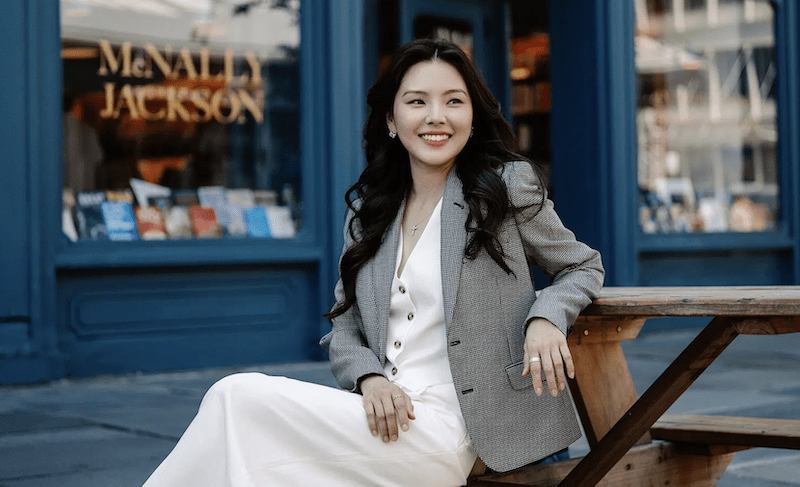
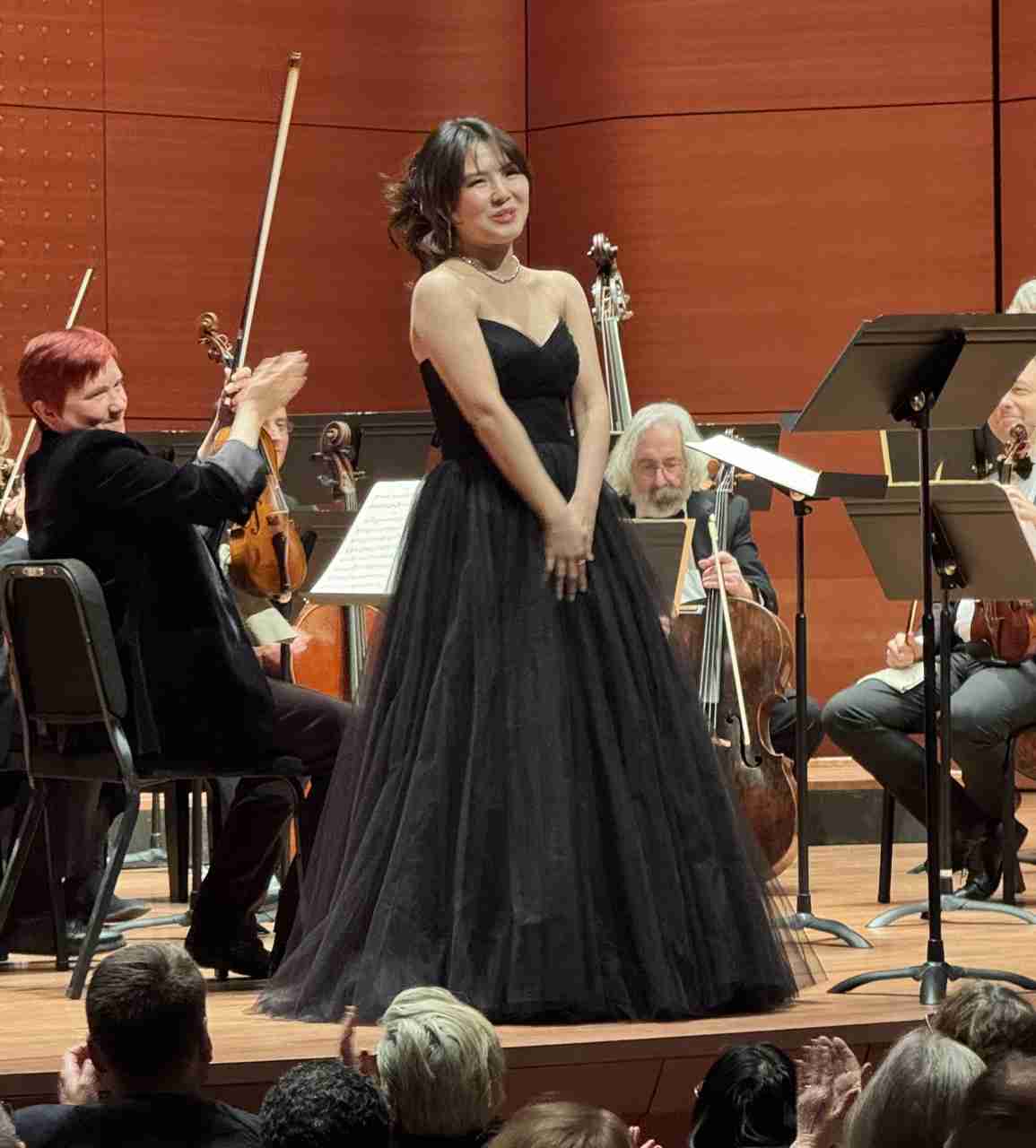
The emotional apogee of the evening arrived with soprano Song Hee Lee in Mozart‘s Exsultate, jubilate. From her first phrase, Lee revealed a command at once youthful and consummate. Her technique was immaculate: every melisma unfurled with legato grace, every phrase shaped by breath, intelligence, and instinctive poise. The voice itself—graceful yet capable of thrilling amplitude—dazzled equally in hushed pianissimo and ringing fortissimo. What distinguished the performance, however, was not virtuosity alone, but communion. Lee did not merely execute Mozart’s writing; she inhabited it. The motet’s architecture emerged as luminous joy—pure celebration, lifted on sound. Her vocal pyrotechnics never tipped into exhibitionism; instead, they served an expressive line of rare coherence and radiance. This was not simply a star turn, but the apotheosis of youthful mastery, a moment when technique and meaning became indistinguishable.
Boccherini’s Noble Symphony: Aristocratic Poise and Expressive Nuance
If Mozart provided the evening’s spiritual center, Boccherini and Haydn supplied its structural and dramatic arc. Boccherini’s Symphony No. 26 in C minor—still too rarely heard—unfolded with aristocratic poise and expressive nuance. Its varied deployment of solo instruments suggested a composer quietly testing the boundaries of orchestral color, presaging the more overt concertante brilliance to follow. The ACO‘s reading emphasized elegance without blandness: lines were shaped with clarity, inner voices articulated with care, and harmonic tensions allowed to register without excess. It was a portrait of a composer often misunderstood as merely decorative, here revealed as thoughtful, balanced, and subtly inventive.
Haydn’s “Le Matin”: The Crowning Achievement of Concertante Brilliance
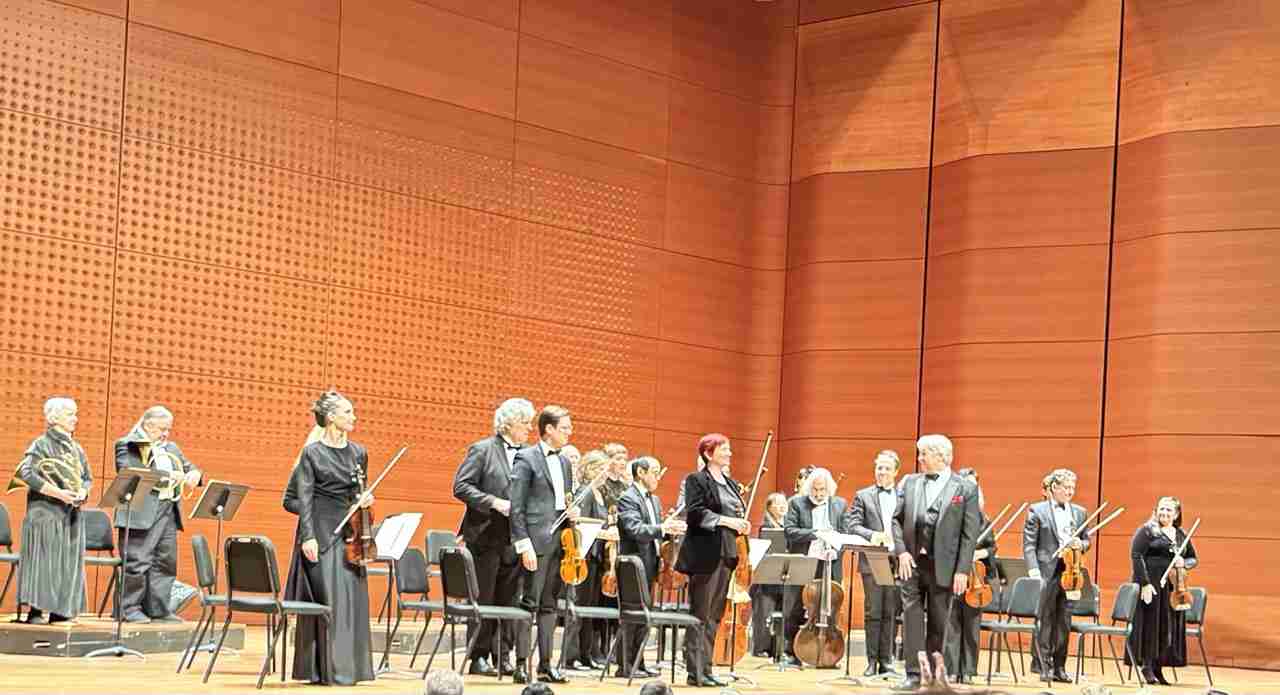
The crowning achievement of the evening was Haydn‘s Symphony No. 6 in D major, “Le Matin.” Written during his early years at Esterházy, the work remains a marvel of unfailing variety and imagination. Its opening evocation of dawn—soft sonorities emerging from darkness into light—was rendered with remarkable poise, each instrumental entrance precisely weighted, each phrase breathing naturally within the whole. The symphony’s concertante design became a living tableau of musical character. Concertmaster Aisslinn Nosky brought incisive brilliance and rhetorical clarity; violist Jessica Troy offered a glowing inner voice of rare warmth; cellist Myron Lutzke shaped lines with resonant eloquence; and bassist John Feeney anchored the texture with firm, expressive authority. Their dialogues sparkled with vivacity, wit, and structural coherence. Haydn’s invention—at once playful and architectonic—unfolded as both drama and delight, the orchestra illuminating every turn of phrase with precision and style.
Historical Awareness as Expressive Liberation
Crawford’s approach throughout the evening underscored a central principle: historical awareness need not constrain expressive freedom. On the contrary, the ACO‘s performance suggested that fidelity to period practice can liberate the music’s innate rhetoric. Ornamentation was purposeful, articulation finely etched, and tempo relationships conceived with a keen sense of proportion. One heard not merely accuracy, but insight—a reading shaped by what might be called musical hermeneutics, in which sound becomes a medium of meaning rather than surface effect. The result was neither academic nor precious, but bracingly alive.
A Legacy of Excellence: Cultural Stewardship at the Highest Level
Since its founding in 1984, the American Classical Orchestra has established itself as New York‘s preeminent period-instrument ensemble. With principal players drawn from the faculty of Juilliard‘s Historical Performance Program and an educational mission that has reached hundreds of thousands of young listeners through its Classical Music for Kids program, the organization embodies cultural stewardship at the highest level. In an era when classical music is too often treated as either a museum artifact or background decoration, the ACO offers something rarer: performances that unite scholarship, imagination, and expressive truth.
Authenticity as Revelation: A Concert That Speaks to the Present
“Morning Stars” was such an evening—lucid, radiant, and intellectually alive. Through Crawford’s illuminating guidance, Song Hee Lee‘s transcendent Mozart, and the orchestral playing of distinction and vitality, the concert reaffirmed the enduring power of historically informed performance not as nostalgia, but as revelation. Here, authenticity did not constrain imagination; it released it. And in that release, the music spoke not only of the past, but vividly, urgently, to the present.
Morning Stars: American Classical Orchestra Illuminates with Radiance
American Classical Orchestra
Thomas Crawford, Conductor and Artistic Director
Guest Artist: Song Hee Lee, Soprano
Orchestra Musicians
Violin: Aisslinn Nosky (Concertmaster), Theresa Saloman (Principal Second), Keats Dieffenbach, Jimmy Drancsak, Karl Kawahara, Peter Kupfer, Leah Nelson, Anca Nicolau, Jessica Park, Jeremy Rhizor, Edson Scheid, Mark Zaki
Viola: Jessica Troy (Principal), Annie Garlid
Cello: Myron Lutzke (Principal), Ezra Seltzer
Bass: John Feeney (Principal), Motomi Igarashi
Flute: Sandra Miller (Principal), Melanie Williams
Oboe: Marc Schachman (Principal), Sarah Davol
Bassoon: Andrew Schwartz (Principal), Stephanie Corwin
Horn: R. J. Kelley (Principal), Alex Cook
Personnel Manager: Alex Cook
Address: PO Box 366, New York, NY 10025-0007
Phone: (212) 362-2727
Email: info@aconyc.org
Website: aconyc.org
Season Tickets: Purchase tickets for the 2025-26 season
Support the ACO: Make a tax-deductible donation