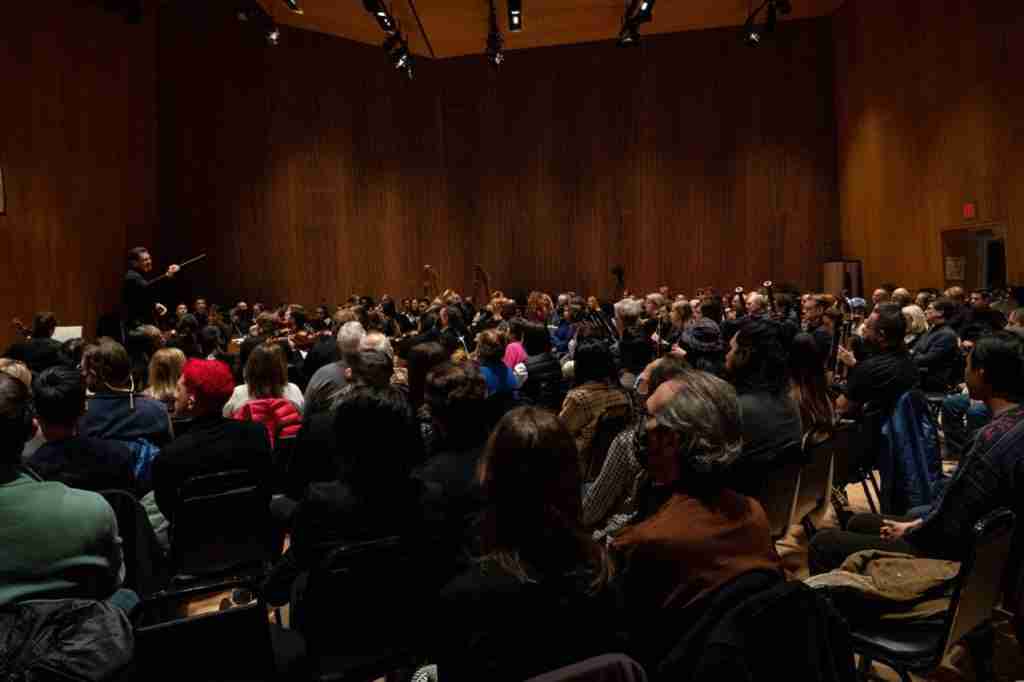
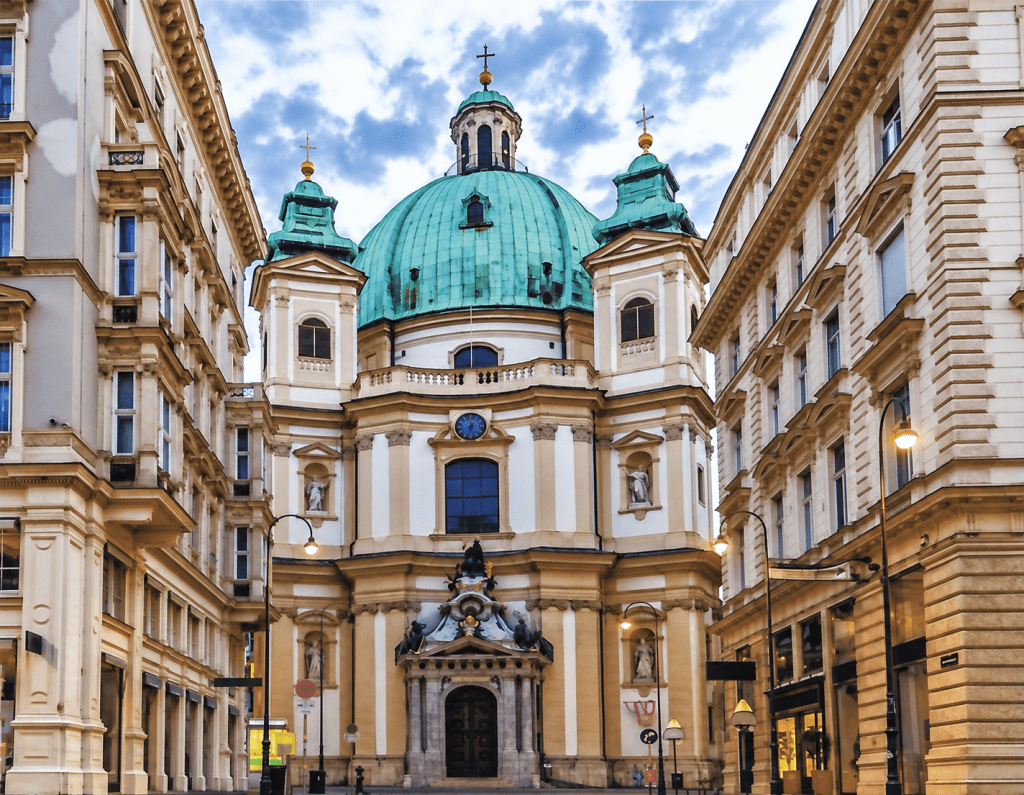
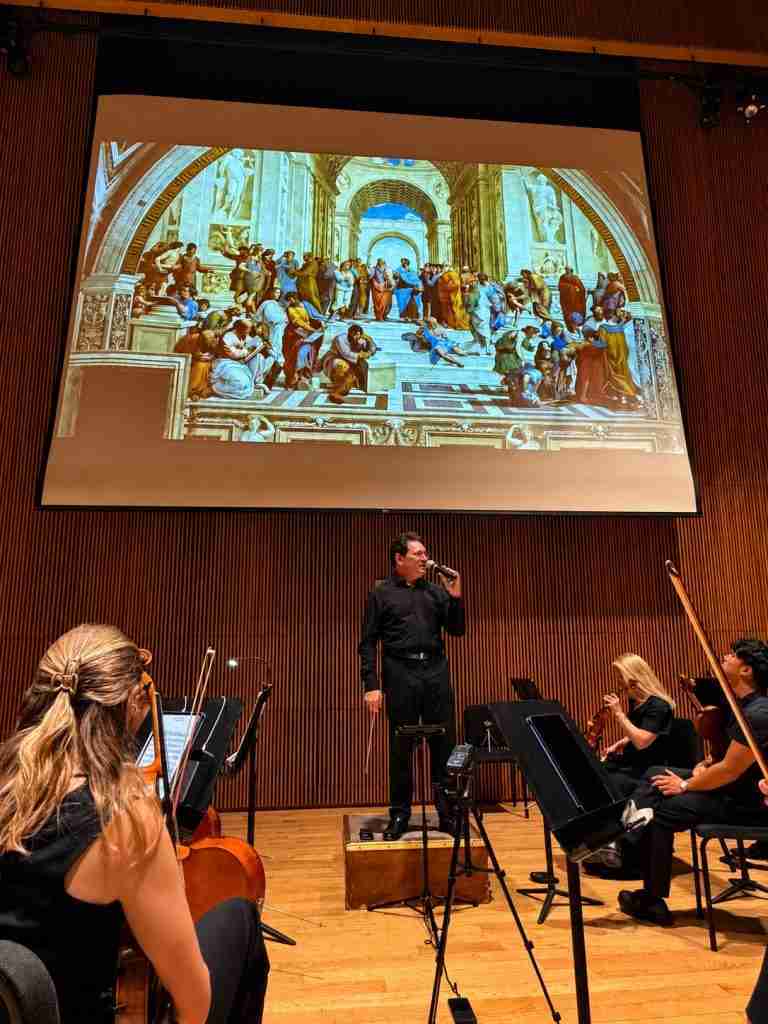
Some concerts arrive with thunderous sound; others, like lamplight drifting across varnished wood. On Wednesday, October 21, 2026, the American Classical Orchestra chose lamplight, gathering an intimate audience in the Gilded Age splendor of the Columbus Citizens Foundation on East 69th Street for a salon program called Enlightenment. Indeed, the room itself appeared to remember another century. One half expected white periwigs at the door, for the setting recalled those gilded chambers where the young Mozart once charmed Empress Maria Theresa and Emperor Francis I at Schönbrunn Palace.
Maestro Crawford’s Overture of Ideas
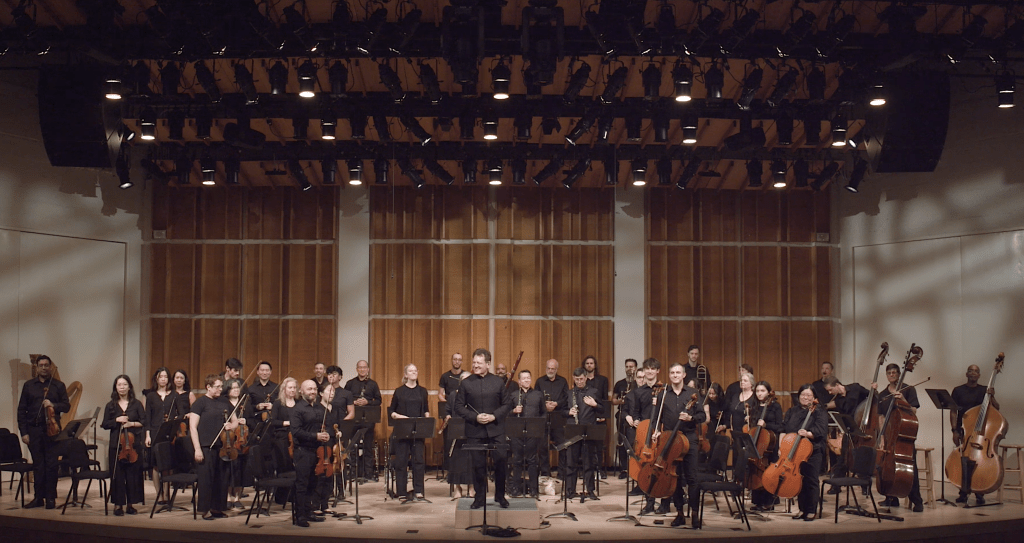
Before a single note risked the air, founder and artistic director Thomas Crawford materialized for his customary preconcert talk—a ceremony as beloved as it is inescapable. Crawford does not so much lecture as conspire, coaxing the players to demonstrate a phrase, a cadence, or the sort of harmonic detour that would make a theorist blink, so the audience can hear precisely what he means. Ears sharpen, smiles creep in. With a charming wit as dry as a well-aged sherry, he drew a line from Voltaire’s grand century to Thomas Jefferson, who, when not drafting revolutions, fiddled away on the violin. These works, Crawford reminded us, belong not just to the Classical style but to an age that worshiped clarity, balance, and the occasional liberty. Every instrument onstage was a period piece, gut strings and boxwood inhaling the same air as 1789, or as close as Manhattan’s HVAC would allow. Kant, ever the party guest, distilled the era into two Latin words: dare to know. Crawford, with a glint, suggested we dare to listen.

Four Decades of Daring: Thomas Crawford and the ACO
That pedagogical grace is no accident. Crawford founded the ensemble in Connecticut in 1984 as the Orchestra of the Old Fairfield Academy, renamed it the American Classical Orchestra in 1999, and brought it to Manhattan in 2005, where it has become New York’s leading period-instrument orchestra, anchored by its series at Lincoln Center’s Alice Tully Hall. Along the way, he conducted the world premiere of Keith Jarrett’s Bridge of Light; furthermore, his Classical Music for Kids program has reached more than half a million students and families, earning honors from the National Endowment for the Arts and Early Music America. In short, Crawford treats the past not as a museum but as a breathing space.
Mozart’s Clarinet Quintet in A Major, K. 581: Friendship in Five Voices
Mozart wrote the Clarinet Quintet in 1789 for his friend Anton Stadler, clarinetist of the imperial court orchestra in Vienna. Stadler introduced it on December 22, 1789, at a Tonkünstler-Societät benefit for musicians’ widows and orphans, and tradition holds that Mozart himself played viola. Tonight, the work embodied the Enlightenment model of equal voices in reasoned dialogue.
From the opening Allegro, the clarinet’s entrance was enthralling, a strain of such tender pathos that time itself appeared to pause and listen. Elise Bonhivert, playing a basset clarinet she built herself, drew from its dusky low register a glow no modern instrument quite captures. Meanwhile, the Larghetto developed like a letter read by candlelight, its long-breathed line floating above hushed strings. The Menuetto, with its two contrasting trios, offered courtly charm, and the closing Allegretto con variazioni turned a simple theme into a gallery of portraits, each variation a fresh glance at an old friend. Throughout, the balance was exemplary, the phrasing supple, and the tonal subtleties rich with finesse.

Haydn’s “The Joke”: Wit as Enlightenment Philosophy
If Mozart spoke to the heart, Joseph Haydn winked at the mind. His Op. 33 quartets, published in 1782 and, he announced, composed in a new and special way, helped define the string quartet as a conversation among equals; indeed, they impressed Mozart so much that he responded with six quartets dedicated to Haydn. Here, Edson Scheid took the first violin chair, leading with sparkle and poise. In the Scherzo, sliding portamenti and glissandi drew delighted smiles, as though Haydn himself were tugging at our sleeves. By contrast, the Largo e sostenuto was pensive and precise, a reflection worthy of any philosopher’s study. Finally, the Presto fizzed with virtuosity, and its famous false endings, played with elegant restraint, left the audience laughing, then applauding, then laughing again at having been fooled.
The Artists: Five Voices, One Conversation
Each performer brought distinctive brilliance. Aisslinn Nosky, concertmaster of Boston’s Handel and Haydn Society since 2011, led the Mozart with radiant authority, and her long acquaintance with Haydn’s Op. 33, which she has recorded on period instruments, glowed in every phrase. Edson Scheid, the Brazilian-born virtuoso distinguished for his period-violin Paganini caprices, brought dash and humor to the Haydn. Violist Jessica Troy, who prepared György Kurtág’s Microludes with the composer himself, supplied the inner voice that binds a quartet’s soul. Cellist Serafim Smigelskiy, formerly of the Tesla Quartet, offered a soulful, supple foundation. And Elise Bonhivert, trained at Indiana University and the Royal Conservatory of The Hague, is that rare artist who plays, makes, restores, and repairs clarinets. Hearing her play an instrument she built felt like reading a poem in the poet’s own handwriting.

Coming Up: ACO Season 42 (2026–27)
Happily, the journey continues:
Capricious, Thursday, November 12, 2026, Alice Tully Hall: Weber’s Oberon Overture, the U.S. premiere of Franz Berwald’s Symphony No. 2, “Capricieuse,” and Beethoven’s Fourth Symphony.
Light of my life (All-Bach), Wednesday, February 3, 2027, Basilica of Old St. Patrick’s Cathedral: the motets Singet dem Herrn and O Jesu Christ, meins Lebens Licht, with Cantatas 36 and 106.
Jefferson’s Songbook, Wednesday, March 10, 2027, Columbus Citizens Foundation: a salon of 18th-century English and colonial American songs by Billings, Davy, and Handel.
Virtuoso, Thursday, May 6, 2027, Alice Tully Hall: Shunske Sato in Beethoven’s Violin Concerto, followed by the Fifth Symphony.
American Classical Orchestra
P.O. Box 105, New York, NY 10024-0105 · (212) 510-7962 · info@aconyc.org · aconyc.org
Tickets and Support
Season: 42 concerts and tickets: aconyc.org · Subscribe and save 15% · Patron Society
Individual tickets: Enlightenment, Irvington, Oct. 23 · Capricious, Nov. 12 · Light of my life, Feb. 3 · Virtuoso, May 6 https://lincolncenter.org/venue/alice-tully-hall/virtuoso-330