

At the storied supper club on West 54th Street, a Chicago troubadour turned an evening of show tunes into a communal act of remembering.
A Room Where the Past Never Quite Leaves
Descend the narrow staircase at 54 Below, and you descend, too, into a peculiar and delicious kind of time travel. The room sits on the literal bones of the old Studio 54, and something of that vanished decadence still hums beneath its white tablecloths; yet what Broadway’s Supper Club has built since 2012 is not nostalgia for its own sake but a seriousness. Into this hospitable dark walked Sam Fazio on the evening of September 26, bearing a program called My Broadway, and by the last chord, the distinction between performer and audience had all but dissolved.
The Man Behind the Baritone
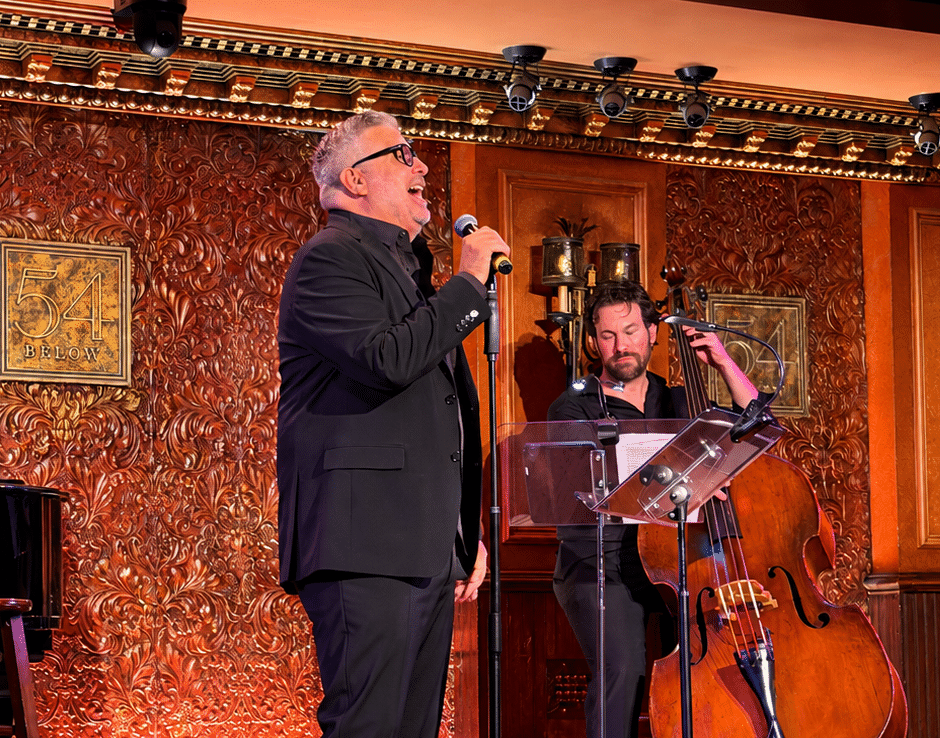
Fazio, a Chicago-bred vocalist with a Sinatra-adjacent swing in his phrasing, is not merely a singer but an old-school raconteur, treating a song’s backstory as inseparable from the song itself. Songs arrive wrapped in a small, generous anecdote—where he first heard it, what it recalled, why it mattered—delivered with gently self-effacing humor that never degenerates into shtick. His baritone, rich and burnished, deepens into something genuinely passionate in its lower register, wielded not to impress but to confide. Convivial, sentimental, unfailingly personable, he creates the rare condition in which an audience relaxes fully into a performer’s company, trusting him equally with the comedy and the pathos.
A Life Measured Out in Broadway Melodies
Taken together, the evening’s chosen songs amounted to an autobiography told through other people’s lyrics, each a way station in Fazio’s own musical voyage. His account of Out Here on My Own, the aching ballad Michael Gore and Lesley Gore wrote for the film Fame, carried unexpected weight in a baritone’s register, its self-reliance reframed as hard-won rather than merely wounded. Later, She Used to Be Mine, Sara Bareilles’s confession of a woman unrecognizable to herself, and Jeff Barry’s tender Here Is My Love extended that same thread of hard-earned self-knowledge, while As If We Never Said Goodbye, from Sunset Boulevard, let Fazio show that grand theatrical yearning need not tip into bombast. One felt in these selections the evening’s quiet, commemorative spirit: a tribute not to any single show but to the accumulated emotional inheritance of the American musical stage.
On the Street Where You Live: The Night’s High-Water Mark
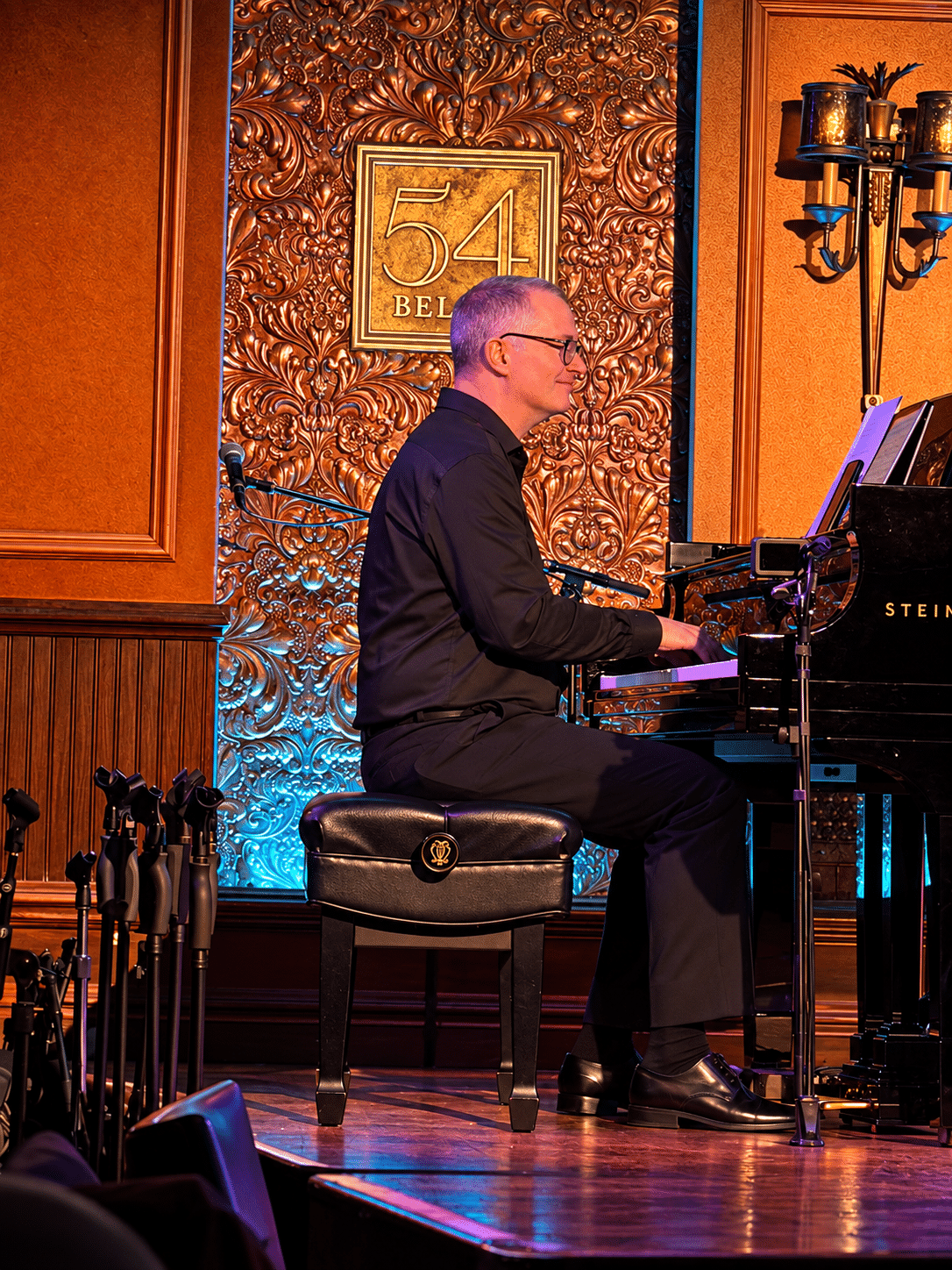
If the ballads established intimacy, Fazio’s swinging, up-tempo overhaul of On the Street Where You Live, from Lerner and Loewe’s My Fair Lady, brought the house fully alive and drew the evening’s most generous ovation. Here the trio’s true character emerged: pianist and music director Chris White took a solo of glittering, unhurried invention. At the same time, bassist John Sutton answered with a walking line so buoyant it seemed to lift the room a half-inch off its banquettes. What might have been a museum piece became a genuinely swinging jazz performance, and the audience, unable to help itself, sang the familiar refrain back at Fazio nearly as loudly as he sang it.

A Broadway Medley, and Memory
The evening’s medley — threading together 42nd Street, What I Did for Love, Cabaret, Argentina, and Seasons of Love — became a compressed history of the American musical: Harry Warren’s backstage optimism giving way to Marvin Hamlisch’s bittersweet valedictory, Kander and Ebb’s decadent Weimar shimmer yielding to Andrew Lloyd Webber’s Eva Perón, and finally to Jonathan Larson’s insistence on measuring a life in love rather than minutes. Here Fazio’s evening earned its subtler, more serious claim on our attention — the kind of claim critic Gilbert Seldes made nearly a century ago in The Seven Lively Arts, insisting the vernacular stage deserved the same sagacious attention as any museum wall. In much the spirit Winthrop Sargeant once conveyed to jazz vocal interpretation, Fazio does not simply perform the Great American Songbook; he inhabits it, restlessly, as a living inheritance rather than a museum piece.
The Trio: More Than Accompanists
Too often “backed by a trio” reduces first-rate musicians to furniture. Not so here. White’s arrangements breathed with the singer rather than beneath him, anticipating each rubato and confiding pause; Sutton’s bass work supplied the evening’s emotional keel. Together they turned accompaniment into conversation, and this conversational ease let Fazio’s storytelling land as naturally as talk among old friends.
Why 54 Below’s Stage Still Matters
None of this intimacy could exist without the room itself. 54 Below, a registered nonprofit, has spent well over a decade proving that the supper-club format, seemingly a holdover of a more elegant age, remains one of New York’s most vital incubators for musical theater artistry, old and new alike. Every ticket helps sustain a stage that has hosted everyone from Broadway legends to first-timers finding their voice — a mission that, in an economy increasingly hostile to live, unamplified storytelling, feels less like hospitality and more like preservation.
A Communal Return
By evening’s end, the sing-alongs, the generous applause, the audible sniffles during As If We Never Said Goodbye — all of it confirmed what the best cabaret always proves: that a well-crafted song, sung by someone who has clearly lived inside it, can dissolve the distance between stranger and confidant in under four minutes. Sam Fazio did not simply perform My BroadWay; he offered it, generously, as a shared inheritance.
The Verdict, in Brief
Warm-voiced, funny, and unashamedly sentimental, Sam Fazio’s My Broadway turns a supper club into a communal memory palace, one showtune at a time. Anchored by Chris White’s luminous piano and John Sutton’s buoyant bass, this is cabaret at its most generous — intimate, swinging, deeply humane, theater history sung by a man who has clearly lived every lyric. Watch for Fazio’s next 54 Below engagement, bring tissues for the ballads and your fullest voice for the choruses, and leave humming, quietly grateful.
54 Below
Donate to 54 Below HERE.