


The Rime Of The Ancient Mariner by Samuel Taylor Coleridge – Exploring Supernatural Elements
The Influence of Supernatural Romanticism
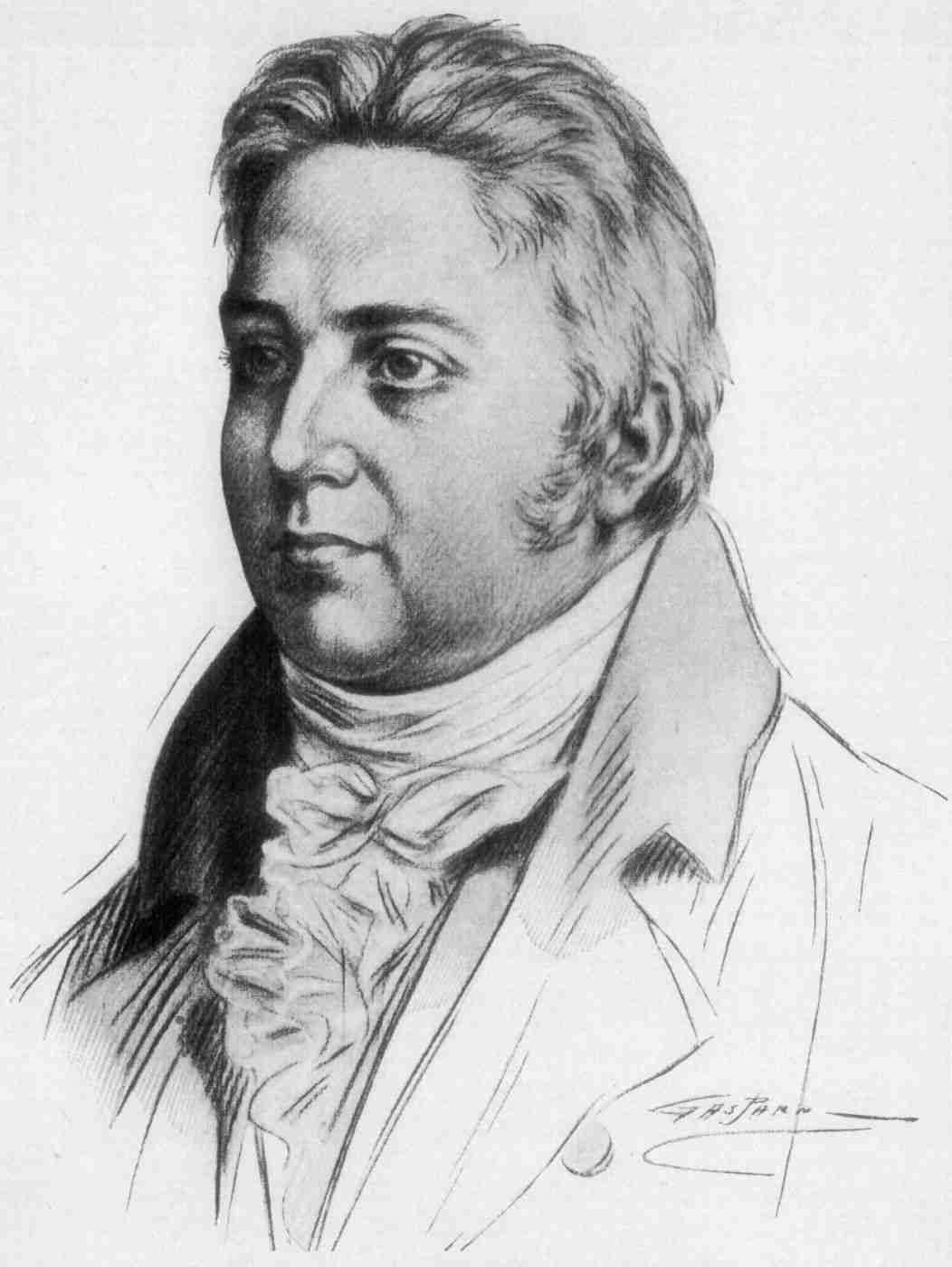
Samuel Taylor Coleridge’s The Rime of the Ancient Mariner (1834) interweaves supernatural elements with Romanticism, crafting a haunting narrative that explores guilt, redemption, and nature’s omnipotence. The mystical aspects elevate the poem, infusing it with a resonant modernity akin to fragmented whispers through eternity. Here’s a link to the text, and below is a reading with text, audio, and images.
Ghostly Atmosphere and Otherworldly Beings
Like specters threading unseen alleyways, Coleridge’s verse evokes a translucent resonance. The mariner’s journey traverses eerie landscapes where the albatross, spectral ships, and whispering spirits reside—symbols more potent than fleeting life. Poised like fragments of “a heap of broken images,” these figures summon a mosaic of dread and redemption.
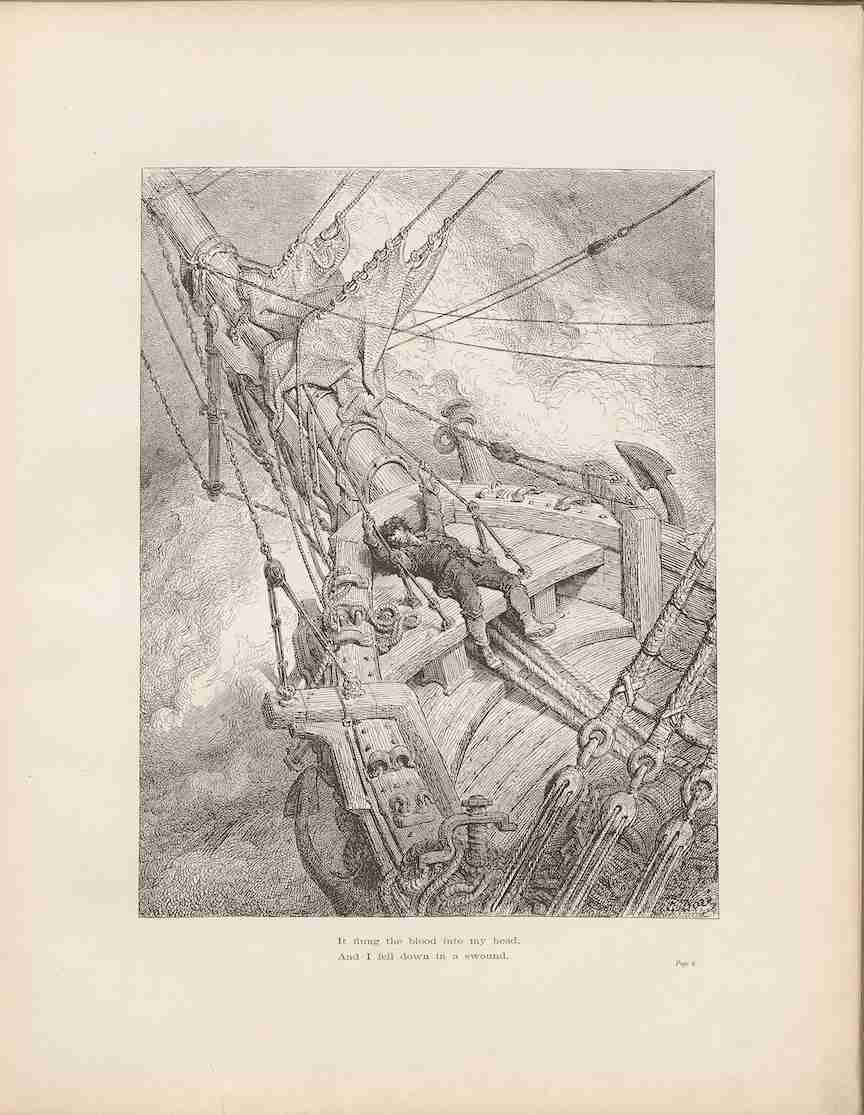
Key Supernatural Elements:
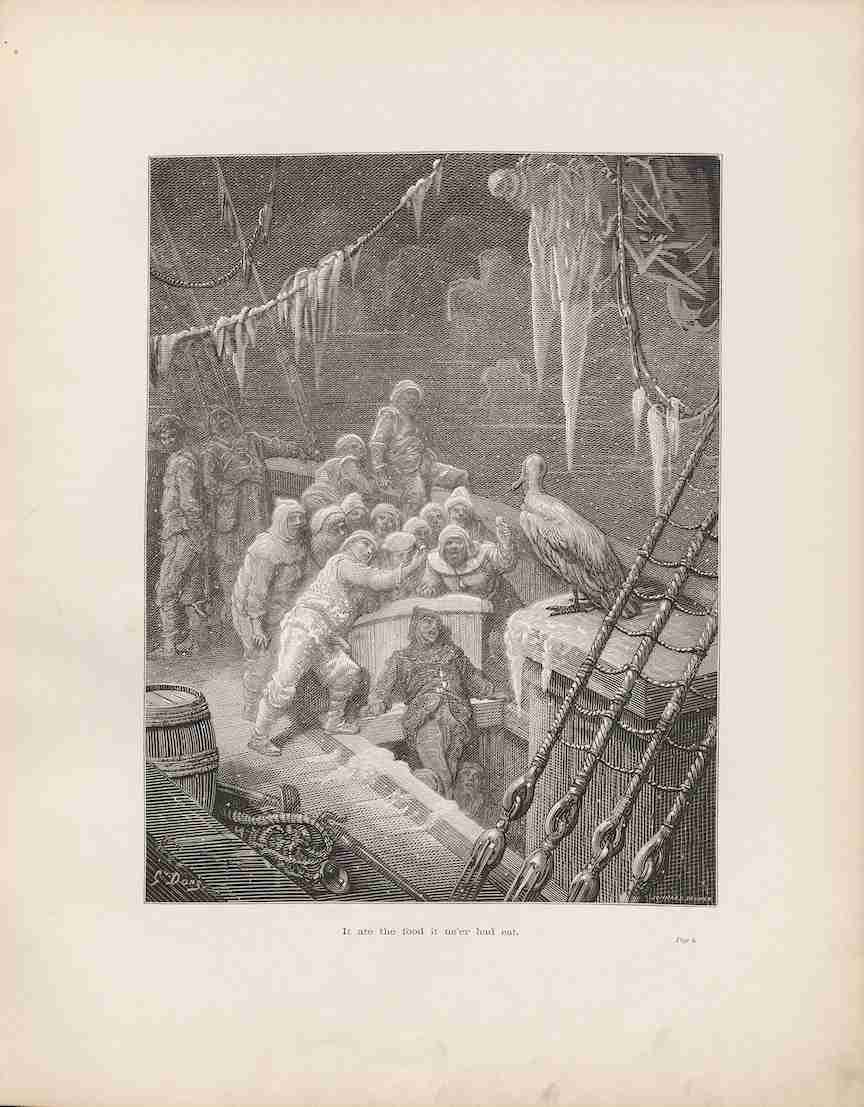
- The Albatross: The sinning mariner’s talisman of natural dissonance, an archetype reverberating through eternal recurrence. Read more.
- Spectral Ship: A metaphysical craft bearing Death and Life-in-Death, embodying moral imbalance. Its spectral voyage—a symbol of shadow’s permanence—distorts reality’s tide.
- Spirits and Voices: Intangible echoes, guardians of fate, and arbiters of destiny—ghostly emissaries who, through “these fragments,” tell the more extraordinary tale.
Nature and the Supernatural
Coleridge’s ocean becomes more than water: a sublime void akin to “the brown fog of a winter dawn,” trembling with nature’s wild heart. Here, the sublime—that Romantic pillar—is unfathomable and familiar. The ancient sea is the abyss and yet the mirror, charged with the spiritual tension of humanity’s primordial discord with the natural order.
Symbolism and Themes
The poem’s supernatural scaffolding lends its verse to the melancholy of human frailty and spiritual striving. Beneath the symbols lies a mariner’s progression toward internal coherence—not unlike a ghost who finds voice amid ruins.
- Guilt and Redemption: The albatross’s death reappears as time’s unending consequence, each fragment imbued with weighted repetition—a fatal emblem of the “infinitely gentle, infinitely suffering thing.”
- Nature’s Power: The ocean’s symphony, shifting between wrath and serenity, haunts the verse as the fractured psalm of nature’s infinite dominion.
The Role of Imagination
Romanticism’s fountainhead of imagination finds its spectral domain in Coleridge’s pen. Here, the mariner’s dreamscape becomes allegory, twisting reality’s limits and summoning visions through “a handful of dust.”
Evolving Perceptions Through the Supernatural
The poem’s fragmentary yet cyclic structure allows the supernatural to warp time, creating a “time future contained in time past.” The mariner’s tale—a desolation told to shifting ears—becomes an ever-receding coastline of human comprehension.
Timeless Appeal
That which endures must embrace decay—the specter of Romanticism’s eternal return. Coleridge’s sea, haunted by what cannot end, echoes “not with a bang but a whimper,” capturing humanity’s spiritual quest through unfathomable depth.
Romanticism Through Coleridge’s Poetic Lens
Coleridge’s Romantic Connection
Samuel Taylor Coleridge, that modernist precursor cloaked in Romantic guise, stands rooted in the phantasmagoria of nature, emotion, and the unreal. His fractured and whole craft weaves an aesthetic of “a thousand visions and revisions,” capturing life’s transitory beauty.
Exploring Nature’s Mysteries
In Coleridge’s Romantic schema, nature moves as the river within “the place where three dreams cross.” Its vastness overwhelms the mariner and reader alike, an enduring witness to a transient soul’s fragile passage.
Inventive Imagination and Romantic Ideals
Imagination, “a patient etherized upon a table,” transforms Coleridge’s verse into otherworldly currents. Unmoored from linear reality, his visions spill into the dream’s broader vista, each poem a lantern upon the abyss.
Narrative Depth and Human Emotion
What is poetry if not emotion recollected and fractured? Coleridge’s mariner inhabits the liminal, his “thousand departures” echoing fear, awe, and sublime anguish—emotions writ eternal within the soul’s sepulchral hall.
Coleridge’s Legacy in Romanticism
Much like Prufrock’s lingering gaze, the mariner’s tale offers no solutions—only movement. Coleridge’s mastery sustains the Romantic desire to find truth in “the still point of the turning world.”
Supernatural Romanticism in The Rime of the Ancient Mariner
Embracing the Supernatural
Coleridge’s spectral palette creates a Romantic chiaroscuro in which ghostly vessels pass over waves like memory’s shadow. Each spectral element—imbued with fate’s irony—whispers, “These are pearls that were his eyes.”
Atmosphere of Isolation and Despair
Isolation, not unlike Prufrock’s endless horizon, enshrouds the mariner’s journey. The vast sea becomes a vacuum—the antithesis of communal wholeness—where fragments of self linger amid despair.
Madness and Psychic Turmoil
The mariner’s unraveling speaks to Romantic chaos and Eliot’s echoes of “the dead land.” His mind, refracting experience through supernatural prisms, illustrates the eternal duel between reason and delusion.
Nature’s Dual Role
Nature’s terrors—its storms and silences—evoke Romantic awe yet modern alienation. The sea’s infinite face symbolizes time’s unrelenting tides, ever “flowing water” over humanity’s wreckage.
Interconnected Imagery and Symbolism
Coleridge’s symbols linger in “eyes that fix you”—the albatross, spectral ship, and the undying sea. Each embodies “fear in a handful of dust,” a Romantic homage to time’s dissolving grasp.
Influence and Legacy
The Rime of the Ancient Mariner, ever a foundation stone, casts its shadow over modernist and Romantic forms. Like Eliot’s “shadow at the turning,” its spectral cadences bequeath endless echoes.
Key Themes and Takeaways
- Nature: The sea—at once vast and intimate—embodies the mariner’s fractured soul. Discover its role.
- Imagination: Reality shifts beneath the mariner’s gaze, “dislocating time.”
- Supernatural: Coleridge’s ghostly layers evoke Eliot’s “multifoliate rose,” spectral yet vibrant.
Coleridge’s mariner persists as “one who walks in shadow. ” His fractured tale is a harbinger of Romantic despair and modernist renewal. The fragments endure, lingering amid time’s undying refrain.
Readers may also enjoy A Midsummer Night’s Dream, Faith by MasterVoices, and Marcel Proust In Search of Lost Time Memory and Involuntary Recollection.